

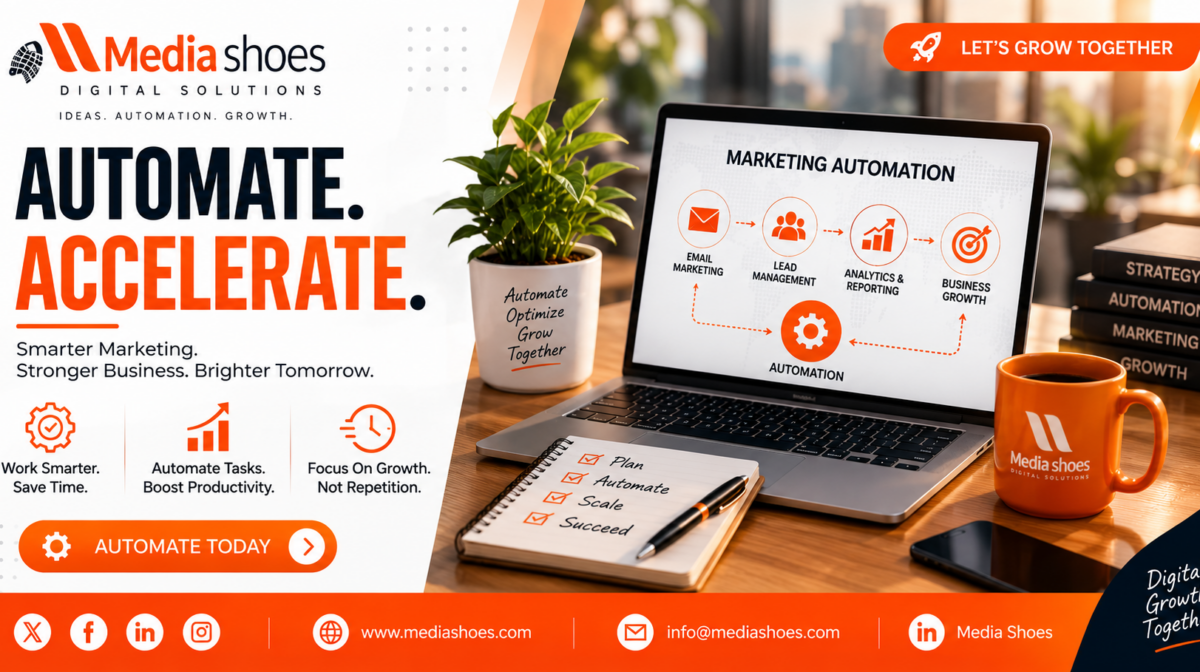
Growth does not always come from doing more. Often, it comes from finding smarter ways to do the work that already needs to be done.
For modern businesses, marketing can involve email campaigns, lead management, customer follow-ups, reporting, analytics, content, sales coordination and dozens of repetitive administrative tasks. Managing every activity manually can consume valuable time that could otherwise be spent on strategy, creativity and growth.
That is where marketing automation can make a meaningful difference.
At MediaShoes Digital Solutions, the philosophy is simple: Automate. Accelerate. By combining digital strategy with intelligent automation, businesses can streamline repetitive processes, improve productivity and create more time to focus on activities that genuinely move the organisation forward.
Work smarter. Save time. Automate tasks. Boost productivity. Focus on growth, not repetition.
What Is Marketing Automation?
Marketing automation is the use of technology to manage, trigger and streamline repetitive marketing activities and workflows.
Instead of requiring someone to manually perform the same action every time a customer or prospect reaches a particular stage, automation can allow predefined processes to run consistently based on specific conditions or behaviours.
Depending on the business and technology being used, marketing automation can support activities such as:
- Email marketing and follow-up sequences
- Lead capture and lead management
- Customer segmentation
- Marketing campaign workflows
- Lead nurturing
- Customer communications
- Analytics and reporting
- Internal notifications
- Sales and marketing coordination
- Routine administrative processes
The objective is not simply to replace manual work with software. Effective automation creates a more organised system in which routine tasks happen consistently while people remain focused on decisions and activities where human input creates greater value.
Why Businesses Are Turning to Automation
As a business grows, its marketing operation usually becomes more complex.
A small number of leads can be managed manually. Hundreds or thousands of contacts are much more difficult to handle consistently. The same challenge applies to email communication, reporting, follow-ups and customer journeys.
Without effective systems, teams can become trapped in repetitive work.
Employees may spend hours transferring information, preparing routine reports, sending similar emails or checking whether follow-ups have taken place. Individually, these activities may seem minor. Collectively, they can consume a substantial amount of productive time.
Automation can help businesses create repeatable processes that continue to function as activity increases.
Work Smarter and Save Time
Time is one of the most valuable resources in any organisation.
If skilled employees spend a large proportion of their working week performing predictable administrative tasks, there may be opportunities to automate some of those activities.
Consider a simple website enquiry.
Without automation, a team member might need to:
- Notice that a new enquiry has arrived
- Copy the contact details into another system
- Send an acknowledgement email
- Notify the appropriate colleague
- Create a follow-up reminder
- Update a spreadsheet or CRM
With a properly designed workflow, several of those steps may be triggered automatically.
The employee can then concentrate on the part that requires human expertise: understanding the prospect and having a meaningful conversation.
Automate Tasks, Not Relationships
One of the most important principles of digital automation is knowing what not to automate.
Automation should support relationships rather than make them feel impersonal.
Businesses still need people to understand complex requirements, develop creative ideas, solve unusual problems and build trust with customers. Technology is most effective when it handles predictable processes around those human interactions.
A useful question is:
“Does this task require judgement, creativity or meaningful human interaction, or is it a predictable process that happens repeatedly?”
The more predictable and repetitive a task is, the more likely it may be suitable for automation.
Email Marketing Automation
Email is one of the most common applications for marketing automation because customer communication often follows identifiable patterns.
For example, a business may want to send different communications when somebody:
- Subscribes to a mailing list
- Downloads a resource
- Submits an enquiry
- Requests information about a service
- Becomes a customer
- Has not engaged for a period of time
Automation can trigger relevant messages according to these actions rather than requiring someone to manually identify every contact and send each email individually.
Welcome Sequences
When someone joins an email list, an automated welcome sequence can introduce the organisation, explain its services and provide useful information over several messages.
Lead Nurturing
Not every prospect is ready to make a decision immediately. Automated nurturing can help businesses maintain relevant communication with potential customers while they continue evaluating their options.
Customer Follow-Ups
Automation can also support communication after a purchase, enquiry or completed project, helping businesses maintain more consistent customer journeys.
Lead Management Without the Manual Chaos
Generating leads is only useful if those opportunities are handled effectively.
Without a clear system, enquiries can become scattered across inboxes, spreadsheets, website forms and individual team members. Follow-ups may be delayed or overlooked completely.
Marketing automation can help establish a more structured process.
A lead workflow could potentially:
- Capture information from a website form
- Add or update the contact in a CRM
- Categorise the enquiry
- Send an acknowledgement
- Notify the appropriate salesperson
- Create a follow-up task
- Track future interactions
This creates greater consistency and helps teams understand what should happen next.
Connecting Marketing and Sales
Marketing and sales perform different functions, but the customer experiences them as part of the same organisation.
If marketing generates an enquiry but sales does not receive the relevant information promptly, the customer journey can break down.
Automation can help create stronger connections between these functions.
For example, actions taken by a prospect can be recorded and used to provide sales teams with additional context. Internal notifications can alert the appropriate person when a meaningful event occurs.
This helps reduce the gap between generating interest and responding to it.
Analytics and Reporting Automation
Data can help businesses understand whether their marketing is producing meaningful results. The problem is that preparing reports manually can itself become a time-consuming task.
Marketing teams may need information from websites, advertising platforms, email systems, CRM software and other digital tools.
Where appropriate integrations are available, automated reporting can help bring important information together more efficiently.
Businesses may monitor metrics such as:
- Website traffic
- Lead volume
- Conversion rates
- Email engagement
- Campaign performance
- Customer acquisition activity
- Sales pipeline movement
The objective should not be to create dashboards full of numbers. Effective reporting should help decision-makers understand what is happening and where action may be required.
From Data to Better Decisions
Collecting data is only the first step. Businesses also need to interpret it.
Automation can make information easier to collect and organise, while human analysis provides the context required to decide what happens next.
For example, a report may show that a campaign is generating large numbers of website visitors but relatively few enquiries. That information could prompt the marketing team to investigate the landing page, audience, messaging or offer.
This illustrates an important principle:
Automation provides efficiency. Strategy provides direction.
The two are most powerful when used together.
Focus on Growth, Not Repetition
Every hour spent repeatedly completing a predictable administrative task is an hour that cannot be spent developing a new campaign, improving the customer experience or exploring a growth opportunity.
This does not mean every repetitive task should automatically disappear. Some processes still require manual oversight.
However, businesses can benefit from reviewing how their teams spend time.
Ask questions such as:
- Which tasks happen every day or every week?
- Which activities follow the same steps each time?
- Where are employees repeatedly copying information between systems?
- Which processes regularly cause delays?
- Where are follow-ups sometimes forgotten?
- Which reports require repetitive manual preparation?
The answers can reveal opportunities for smarter digital workflows.
Automation Can Improve Consistency
Efficiency is only one potential advantage of automation. Consistency can be equally valuable.
Manual processes depend on someone remembering what needs to happen. During busy periods, tasks can be delayed or overlooked.
A properly configured automated workflow follows the defined process whenever its conditions are met.
This can help create greater consistency across:
- Lead responses
- Customer communications
- Internal notifications
- Data collection
- Marketing workflows
- Reporting processes
Businesses should still monitor automated processes, but they no longer need to rely entirely on manual memory for every routine action.
Automation and the Customer Journey
Effective marketing automation should be designed around the customer journey rather than around technology alone.
Consider the stages someone may move through:
Awareness → Interest → Consideration → Enquiry → Customer → Retention
Different information is useful at different stages.
A first-time visitor may need educational content. A prospect who has already requested information may need more detailed guidance. An existing customer may benefit from support, updates or relevant additional services.
Automation can help businesses deliver appropriate communications at different stages without manually managing every interaction.
Personalisation and Segmentation
Automation does not have to mean sending exactly the same message to everybody.
When customer data is organised appropriately, businesses can segment audiences according to relevant characteristics or behaviours.
For example, contacts might be grouped according to:
- Services they are interested in
- Previous interactions
- Customer status
- Industry or business type
- Stage in the buying journey
- Engagement with previous campaigns
This can make marketing communications more relevant than a one-size-fits-all approach.
Businesses should, of course, ensure that their marketing practices and use of personal data comply with applicable privacy and data-protection requirements.
Automation Helps Businesses Scale
Manual processes can work reasonably well at low volumes. Problems often appear as a business grows.
Imagine a team manually sending welcome messages to ten new contacts each week. The process may be manageable. If that number grows significantly, the same process becomes increasingly demanding.
Automation allows certain workflows to handle greater volumes without requiring an equivalent increase in repetitive manual activity.
This makes automation particularly valuable for businesses planning to scale their marketing and sales operations.
Common Marketing Automation Mistakes
Automation can create substantial value, but poor implementation can create additional complexity. Businesses should avoid several common mistakes.
Automating a Broken Process
If an existing workflow is confusing or inefficient, automating it may simply make the problem happen faster. Review and simplify the process first.
Trying to Automate Everything
Not every task benefits from automation. Human judgement and personal interaction remain essential in many areas.
Using Too Many Disconnected Tools
Adding software without considering how systems work together can create fragmented data and additional administration.
Ignoring the Customer Experience
An automated process may be operationally efficient while still creating a poor experience for customers. Workflows should be reviewed from the customer’s perspective.
Failing to Measure Results
Automation should have a purpose. Businesses should define what they expect a workflow to improve and review whether it is achieving that objective.
Setting It and Forgetting It
Automated workflows still require monitoring. Customer behaviour, business priorities and technology can change, so processes should be reviewed and improved over time.
How to Start With Marketing Automation
Businesses do not necessarily need to automate an entire marketing operation at once.
A more practical approach is often to identify one repetitive process where improvement would create meaningful value.
Step 1: Map the Current Process
Document what currently happens from beginning to end. Include the people, tools and information involved.
Step 2: Identify Repetitive Actions
Look for tasks that follow predictable rules and require limited human judgement.
Step 3: Remove Unnecessary Steps
Simplify the workflow before automating it. Technology should support a good process rather than preserve unnecessary complexity.
Step 4: Define the Trigger
Determine what should start the automation. This could be a form submission, status change, customer action or another defined event.
Step 5: Define the Actions
Decide exactly what should happen after the trigger.
Step 6: Test the Workflow
Run realistic scenarios before relying on the automation in normal operations.
Step 7: Measure and Improve
Monitor the process and refine it as you learn more about how people interact with it.
A Simple Marketing Automation Framework
| Stage | Objective | Possible Automation |
|---|---|---|
| Attract | Generate awareness and interest | Campaign workflows and audience management |
| Capture | Turn interest into identifiable leads | Forms, CRM entry and notifications |
| Nurture | Maintain relevant communication | Email sequences and segmented messaging |
| Convert | Support sales opportunities | Lead routing, reminders and sales notifications |
| Measure | Understand performance | Analytics dashboards and automated reporting |
| Optimise | Improve future results | Data-led workflow and campaign refinement |
AI and the Future of Marketing Automation
Artificial intelligence is expanding what businesses can achieve through digital automation.
Traditional automation generally follows predefined rules: when a particular event occurs, perform a particular action. AI-enabled systems can potentially add more sophisticated analysis, classification and content support to those workflows.
Depending on the technology and use case, AI may assist with:
- Analysing marketing data
- Identifying patterns in customer behaviour
- Supporting audience segmentation
- Drafting and adapting marketing content
- Prioritising information
- Supporting customer-service workflows
- Summarising reports and insights
AI should still be implemented thoughtfully. Human oversight, data quality, privacy, accuracy and brand standards remain important considerations.
The strongest approach is not simply “use AI everywhere.” It is to identify where AI or automation can solve a genuine business problem and then implement it within a clear strategy.
Automation Is Part of a Bigger Digital Strategy
Marketing automation should not exist in isolation.
It works best when connected with a wider digital ecosystem that may include a company’s website, CRM, email marketing, analytics, advertising, content and sales processes.
For example, driving more visitors to a website provides limited value if there is no effective process for capturing and managing enquiries. Similarly, collecting leads is less valuable if follow-up processes are inconsistent.
A connected digital strategy considers the complete journey:
Attract → Engage → Capture → Nurture → Convert → Measure → Improve.
Automation can help connect those stages and reduce unnecessary friction between them.
How MediaShoes Digital Solutions Can Help
Successful automation starts with understanding the business problem rather than selecting technology first.
At MediaShoes Digital Solutions, the focus is on using digital solutions, automation and strategy to help businesses work smarter and create stronger foundations for growth.
That means looking at existing processes, identifying repetitive work and considering how technology can improve the way marketing activities connect.
The goal is not automation for automation’s sake.
The goal is to help businesses:
- Save valuable time
- Reduce unnecessary repetitive work
- Create more consistent processes
- Improve lead management
- Connect marketing activity more effectively
- Gain better visibility through analytics and reporting
- Build scalable digital workflows
- Focus more attention on strategy and growth
Ideas. Automation. Growth.
Frequently Asked Questions About Marketing Automation
What is marketing automation in simple terms?
Marketing automation uses software and digital workflows to complete or trigger repetitive marketing activities according to predefined conditions. Examples can include sending emails, updating lead information, creating notifications and preparing recurring reports.
What marketing tasks can be automated?
Depending on the systems a business uses, automation may support email campaigns, lead capture, lead nurturing, CRM updates, internal notifications, customer segmentation, analytics and reporting, among other repetitive processes.
Is marketing automation only for large companies?
No. Smaller businesses can also benefit from automation, particularly when limited teams spend significant time performing repetitive marketing or administrative tasks. The appropriate level of automation should reflect the size and requirements of the organisation.
Does marketing automation replace employees?
Marketing automation is often most useful for reducing repetitive manual work rather than replacing the human aspects of marketing. Strategy, creativity, relationship-building, complex decision-making and oversight still require human expertise.
How can marketing automation improve lead management?
Automation can help create a consistent process after a lead is generated. Depending on the workflow, it can record information, send acknowledgements, notify the appropriate team member, create follow-up actions and support ongoing communication.
Can marketing automation improve productivity?
It can improve productivity when it reduces repetitive manual tasks and simplifies workflows. The actual benefit depends on selecting appropriate processes, configuring the automation correctly and reviewing its performance over time.
What is the difference between marketing automation and AI?
Traditional automation generally performs predefined actions according to rules and triggers. AI can add capabilities such as analysis, classification, prediction or content assistance. The technologies can also be combined within the same workflow.
How do I know what to automate first?
Look for a task that occurs frequently, follows predictable steps and consumes unnecessary manual time. Start with a manageable workflow where success can be measured before moving on to more complex automation.
Can email marketing be automated?
Yes. Email is a common use of marketing automation. Businesses can create workflows for welcome messages, lead nurturing, customer communication and other journeys triggered by relevant actions or conditions.
Do automated workflows need to be monitored?
Yes. Automation should be tested before launch and reviewed regularly afterwards. Processes, customer behaviour and business requirements can change, so workflows may need to be adjusted over time.
Automate Today. Accelerate Tomorrow.
The purpose of automation is not to make marketing less human. It is to remove unnecessary repetition so people have more time for the work where human thinking matters most.
When businesses automate appropriate tasks, connect their digital systems and use data intelligently, they can create more efficient marketing operations and stronger foundations for scalable growth.
Start with the repetitive work. Simplify the process. Automate what makes sense. Measure the outcome. Then continue improving.
Automate. Optimise. Scale. Grow.
Ready to Work Smarter?
Talk to MediaShoes Digital Solutions about marketing automation and digital solutions designed to help your business save time, improve productivity and focus on growth.
Website: www.mediashoes.com
Email: info@mediashoes.com
Let’s grow together.