

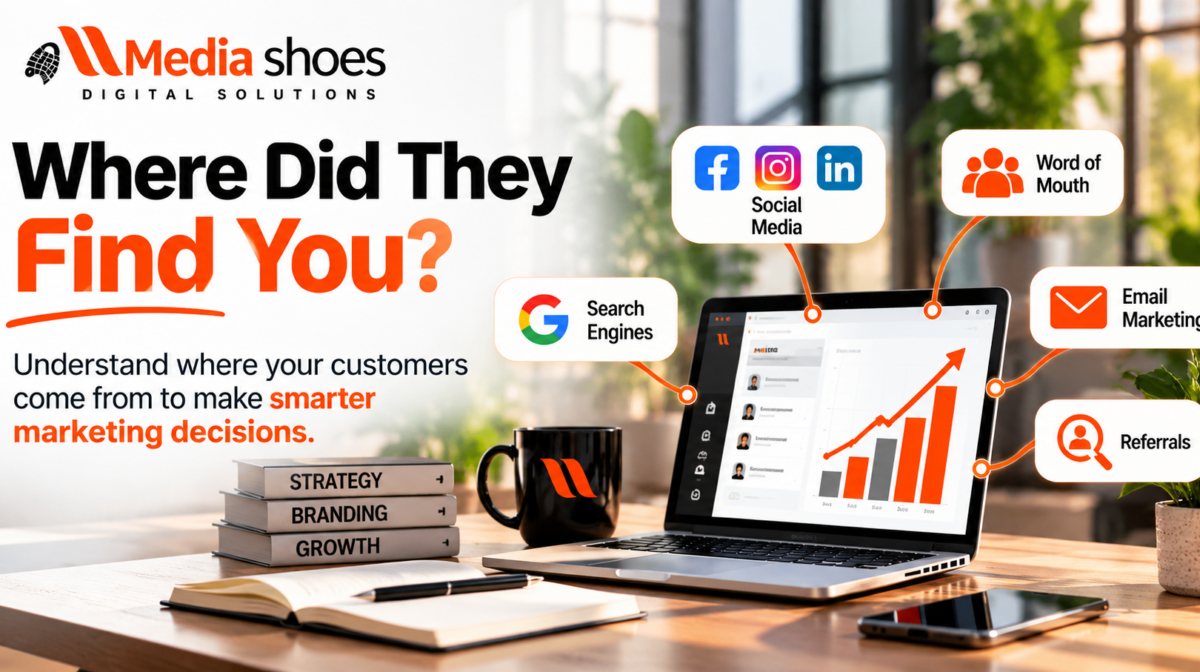
Every business wants to attract more customers, but one important question is often overlooked: Where did your customers find you?
Did they discover your business through Google, social media, an email campaign, a recommendation from a friend or a referral from an existing customer?
Understanding these customer acquisition sources is essential for building an effective marketing strategy. Without knowing which channels generate enquiries, leads and sales, businesses risk spending valuable time and money on activities that deliver limited results.
Customer source tracking helps businesses identify how people discover their products or services, which marketing channels influence purchasing decisions and where future investment may produce better outcomes.
For businesses seeking sustainable growth, tracking customer origins is not simply about collecting data. It is about turning information into practical marketing decisions.
At Media Shoes Digital Solutions, the message is clear: understanding where your customers come from helps you make smarter marketing decisions.
This guide explains how to identify customer acquisition channels, measure marketing performance and use reliable data to improve your digital marketing strategy.
What Is Customer Source Tracking?
Customer source tracking is the process of identifying the channels, platforms or interactions through which people discover and engage with a business.
These sources may include search engines, social media platforms, email marketing, referrals, direct website visits and word-of-mouth recommendations.
For example, a customer might discover a business through a Google search, visit its website and submit an enquiry.
Another customer might see an Instagram post, follow the brand for several weeks and eventually make a purchase after receiving a promotional email.
Both customers may complete the same action, but their journeys involve different marketing channels.
Understanding these differences helps businesses evaluate how their marketing activities contribute to customer acquisition.
Why Customer Source Tracking Matters
Tracking customer origins can help businesses:
- Identify marketing channels that generate valuable enquiries.
- Understand how customers discover products and services.
- Evaluate the performance of advertising campaigns.
- Allocate marketing budgets more effectively.
- Improve customer acquisition strategies.
- Recognise opportunities to strengthen underperforming channels.
- Make informed decisions using measurable information.
However, tracking should go beyond counting website visitors.
A channel that generates substantial traffic may not necessarily produce qualified leads or paying customers.
The most useful approach connects marketing activity with meaningful business outcomes.
Why Understanding Where Your Customers Come From Is Important
Businesses often invest in several marketing channels simultaneously.
They may publish social media content, run paid advertisements, optimise their websites for search engines and send promotional emails.
Without effective tracking, it becomes difficult to determine which activities contribute to results.
1. Improve Marketing Budget Allocation
Marketing budgets are limited, making efficient spending an important consideration.
Customer source data can help businesses identify channels associated with enquiries, sales and revenue.
For example, a company may discover that paid social media campaigns generate significant website traffic, while organic search produces a higher proportion of qualified enquiries.
This information can support decisions about where to invest additional resources.
However, budget decisions should also consider customer acquisition costs, profitability and the role each channel plays in the purchasing journey.
2. Understand Customer Behaviour
Different customers discover and evaluate businesses in different ways.
Some actively search for solutions through Google, while others become aware of a brand through social media content.
Understanding these behaviours helps businesses create marketing messages that match customer expectations.
3. Improve Campaign Performance
Tracking allows marketers to compare campaigns and identify opportunities for improvement.
If a campaign attracts visitors but generates few enquiries, the issue may involve audience targeting, landing page quality or an unclear call to action.
Reliable data makes it easier to investigate these possibilities.
4. Support Long-Term Business Growth
A marketing strategy becomes more sustainable when businesses understand which activities contribute to valuable customer relationships.
Tracking customer acquisition sources provides a foundation for continuous improvement rather than relying on assumptions.
1. Search Engines: Understanding Organic and Paid Search Traffic
Search engines are an important discovery channel for many businesses.
When potential customers need information, products or services, they may search through platforms such as Google or Bing.
Search traffic generally includes organic and paid search.
Organic Search Traffic
Organic search refers to visitors who reach a website through unpaid search results.
For example, someone searching for “digital marketing services for small businesses” may discover a relevant company website through its search listings.
Search engine optimisation, commonly known as SEO, aims to improve a website’s relevance, accessibility and visibility for appropriate search queries.
Effective SEO may involve:
- Publishing useful, relevant website content.
- Researching customer search intent.
- Optimising page titles and headings.
- Improving website navigation and technical performance.
- Creating clear internal links.
- Maintaining accurate business information.
SEO performance should be evaluated through relevant search visibility, organic traffic quality, enquiries and conversions.
Paid Search Advertising
Paid search allows businesses to advertise for selected search queries.
Platforms such as Google Ads provide reporting tools that can help advertisers evaluate campaign activity.
Useful measures may include clicks, conversions, advertising costs and conversion value.
However, paid search results should be interpreted carefully.
A campaign with a low cost per click may still perform poorly if visitors do not become customers.
How to Track Search Engine Customers
Businesses can use website analytics, search performance tools and appropriate conversion tracking to understand search activity.
Google Search Console can provide information about how a website appears in Google Search, while Google Analytics can help analyse website traffic and recorded interactions.
These tools serve different purposes and should be interpreted together where relevant.
2. Social Media: Tracking Customers From Facebook, Instagram and LinkedIn
Social media platforms help businesses communicate with audiences, share information and increase brand awareness.
Depending on the target market, platforms such as Facebook, Instagram and LinkedIn may contribute to customer discovery and engagement.
However, likes and followers do not automatically translate into business growth.
Businesses need to understand how social media activity contributes to meaningful outcomes.
Organic Social Media Marketing
Organic social media involves publishing content without paying to promote individual posts.
Businesses may share educational articles, company updates, product information, customer stories and industry insights.
The objective may be to build awareness, encourage engagement or direct relevant visitors to a website.
Paid Social Media Campaigns
Paid social advertising allows businesses to reach selected audiences using platform advertising tools.
Campaign objectives may include website visits, lead generation or sales.
Tracking should reflect the actual campaign objective.
For example, a lead generation campaign should be evaluated using lead quality and acquisition costs rather than impressions alone.
How to Measure Social Media Performance
Relevant indicators include:
- Website visits originating from social media.
- Enquiries and leads attributed to campaigns.
- Conversion rates.
- Cost per lead.
- Customer acquisition cost.
- Revenue associated with tracked conversions.
- Engagement and audience growth where relevant.
Businesses should also recognise that social media can influence purchasing decisions before a customer visits the website.
Not every valuable interaction will appear as a directly attributed conversion.
3. Word of Mouth: Understanding Personal Recommendations
Word-of-mouth marketing occurs when people share opinions, experiences or recommendations about a business with others.
These recommendations may happen through conversations, messaging applications, online communities or professional networks.
Word of mouth can be particularly valuable because potential customers may place considerable trust in recommendations from people they know.
Why Word of Mouth Matters
A positive customer experience can encourage people to recommend a business.
Customers may discuss product quality, service reliability, responsiveness or overall satisfaction.
However, word-of-mouth activity can be difficult to measure because many conversations happen outside digital tracking systems.
Practical Ways to Track Word-of-Mouth Enquiries
One straightforward method is to ask new customers how they heard about the business.
This can be included in an enquiry form, onboarding questionnaire or customer conversation.
For example:
How did you hear about us?
Possible responses could include Google, Facebook, Instagram, LinkedIn, recommendation from a friend, existing customer referral or another source.
Businesses should keep these categories clear and consistent.
Customer responses are useful, although they may not capture every marketing interaction that influenced the final decision.
4. Email Marketing: Measuring Engagement and Conversions
Email marketing allows businesses to communicate with people who have agreed to receive relevant messages.
It can support customer relationships, product announcements, educational content and promotional campaigns.
Unlike some discovery channels, email marketing frequently involves audiences who already know the brand.
This makes it important to distinguish between acquiring new customers and encouraging existing contacts to return.
Important Email Marketing Metrics
Businesses may monitor:
Delivery rate: The proportion of messages accepted by receiving mail systems.
Click-through rate: The proportion of recipients or delivered emails generating recorded clicks, depending on the reporting definition.
Conversion rate: The proportion of relevant users completing a desired action.
Unsubscribe rate: The proportion of recipients choosing to stop receiving messages.
Revenue or leads generated: The business outcomes associated with tracked email campaigns.
Open rates can provide some information, but privacy features and automated email processing may affect their reliability.
Track Email Campaigns Using UTM Parameters
UTM parameters are tags added to website links to help analytics tools identify campaign traffic.
For example:
This link identifies the source, medium and campaign.
Using consistent naming conventions makes campaign reporting easier to interpret.
Businesses should avoid placing sensitive personal information in tracking URLs.
5. Referrals: Identifying Customers Recommended by Others
Referral marketing involves customers or partners directing potential buyers towards a business.
Although referrals are closely related to word of mouth, a referral process may be more structured.
For example, a business might ask existing customers to recommend its services or establish a formal referral programme.
Why Referral Tracking Is Useful
Referral tracking helps businesses understand whether recommendations contribute to new enquiries or sales.
It can also reveal which customer relationships or partnerships generate valuable introductions.
How to Track Referral Sources
Businesses may use:
- Dedicated referral links.
- Referral codes.
- Customer relationship management records.
- Enquiry form questions.
- Manually recorded introductions.
If a referral programme offers incentives, the terms should be transparent and comply with applicable requirements.
Referral data should also be reviewed alongside customer quality and long-term value.
A high number of referrals is not necessarily beneficial if they rarely become suitable customers.
6. Direct Traffic and Other Customer Acquisition Channels
Not every website visit can be assigned to a clear marketing source.
Analytics platforms may classify some visits as direct traffic when they cannot identify a referring source.
This can include people entering a website address manually or using a saved bookmark.
However, direct traffic may also include visits where referral information is unavailable.
Other Sources Worth Monitoring
Depending on the business, additional channels may include:
- Online directories.
- Business listing platforms.
- Industry websites.
- Affiliate partnerships.
- Events and exhibitions.
- Offline advertising.
- Messaging applications.
- Professional networking activities.
Businesses should identify the channels relevant to their customers rather than attempting to use every available platform.
7. How to Track Customer Sources Using Google Analytics 4
Google Analytics 4, commonly known as GA4, can help businesses understand website activity and traffic acquisition.
When configured appropriately, it can provide information about how users arrive at a website and which recorded events they complete.
Step 1: Configure Website Analytics
Ensure that analytics tracking is implemented correctly and that the business has appropriate access to its reporting property.
Review privacy requirements, consent arrangements and data collection settings before using analytics tools.
Step 2: Identify Important Business Actions
Decide which website interactions represent meaningful outcomes.
Examples include:
- Submitting an enquiry form.
- Completing a purchase.
- Requesting a quotation.
- Booking an appointment.
- Registering for a service.
In GA4, relevant events can be marked as key events for reporting purposes.
Step 3: Review Traffic Acquisition Reports
Traffic acquisition reports can help businesses understand recorded sessions by source, medium and channel group.
For example, reports may distinguish between organic search, paid search, organic social, email and referral traffic.
Step 4: Compare Traffic With Conversions
Review which channels generate important events rather than focusing exclusively on visitor numbers.
A source that produces fewer visitors may still be valuable if those visitors are more likely to enquire or purchase.
Step 5: Monitor Changes Over Time
Compare performance across suitable reporting periods.
Consider campaign activity, seasonal demand, website changes and other factors that may influence results.
Avoid making major decisions based on small or incomplete datasets.
8. Understanding Marketing Attribution and the Customer Journey
Customer journeys are rarely as simple as one click followed by one purchase.
A person might discover a business on Instagram, later search for its name on Google and eventually convert after receiving an email.
Which channel should receive credit?
This question is addressed through marketing attribution.
What Is Marketing Attribution?
Marketing attribution is the process of assigning credit to marketing interactions associated with a conversion.
Different attribution approaches may distribute credit differently.
For example, a last-click approach gives credit to the final eligible interaction before conversion.
Other approaches may consider multiple interactions along the customer journey.
Why Attribution Matters
Without understanding attribution, businesses may overvalue channels that appear immediately before a conversion and undervalue channels that help create initial awareness.
However, attribution reporting has limitations.
Consent choices, device changes, offline interactions and incomplete tracking can prevent businesses from observing the full customer journey.
Attribution data should therefore be treated as useful evidence rather than a perfect account of every customer decision.
9. Key Marketing Metrics Every Business Should Understand
Collecting marketing data is only useful when businesses know how to interpret it.
Several performance indicators can support more informed decisions.
Customer Acquisition Cost
Customer acquisition cost, or CAC, measures the cost associated with acquiring new customers.
A simplified calculation is:
Customer Acquisition Cost = Customer Acquisition Expenditure ÷ Number of New Customers Acquired
Businesses should define which expenses are included and use consistent measurement periods.
Conversion Rate
Conversion rate measures the proportion of a defined audience that completes a desired action.
For example:
Conversion Rate = Conversions ÷ Relevant Visits or Users × 100
The denominator should be clearly defined because different reporting tools may use different calculation methods.
Return on Advertising Spend
Return on advertising spend, or ROAS, compares attributed revenue with advertising expenditure.
ROAS = Attributed Advertising Revenue ÷ Advertising Cost
A higher ROAS does not automatically mean a campaign is profitable because product costs and other business expenses may not be included.
Customer Lifetime Value
Customer lifetime value estimates the economic value a customer contributes throughout their relationship with a business.
It can help organisations consider long-term customer quality rather than focusing only on immediate sales.
Different businesses use different calculation methods, so assumptions should be documented.
10. Common Customer Tracking Mistakes to Avoid
Even businesses using analytics tools can make mistakes that affect marketing decisions.
Focusing Only on Website Traffic
High visitor numbers may look impressive, but traffic alone does not establish commercial value.
Businesses should connect traffic data with relevant enquiries, conversions and customer outcomes.
Using Inconsistent Campaign Tags
Different spellings or naming conventions can fragment reporting.
For example, using “facebook”, “Facebook” and “fb” inconsistently may make analysis more difficult.
Create a standard campaign naming system.
Ignoring Offline Customer Sources
Not every customer discovers a business through a trackable digital link.
Phone calls, personal recommendations and offline events may contribute to enquiries.
Customer surveys and CRM records can help provide additional context.
Assuming Correlation Means Causation
A campaign may coincide with increased sales without being the sole reason for the improvement.
Seasonality, promotions, competitor activity and existing customer demand may also influence results.
Overlooking Privacy and Consent
Customer tracking should respect applicable privacy and data protection requirements.
Businesses should collect only appropriate information, communicate relevant practices clearly and implement suitable security controls.
11. How to Use Customer Source Data to Improve Marketing Strategy
The purpose of customer source tracking is not simply to produce reports.
It is to support better business decisions.
Identify High-Value Channels
Review which sources generate qualified leads, customers and commercially meaningful results.
Consider both acquisition costs and customer value.
Improve Underperforming Campaigns
If a channel attracts visitors but produces limited conversions, investigate possible causes.
Review audience targeting, landing page content, website usability and the clarity of the offer.
Test Marketing Improvements
Make controlled changes where practical.
For example, test different advertisement messages or landing page calls to action.
Measure the results using appropriate data and avoid drawing conclusions before sufficient evidence is available.
Align Marketing With Business Objectives
Marketing performance should be assessed against actual organisational priorities.
A business seeking more qualified enquiries may require different measures from an e-commerce retailer focused on completed purchases.
Review Performance Regularly
Establish a consistent reporting routine.
Monthly reviews may be appropriate for many businesses, while active advertising campaigns may require more frequent monitoring.
Focus on trends, meaningful changes and decisions that can be acted upon.
12. Creating a Simple Customer Source Tracking Plan
Businesses do not necessarily need a complicated reporting system to begin understanding customer acquisition.
A structured approach can provide valuable insights.
Step 1: List Your Marketing Channels
Identify the platforms and activities currently used to attract customers.
Include both online and offline sources.
Step 2: Define Your Conversion Goals
Decide which customer actions matter most.
These may include purchases, qualified enquiries, bookings or quotation requests.
Step 3: Implement Appropriate Tracking
Use suitable website analytics, campaign parameters, enquiry forms and customer records.
Ensure that data collection respects applicable privacy requirements.
Step 4: Organise Customer Information
Record customer sources consistently.
A CRM system or structured spreadsheet may be sufficient for smaller operations, depending on their needs.
Step 5: Compare Channel Performance
Review traffic, enquiries, conversions, costs and customer quality.
Look for patterns rather than relying on isolated figures.
Step 6: Make Informed Adjustments
Use the findings to refine content, improve campaigns and allocate resources more effectively.
Step 7: Continue Measuring
Repeat the process regularly.
Customer behaviour and marketing performance can change over time, so tracking should be an ongoing activity.
Why Smarter Marketing Starts With Better Customer Insights
Effective marketing is not simply about being visible on as many platforms as possible.
It is about reaching relevant audiences, communicating useful messages and understanding which activities contribute to business objectives.
Customer source tracking helps businesses replace assumptions with evidence.
When organisations know how customers discover them, they can evaluate their marketing channels more effectively and identify opportunities for improvement.
However, data should always be interpreted alongside customer feedback, market knowledge and commercial priorities.
The strongest marketing decisions combine reliable measurement with informed professional judgement.
Conclusion: Know Where Your Customers Come From and Grow Smarter
Understanding where your customers come from is an important step towards building a more effective digital marketing strategy.
Search engines, social media, email marketing, referrals and word-of-mouth recommendations can all contribute to customer acquisition.
By tracking these channels, measuring meaningful conversions and reviewing performance consistently, businesses can make more informed decisions about their marketing investments.
The objective is not to collect the largest possible amount of data. It is to understand which information helps improve customer acquisition, marketing efficiency and long-term growth.
At Media Shoes Digital Solutions, the Where Did They Find You? message highlights a valuable principle: better customer insights lead to smarter marketing decisions.
Whether you are reviewing your existing campaigns or planning your next stage of digital growth, start by asking a simple question:
Do you know where your best customers are finding you?
Explore Media Shoes Digital Solutions at www.mediashoes.com, or contact info@mediashoes.com to discuss your digital marketing requirements.
Let’s grow together through smarter, more informed marketing.