Introduction: Why Customer Acquisition Is Broken for Most Businesses
Customer acquisition has never been more important—or more difficult—than it is today.
Every business is competing for attention.
- Ads are getting expensive
- Organic reach is declining
- Customers are more skeptical than ever
Despite this, most companies are still using outdated strategies.
They rely on:
- Random social media posting
- Inconsistent ad campaigns
- Generic messaging
And they expect results.
But modern customer acquisition doesn’t work like that anymore.
In 2026, success depends on one thing:
Building a structured, intentional acquisition system—not relying on scattered tactics.
What Is Customer Acquisition (And Why It Matters More Than Ever)
Customer acquisition is the process of turning strangers into paying customers.
Simple in theory.
Complex in execution.
It includes everything from:
- First interaction with your brand
- Website visits
- Lead generation
- Conversion
- Follow-up and retention
The goal is not just to get customers.
The goal is to get the right customers—those who:
- Stay longer
- Spend more
- Recommend your business
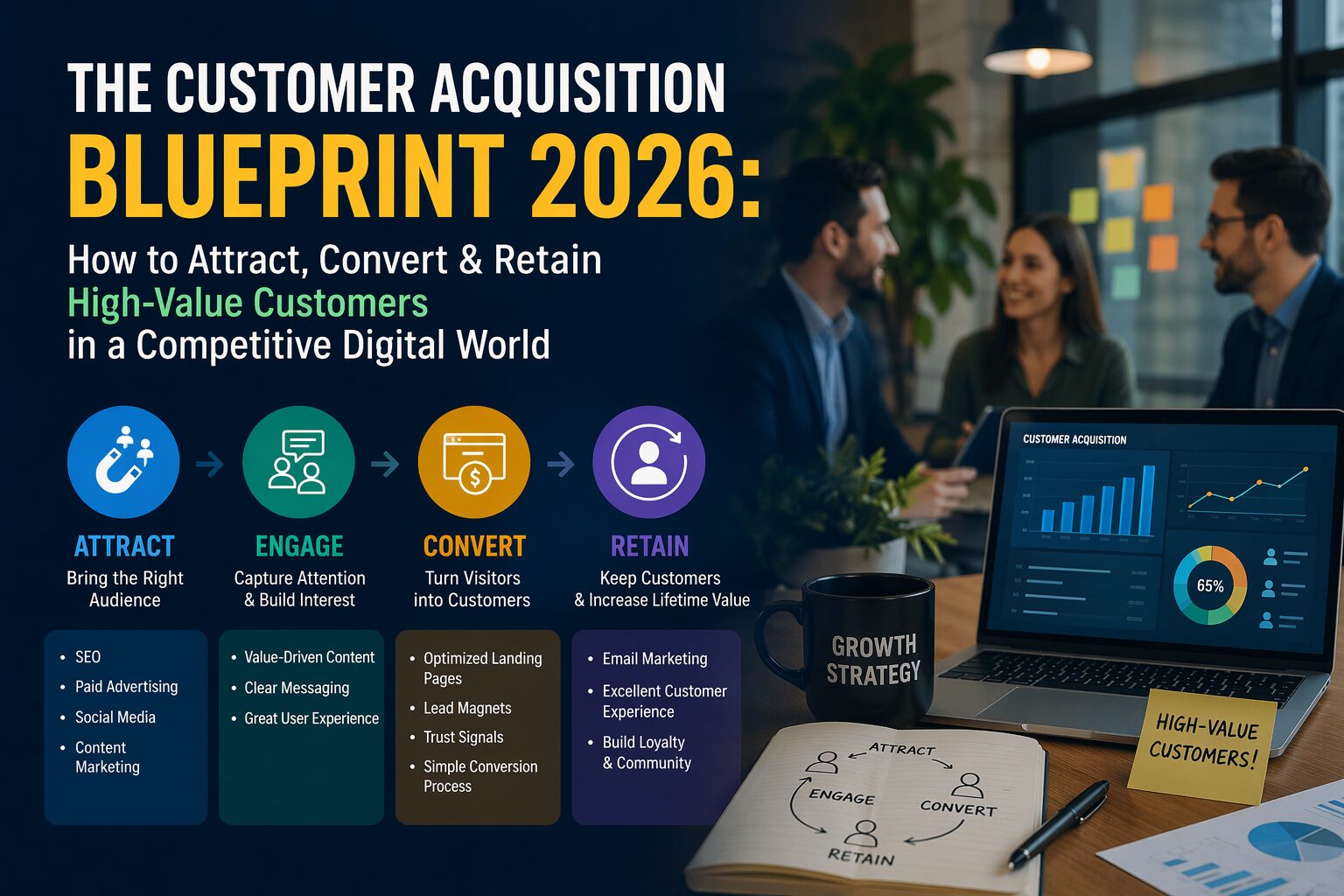
The 4 Stages of a High-Performing Customer Acquisition System
A strong acquisition strategy follows a structured journey:
- Attract – Bring the right audience
- Engage – Capture attention and interest
- Convert – Turn visitors into customers
- Retain – Keep customers and increase lifetime value
Most businesses focus only on stage 1.
Winning businesses optimize all four.
Stage 1: Attract — Getting the Right Traffic (Not Just More Traffic)
Traffic alone is meaningless.
What matters is qualified traffic.
Key Acquisition Channels
1. Search Engine Optimization (SEO)
SEO brings users who are actively searching.
This makes it one of the highest-intent channels.
Benefits:
- Long-term traffic
- High credibility
- Cost-effective over time
2. Paid Advertising (PPC)
Ads provide immediate results.
Ideal for:
- Testing offers
- Scaling campaigns
- Generating quick leads
3. Social Media Marketing
Social media builds awareness and trust.
But in 2026, it must be strategic—not random.
Focus on:
- Consistent messaging
- Audience targeting
- Value-driven content
4. Content Marketing
Content attracts and educates simultaneously.
- Blogs
- Videos
- Guides
- Case studies
Educational content helps establish authority and attract users actively looking for solutions
Stage 2: Engage — Turning Visitors into Interested Prospects
Getting attention is not enough.
You need to keep it.
What Drives Engagement?
1. Clear Value Proposition
Visitors should instantly understand:
- What you do
- Who it’s for
- Why it matters
2. Strong Content Strategy
Content must:
- Solve problems
- Answer questions
- Provide value
User-generated content, for example, increases authenticity and engagement because people trust real experiences more than ads
3. Visual & UX Experience
Your website should be:
- Fast
- Clean
- Easy to navigate
Poor design kills engagement instantly.
Stage 3: Convert — Turning Attention into Revenue
This is where most businesses fail.
They generate traffic but fail to convert it.
Key Conversion Elements
1. Landing Pages
A high-converting page includes:
- Clear headline
- Focused message
- Strong call-to-action
2. Lead Magnets
Offer value before asking for anything.
Examples:
- Free audits
- E-books
- Checklists
3. Trust Signals
People don’t trust easily.
You need:
- Testimonials
- Case studies
- Social proof
4. Simple Conversion Flow
Complicated forms reduce conversions.
Keep it:
- Short
- Clear
- Easy
Stage 4: Retain — The Most Underrated Growth Lever
Most businesses focus only on acquiring customers.
But retention is where real growth happens.
Why Retention Matters
- It costs less than acquisition
- Increases customer lifetime value
- Drives referrals
Retention Strategies
Email Marketing
Stay connected with your audience.
- Follow-ups
- Offers
- Value-based emails
Customer Experience
Happy customers stay longer.
Focus on:
- Fast support
- Clear communication
- Consistent delivery
Community Building
Build relationships, not just transactions.
The Biggest Customer Acquisition Mistakes to Avoid
1. Chasing Traffic Without Strategy
More traffic does not equal more revenue.
2. Ignoring Messaging
If your message is unclear, nothing converts.
3. Weak Follow-Up
Most leads don’t convert immediately.
4. No Data Tracking
Without data, you are guessing.
How to Build a Scalable Customer Acquisition Strategy
Step 1: Define Your Ideal Customer
Be specific.
Not:
“Everyone”
But:
“E-commerce brands generating $50K–$500K monthly”
Step 2: Identify Pain Points
Understand:
- What problems they face
- What solutions they seek
Step 3: Craft a Strong Offer
Your offer should clearly communicate:
- Value
- Outcome
- Benefit
Step 4: Choose the Right Channels
Don’t try everything.
Focus on:
- 2–3 main channels
Step 5: Build a Funnel
From awareness to conversion:
- Content → Lead magnet → Email → Offer
Step 6: Optimize Continuously
Track:
- Conversion rate
- Cost per lead
- ROI
Then improve.
Real-World Scenario: Turning Marketing into a Predictable System
Before:
- Random marketing
- No funnel
- Inconsistent leads
After:
- SEO driving organic traffic
- Ads generating leads
- Optimized landing pages
- Email nurturing
Result:
- Predictable growth
- Better conversions
- Higher ROI
The Role of Content in Customer Acquisition
Content is no longer optional.
It is a core growth driver.
Types of High-Performing Content
- Educational blogs
- How-to guides
- Case studies
- Comparison articles
Content works because it:
- Builds trust
- Educates users
- Positions you as an authority
Customer Acquisition Trends in 2026
1. AI-Driven Personalization
Marketing is becoming smarter.
2. Omnichannel Strategy
Customers interact across platforms.
3. Trust-Based Marketing
Authenticity is more important than ever.
4. Data-Driven Decisions
Guesswork is no longer effective.
Key Metrics You Must Track
To measure success:
- Website traffic
- Conversion rate
- Cost per acquisition
- Customer lifetime value
- ROI
Final Thoughts: Build Systems, Not Campaigns
Customer acquisition in 2026 is not about:
- Posting more
- Spending more
- Trying everything
It’s about building a system that works.
A system that:
- Attracts the right audience
- Converts consistently
- Scales predictably
Businesses that understand this will dominate.
Others will struggle.
Call to Action
If your marketing is inconsistent, expensive, or not delivering results—
It’s time to rethink your approach.
Focus on building a structured customer acquisition system.
Because in today’s digital world, success doesn’t come from doing more.
It comes from doing it right.