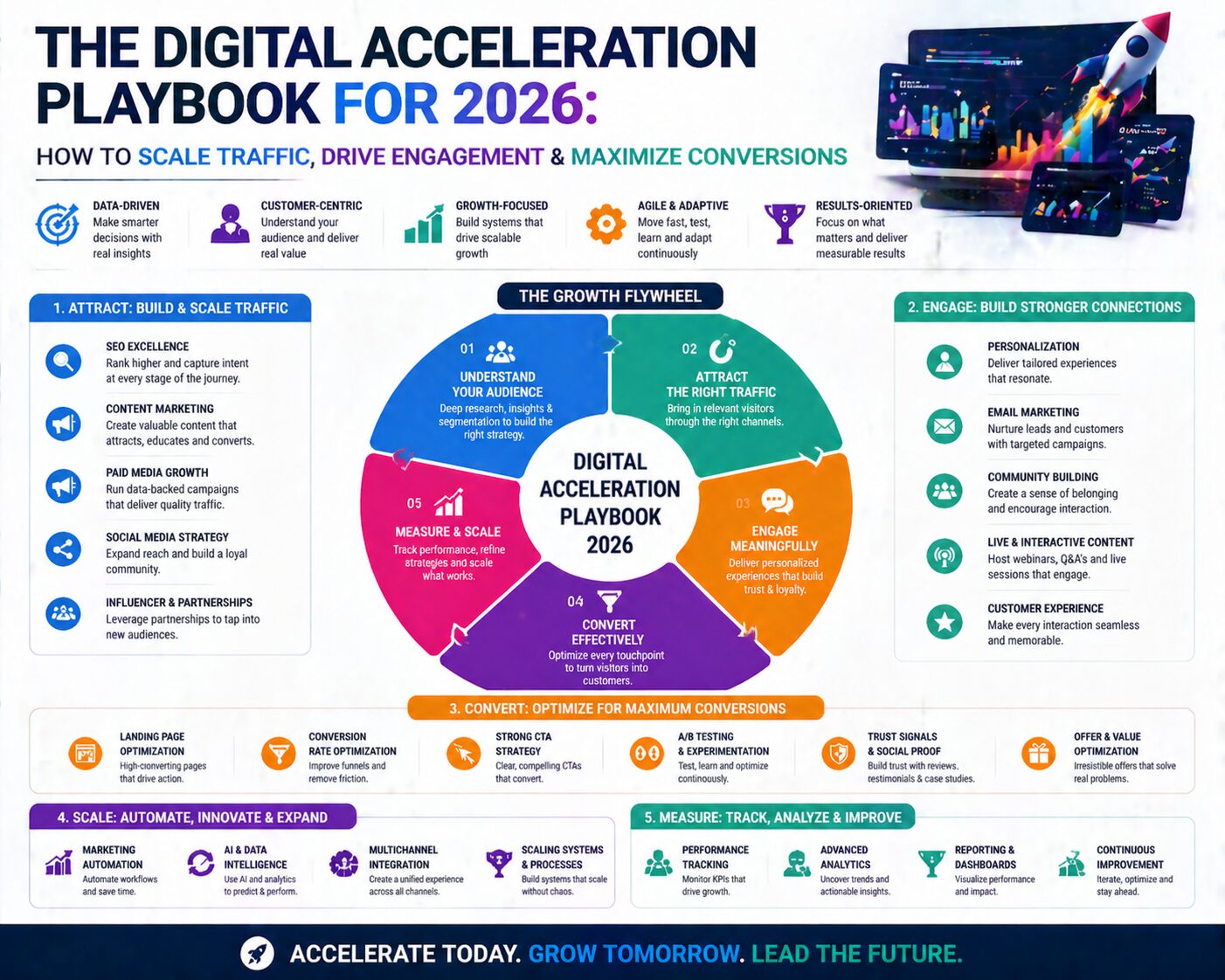
Introduction — Charting a New Era of Digital Growth
Digital marketing continues to evolve rapidly — and 2026 is shaping up to be a year where the brands that win are those that treat growth as a system, not a set of tactics. With rising privacy standards, AI‑powered optimization, and audiences spread across digital pathways, modern growth demands strategic integration of channels, data‑driven decisions, and a relentless focus on customer value.
This guide is a full Digital Acceleration Playbook for 2026 — designed for founders, marketers, and growth teams who want to build predictable, sustainable, and measurable digital momentum.
You’ll learn how to:
- Understand the changing digital landscape
- Build cohesive multichannel acquisition engines
- Personalize engagement at scale
- Optimize conversion paths
- Retain and expand customer value
- Measure what matters and iterate quickly
- Institutionalize growth execution across teams
This isn’t theory — it’s actionable strategy, ready to implement.
1. The Digital Growth Landscape in 2026
Before diving into tactics, it’s critical to understand the forces redefining digital growth today.
1.1 Privacy, Consent & First‑Party Data
Third‑party cookies have essentially disappeared, and privacy regulations such as GDPR, CCPA, and emerging global standards mean that growth strategies must be consent‑based.
- First‑party data becomes the foundation for personalization
- Consented user profiles drive engagement automation
- Contextual signals matter more than ever
Success in 2026 relies on trust‑based data collection and ethical usage.
1.2 AI & Predictive Systems Are Core Tools
AI has transitioned from buzzword to backbone:
- Predictive models forecast audience behavior
- Automated systems optimize bidding and segmentation
- AI‑assisted content tools streamline production
- Personalization emerges through AI‑driven recommendations
AI doesn’t replace strategy — it amplifies what works.
1.3 The Customer Journey Is Multimodal
Customers no longer convert in linear paths. They:
- Search on Google
- Discover on social
- Evaluate via email and review sites
- Compare with peers and forums
- Convert on mobile or desktop
Growth teams must treat digital channels as points on a path, not islands.
2. Awareness — Be Found Where Audiences Search & Discover
Brand discovery begins with visibility — but visibility without relevance yields poor results.
2.1 Intent‑Driven SEO as a Foundation
Modern SEO isn’t about keywords — it’s about topics and intent.
Best practices for 2026 SEO:
- Build topic clusters around core themes
- Create evergreen pillar content
- Expand with semantically related content clusters
- Optimize for rich results and search features
Audience intent signals (click patterns, dwell time, interaction depth) drive ranking signals more than simple keyword use.
2.2 Social Discovery & Narrative‑Driven Short Content
Social platforms (Reels, TikTok, Shorts) are discovery engines, not destinations. They require:
- Narrative hooks within the first seconds
- Consistent vertical story formats
- Collaboration with niche creators
- Community interaction, not one‑way messaging
Engagement signals on social boost organic distribution and cross‑platform discovery.
2.3 Paid Reach With Purpose
Paid campaigns should be purposeful and measured:
- Target high‑intent segments
- Use creative that adapts by audience segment
- Link paid channels to conversion pathways
- Prioritize CPA and LTV over reach alone
Paid is amplification — not a fallback for weak organic presence.
3. Acquisition & Engagement — Interactions With Intent
Visitors become leads when the experience connects with their motivations.
3.1 High‑Value Lead Magnets & Contextual Offers
A lead magnet must be:
- Relevant to intent
- Immediately usable
- Perceived as valuable
- Positioned with contextual messaging
Examples:
- Industry‑specific toolkits
- Exclusive research reports
- Actionable checklists
- Personalized assessments
Remove friction — the first step toward conversion should feel easy.
3.2 Engagement Through Personalization & Dynamic Content
Personalization in 2026 is context‑aware, not intrusive. Use behavior signals to tailor:
- Email content sequences
- Web page modules
- In‑app suggestions
- Conversion triggers
This fosters a sense that the experience was designed for the user.
3.3 Interactive Content That Captures Intent
Interactive formats increase engagement and data signals:
- Calculators and ROI tools
- Interactive case studies
- Gamified assessments
- Surveys that tailor follow‑ups
Interactive journeys surface audience intent and segment leads automatically.
4. Conversion — Making the Path to Action Clear
Acquisition is halfway — conversion is where value is realized.
4.1 Conversion‑Optimized Pathways
Conversion optimization isn’t cosmetic — it’s structural:
- Clarity of value proposition
- One primary CTA per page
- Trust signals (testimonials, case studies)
- Fast load times and mobile optimization
Remove decision friction everywhere.
4.2 Offer Structuring for Buyer Momentum
Convert at the right time with the right offer:
| Audience Stage | Optimal Offer |
|---|---|
| Early Explore | Guides, sample content |
| Consideration | Demo, consult call |
| High Intent | Free trial, limited discount |
| Repeat Visitors | Personalized incentives |
Match offer intensity to user readiness.
4.3 Form Optimization & Friction Reduction
Forms shouldn’t be barriers — they are conversion checkpoints:
- Minimize fields
- Use progressive profiling
- Provide mobile‑optimized fields
- Offer social logins
More data later — less friction now.
5. Retention — The Growth Channel Most Marketers Overlook
Retention converts past behavior into future value.
5.1 Onboarding That Drives Early Value
First 7–14 days shape retention:
- Set expectations
- Deliver quick wins
- Provide guidance loops
- Prompt feedback early
Onboarding is not transactional — it’s value delivery.
5.2 Loyalty Programs With Habit Forming Mechanics
Retention isn’t freebies — it’s repeated perceived value.
Loyalty mechanics include:
- Tiered benefit structures
- Rewards tied to action milestones
- Surprise and delight triggers
- Community access incentives
Loyal users spend more and refer more.
5.3 Customer Feedback & Experience Signals
Measure experience with metrics like:
- NPS (Net Promoter Score)
- CSAT (Customer Satisfaction)
- Product or content usage patterns
- Engagement depth over time
Feedback informs product and messaging improvements.
6. Advocacy — Turn Customers Into Growth Engines
Advocacy accelerates reach without proportional spend.
6.1 Referral Programs With Balanced Incentives
Design programs where both sides benefit:
- Reward advocates and referees
- Time‑limited incentives
- Gamified progress indicators
- Easy sharing options
Referrals source high‑quality leads.
6.2 User‑Generated Content as a Trust Signal
UGC is authentic and persuasive:
- Customer testimonials
- Case study narratives
- Social content from users
- Community highlights
UGC feeds awareness, retention, and trust.
6.3 Community Engagement Engines
Communities extend value beyond transactions:
- LinkedIn or Slack groups
- Webinars and cohorts
- Invite‑only events
- Q&A forums
Communities generate deep engagement and long‑term retention.
7. Measurement — What to Track & Why It Matters
If you can’t measure it, you can’t optimize it.
7.1 Key Growth Metrics by Stage
| Stage | Core Metrics |
|---|---|
| Awareness | Reach, Impressions, New Users |
| Acquisition | Lead Rate, Engagement Depth |
| Conversion | CVR, CPA, Revenue per Visit |
| Retention | Repeat Rate, Customer Lifetime Value |
| Advocacy | Referral Rate, UGC Engagement |
Use metrics to track real business value, not vanity.
7.2 Multi‑Touch Attribution
Attribution must reflect complex journeys:
- Time‑decay models
- Position‑based models
- Custom hybrid models
Understand true impact across channels.
7.3 Predictive Metrics for Growth Forecasting
Predictive KPIs include:
- Lead velocity
- Intent signal strength
- Churn risk indicators
- Predictive lifetime value
These help teams act before lagging signals show outcomes.
8. Growth Organization — Teams & Processes That Scale
Growth is a function — not a slogan.
8.1 Cross‑Functional Growth Squads
Teams should include:
- Strategy
- Analytics
- Content
- Product/UX
- Customer Success
Shared ownership drives focus and speed.
8.2 OKRs for Growth Alignment
Objectives and Key Results (OKRs) frame accountability:
- Objective: Increase qualified pipeline by 40%
- KR1: Improve SEO discovery by 30%
- KR2: Lift CVR by 20%
- KR3: Grow retention by 15%
Align teams around outputs, not outputs alone.
8.3 Experimentation & Continuous Learning
Run disciplined experiments:
- Define hypothesis
- Select success metric
- Run tests with sufficient power
- Learn and iterate
Experimentation amplifies performance over time.
9. Common Pitfalls & Growth Anti‑Patterns
Avoid traps that undermine growth.
9.1 Chasing Vanity Metrics Over Value Metrics
Avoid focusing on:
- Follower counts
- Page views without conversion
- Engagement without intent
Focus on conversion and business impact.
9.2 Siloed Channel Thinking
Silos kill coordination. Integrated growth requires cohesive paths across all touchpoints.
9.3 Ignoring Data Privacy & Ethics
Respect privacy:
- Clear consent flows
- Transparent data usage
- Uphold compliance
Trust drives long‑term value.
10. Future Signals Shaping Digital Growth Beyond 2026
10.1 Contextual Personalization Is Prime
Beyond personalization — contextual relevance — including:
- Time
- Device
- Intent
- Past behavior
- Role and segment
Context drives relevance.
10.2 AI‑Augmented Growth Systems
AI helps with:
- Predictive optimization
- Smart segmentation
- Creative variation tests
- Automated insights
Strategic AI usage amplifies human decisions.
10.3 Immersive & Experience‑First Growth Channels
Future touchpoints include immersive experiences:
- AR/VR guided demos
- Conversational experiences
- Immersive product showcases
These formats increase engagement.
Conclusion — Growth in 2026 Is a System You Build
Digital growth in 2026 is not about hacking a single metric. It’s about building and refining a system that delivers sustainable value across acquisition, engagement, conversion, retention, and advocacy.
Your growth engine should be:
✔ Multichannel and integrated
✔ Driven by first‑party insights
✔ Optimized through experimentation
✔ Measured with intention
✔ Focused on real business outcomes
This playbook provides a framework you can adopt and evolve — start with one pillar this month, track results, iterate, and scale what works. Growth isn’t a destination; it’s a disciplined practice.