Introduction: Why Most Marketing Fails Even in 2026
Digital marketing has never been more advanced than it is today. Businesses now have access to AI-driven analytics, automated advertising systems, real-time customer tracking, and multi-channel attribution models. Yet despite this technological progress, most companies still struggle to achieve predictable revenue growth.
The core issue is not lack of tools. It is lack of structure.
Most businesses still operate marketing as a collection of disconnected activities:
- SEO is handled separately
- Paid ads are optimized in isolation
- Content is created without conversion strategy
- Social media is managed for engagement only
This fragmented approach leads to inconsistent results, wasted budget, and unpredictable revenue.
In 2026, successful digital growth is no longer about doing more marketing. It is about building a revenue-driven marketing system—a structured framework that connects visibility, engagement, and conversion into a single predictable engine.
This article breaks down that system and explains how businesses can implement it effectively.
1. Understanding Revenue-Driven Marketing vs Traditional Marketing
Traditional marketing focuses on output:
- More posts
- More ads
- More traffic
- More impressions
Revenue-driven marketing focuses on outcomes:
- Customer acquisition cost
- Conversion rate
- Lifetime value
- Revenue per channel
The difference is fundamental.
Traditional marketing asks:
“How much content did we publish?”
Revenue-driven marketing asks:
“How much revenue did this content generate?”
This shift changes everything—from strategy to execution.
2. The Core Structure of a Revenue-Driven Marketing System
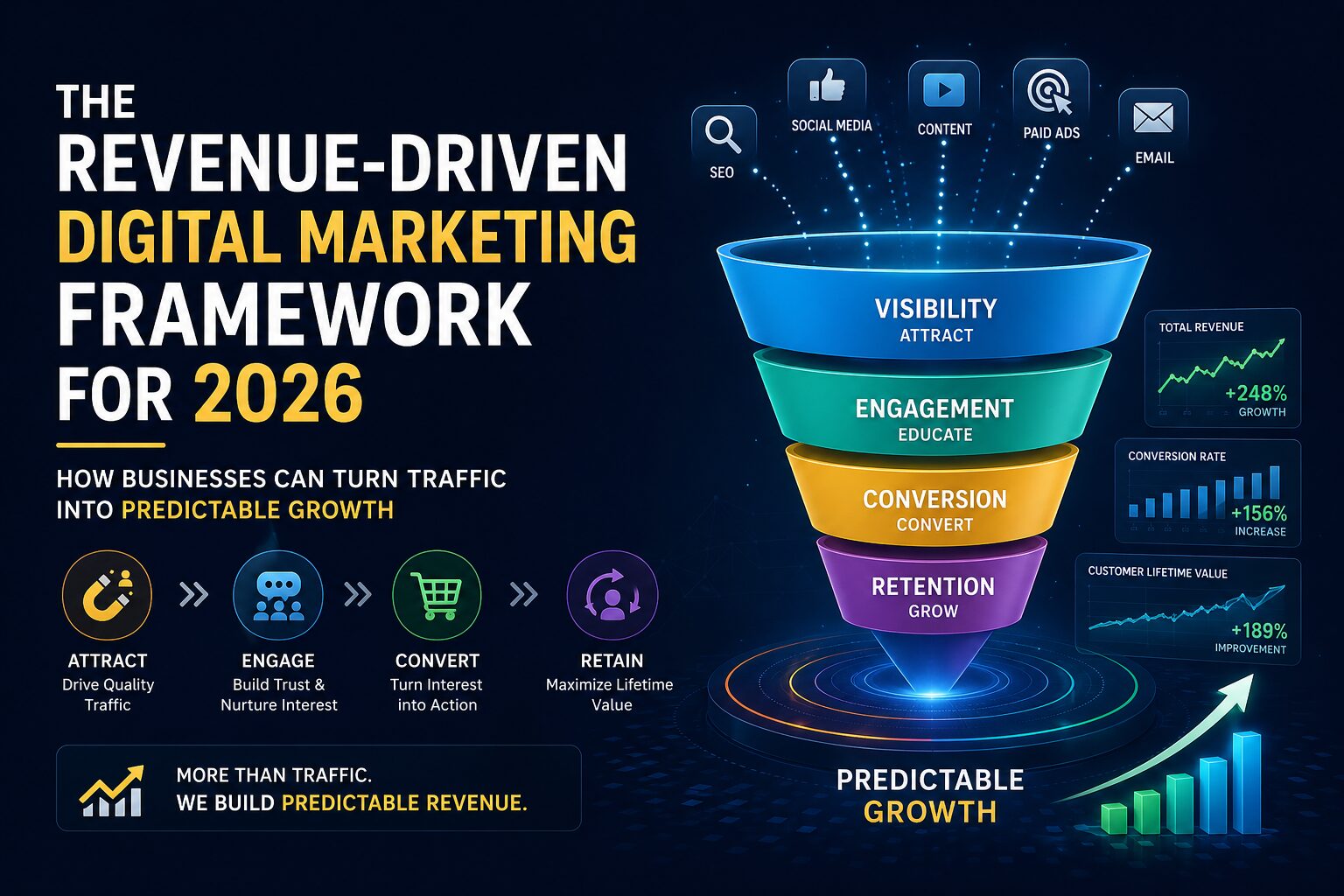
A high-performance digital system in 2026 operates on four interconnected layers:
2.1 Visibility Engine (Attract)
This layer ensures your business is discoverable across multiple platforms:
- Google search
- Social media discovery
- YouTube content
- AI-powered search assistants
Visibility is not about presence—it is about strategic positioning.
Modern visibility requires:
- Topic authority clusters (SEO structure)
- Multi-platform content adaptation
- High-intent keyword targeting
- Consistent publishing cadence
Without visibility, even the best product remains invisible.
2.2 Engagement Engine (Educate + Build Interest)
Once users discover your brand, the next challenge is retention of attention.
In 2026, attention span is shorter, but decision cycles are longer. This means users do not convert immediately—they evaluate, compare, and validate.
Effective engagement systems include:
- Educational blog content
- Short-form video explainers
- Case studies and proof-based storytelling
- Interactive social content
- Email nurturing sequences
The goal is to move users from awareness to consideration.
2.3 Conversion Engine (Turn Interest into Action)
This is where most businesses fail.
Even with traffic and engagement, poor conversion systems lead to revenue leakage.
A strong conversion engine includes:
- High-performance landing pages
- Clear value propositions
- Behavioral triggers (urgency, trust, clarity)
- Optimized user journeys
- Reduced friction pathways
Conversion is not persuasion—it is clarity engineering.
If a user has to think too much, they do not convert.
2.4 Retention Engine (Maximize Lifetime Value)
Modern growth is no longer acquisition-focused only. Sustainable profitability depends on retention.
Retention systems include:
- Email lifecycle automation
- Loyalty programs
- Personalized offers
- Customer success engagement
- Re-engagement campaigns
Acquiring a customer is expensive. Retaining them is profitable.
In 2026, the most successful companies earn more from existing customers than new ones.
3. The Role of AI in Revenue-Driven Marketing
Artificial intelligence is no longer optional. It is embedded in every stage of digital marketing execution.
3.1 AI in Audience Targeting
AI systems now analyze:
- Behavioral patterns
- Purchase intent signals
- Content engagement history
- Cross-platform activity
This allows businesses to target users with far greater precision than traditional demographic targeting.
3.2 AI in Content Optimization
AI tools can now:
- Suggest high-performing topics
- Optimize SEO structure
- Predict content engagement levels
- Generate variations for testing
However, human strategy remains essential for brand positioning and messaging depth.
3.3 AI in Conversion Optimization
AI-driven CRO systems can:
- Identify drop-off points in real time
- Suggest landing page improvements
- Personalize user experiences dynamically
- Adjust offers based on user behavior
This turns websites into adaptive systems rather than static pages.
4. Data as the Central Decision Layer
Without data intelligence, even the best strategy becomes guesswork.
Modern marketing systems rely on three types of data:
4.1 Descriptive Data
What happened:
- Traffic numbers
- Engagement rates
- Conversion counts
4.2 Diagnostic Data
Why it happened:
- Drop-off analysis
- Channel performance comparison
- User behavior mapping
4.3 Predictive Data
What will happen:
- Customer lifetime value forecasting
- Churn prediction
- Campaign outcome modeling
Businesses that reach predictive capability gain a significant competitive advantage.
5. Building High-Impact Content That Drives Revenue
Content in 2026 must serve a clear business function. Content without purpose is operational noise.
5.1 Content Must Map to the Funnel
- Awareness content → SEO blogs, social posts
- Consideration content → guides, comparisons, case studies
- Conversion content → landing pages, testimonials, offers
- Retention content → email sequences, updates, value delivery
Each piece must have a defined role.
5.2 Authority Content vs Traffic Content
Traffic content:
- Targets high-volume keywords
- Focuses on reach
- Often generic
Authority content:
- Targets strategic topics
- Builds trust
- Converts higher-value customers
Businesses need both, but authority content drives long-term revenue stability.
5.3 The Content Depth Advantage
Search engines now prioritize:
- Depth over frequency
- Context over keyword density
- Expertise over volume
A single well-structured article can outperform dozens of shallow posts.
6. Channel Integration: The Missing Growth Layer
Most businesses treat channels independently. High-performing systems integrate them.
Example flow:
- SEO blog attracts traffic
- Social media amplifies reach
- Retargeting ads re-engage visitors
- Email nurtures leads
- Landing page converts users
- CRM retains customers
This creates a closed-loop growth system.
7. Common Mistakes Businesses Make in Digital Growth
Even advanced businesses fall into predictable traps:
7.1 Vanity Metrics Dependency
Likes, impressions, and followers do not equal revenue.
7.2 Channel Isolation
SEO, ads, and social media working independently reduce efficiency.
7.3 Weak Conversion Systems
High traffic with low conversion is a structural failure.
7.4 Lack of Customer Lifecycle Strategy
Acquisition without retention limits profitability.
8. The Future of Digital Growth Systems
By 2026 and beyond, digital marketing will evolve into:
- Fully AI-assisted campaign execution
- Predictive revenue modeling
- Hyper-personalized user journeys
- Automated content ecosystems
- Real-time conversion optimization
The role of marketers will shift from execution to system design.
Businesses that adapt early will dominate their industries.
Conclusion: Growth Belongs to Structured Systems, Not Isolated Efforts
Digital marketing success in 2026 is not defined by how many campaigns a business runs. It is defined by how well those campaigns work together.
A revenue-driven marketing system ensures that every action contributes to measurable business outcomes:
- Visibility generates attention
- Engagement builds trust
- Conversion drives revenue
- Retention ensures profitability
When these elements are connected, growth becomes predictable.
Businesses that continue operating in fragmented systems will struggle with inefficiency and rising acquisition costs. Those that adopt structured, revenue-driven frameworks will scale faster, more efficiently, and more sustainably.
The future of digital marketing is not about doing more.
It is about building systems that do more for you.