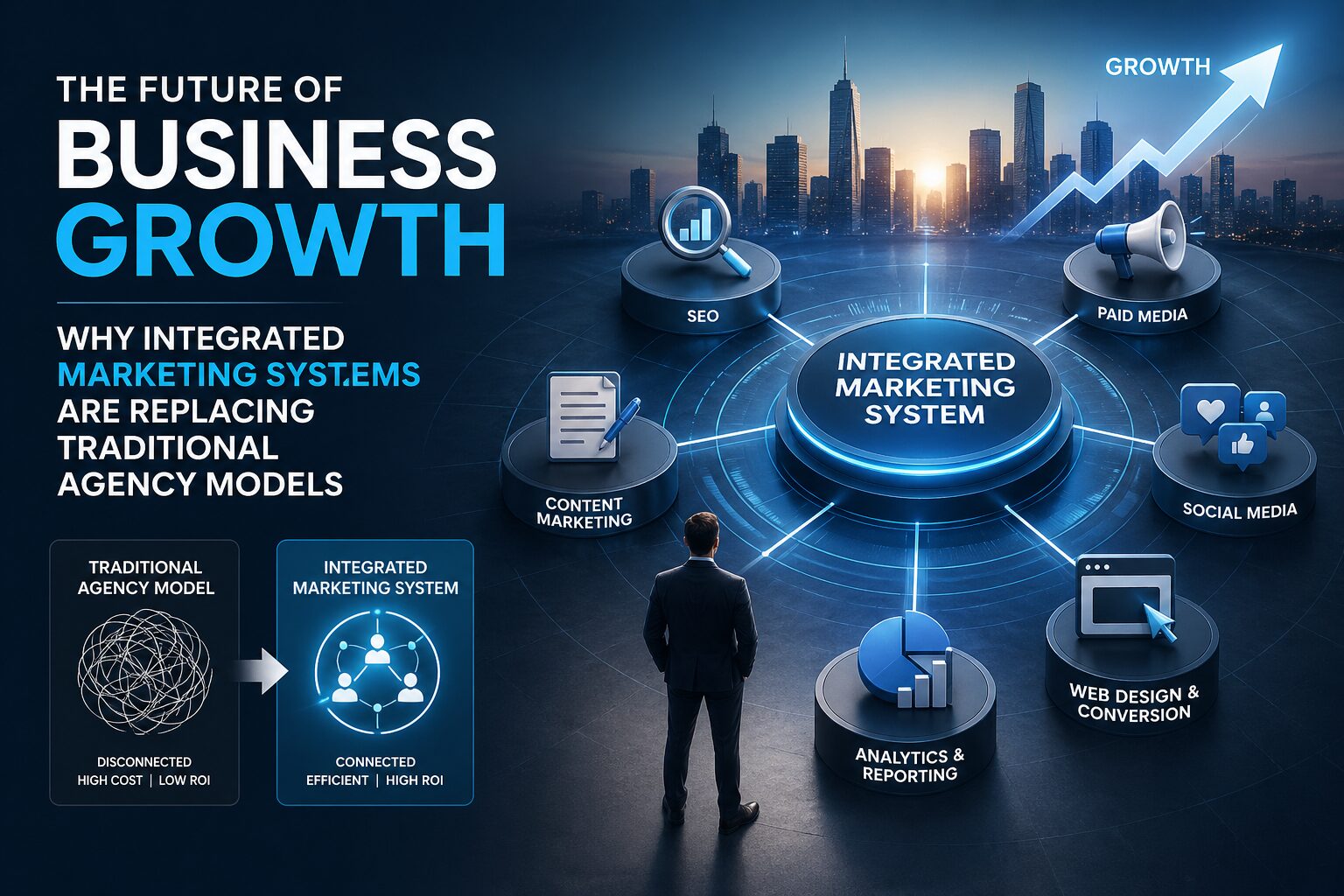
Introduction: The End of Fragmented Marketing
For years, businesses have relied on separate agencies for SEO, social media, paid ads, branding, and content creation. While this approach once worked, it is now becoming inefficient in a fast-moving digital economy.
Modern consumers interact with brands across multiple channels simultaneously—search engines, social platforms, email, paid ads, and direct engagement. When these channels operate independently, the result is inconsistency, wasted budget, and weak conversion performance.
The future belongs to integrated marketing systems—structured, data-driven ecosystems where every marketing channel works together under one unified strategy.
This shift is not optional anymore. It is becoming the standard for businesses that want predictable growth.
1. The Problem With Traditional Marketing Structures
Most businesses still operate with a fragmented marketing model:
- One agency handles SEO
- Another manages social media
- A third runs paid ads
- Designers work separately
- Analytics are disconnected
This creates three critical problems:
1.1 Lack of Strategic Alignment
When each channel operates independently, messaging becomes inconsistent. SEO content may not match paid ad campaigns. Social media branding may differ from website messaging.
This inconsistency reduces trust and weakens brand authority.
1.2 Data Silos and Poor Decision Making
Each agency tracks its own metrics:
- SEO reports focus on rankings
- PPC agencies focus on clicks
- Social media teams focus on engagement
But none of these are connected to the full customer journey.
As a result, businesses cannot answer the most important question:
Which channel is actually driving revenue?
1.3 Increased Cost With Lower ROI
Multiple agencies mean:
- Higher management overhead
- Repeated strategies
- Overlapping tools
- Inefficient budgets
Instead of optimizing performance, companies end up paying for disconnected execution.
2. What Integrated Marketing Actually Means
Integrated marketing is not just “using multiple channels.” It is a structured system where all marketing efforts are designed, executed, and measured under one strategy.
It includes:
- Unified brand messaging
- Shared data systems
- Cross-channel strategy alignment
- Centralized reporting
- Conversion-focused execution
In simple terms:
Every marketing activity supports the same growth goal.
3. The Core Pillars of an Integrated Growth System
To understand how modern digital growth works, we need to break it into five core pillars.
3.1 Strategic SEO as the Foundation
SEO is no longer just about ranking keywords. It is about building intent-driven visibility.
A modern SEO system includes:
- Search intent mapping
- Content architecture planning
- Technical optimization
- Authority building (backlinks + PR)
- Conversion optimization
SEO acts as the long-term traffic engine that continuously feeds the system with qualified users.
3.2 Paid Media for Immediate Scale
While SEO builds long-term traffic, paid ads provide immediate data and scaling capability.
Effective paid media is not just advertising—it is testing infrastructure:
- Audience validation
- Message testing
- Offer optimization
- Conversion tracking
When integrated properly, paid ads inform SEO content strategy and landing page optimization.
3.3 Social Media as a Trust Layer
Social platforms are no longer just branding tools. They are trust-building systems.
Their role includes:
- Establishing authority
- Building community engagement
- Reinforcing messaging consistency
- Supporting SEO content distribution
Social content should not operate independently—it should amplify SEO and paid campaigns.
3.4 Conversion-Focused Web Design
A website is not a digital brochure. It is a conversion engine.
Integrated web systems focus on:
- UX optimization
- Funnel design
- Speed performance
- Psychological triggers
- Clear CTAs
Even high traffic is useless without conversion structure.
3.5 Analytics and Feedback Loops
Without analytics integration, marketing becomes guesswork.
A proper system tracks:
- Customer journey paths
- Conversion attribution
- Cost per acquisition
- Lifetime value
- Channel performance correlation
This creates a feedback loop where every decision is data-driven.
4. Why Businesses Are Moving Toward Unified Systems
There are three major reasons this shift is accelerating.
4.1 AI and Automation Are Changing Execution
AI tools now automate:
- Content creation
- Ad optimization
- Customer segmentation
- Reporting
This reduces the need for multiple disconnected agencies and increases demand for system-based thinking.
4.2 Competition Has Increased in Every Industry
No matter the niche—e-commerce, services, SaaS, or local businesses—competition is now global.
Winning requires:
- Faster execution
- Smarter targeting
- Integrated messaging
Fragmented marketing cannot keep up.
4.3 Customers Expect Consistency
A user might:
- See an ad on Instagram
- Search on Google
- Visit your website
- Compare reviews
If messaging changes at each stage, trust breaks instantly.
Integrated systems solve this.
5. The Business Impact of an Integrated Strategy
Companies that adopt unified marketing systems experience:
5.1 Higher Conversion Rates
Because messaging stays consistent across all touchpoints.
5.2 Lower Customer Acquisition Cost
Because data is shared and optimized across channels.
5.3 Faster Scaling
Because successful campaigns can be replicated across multiple platforms.
5.4 Stronger Brand Authority
Because every interaction reinforces the same positioning.
6. How to Transition From Fragmented to Integrated Marketing
Most businesses do not switch overnight. The transition happens in stages.
Step 1: Centralize Strategy
Instead of separate agencies, define one core marketing strategy that includes:
- Target audience
- Core message
- Conversion goals
Step 2: Unify Tracking Systems
Implement:
- Google Analytics 4
- CRM integration
- Conversion tracking across all platforms
Step 3: Align Content Across Channels
Ensure:
- SEO blogs match ad messaging
- Social posts reinforce website content
- Landing pages support campaigns
Step 4: Build Feedback Loops
Use performance data to:
- Adjust SEO topics
- Optimize ad creatives
- Improve website conversion paths
Step 5: Move Toward System-Based Execution
Replace “task-based outsourcing” with “system-based growth execution.”
7. The Future: Fully Automated Growth Ecosystems
The next stage of marketing evolution will involve:
- AI-driven campaign optimization
- Predictive customer behavior modeling
- Fully automated funnel adjustments
- Real-time personalization across platforms
Businesses that adopt integrated systems early will dominate this shift.
Those that remain fragmented will struggle to compete.
Conclusion: Integration Is No Longer Optional
Marketing is no longer about isolated channels. It is about connected systems that work together to drive predictable growth.
The businesses that will succeed in the next decade are those that:
- Think in systems, not services
- Focus on data, not assumptions
- Prioritize integration over fragmentation
- Build long-term growth engines instead of short-term campaigns
Integrated marketing is not just the future—it is already the standard for high-performing businesses.