Introduction: A Shift in How Growth Actually Happens
Business growth is no longer driven by isolated marketing activities. For decades, companies relied on fragmented service providers—an SEO agency here, a social media freelancer there, a branding studio somewhere else. Each team worked independently, often without alignment, shared data, or a unified strategy.
The result was predictable: inconsistent messaging, wasted budgets, and campaigns that looked good on paper but failed to deliver measurable business outcomes.
Today, that model is breaking down.
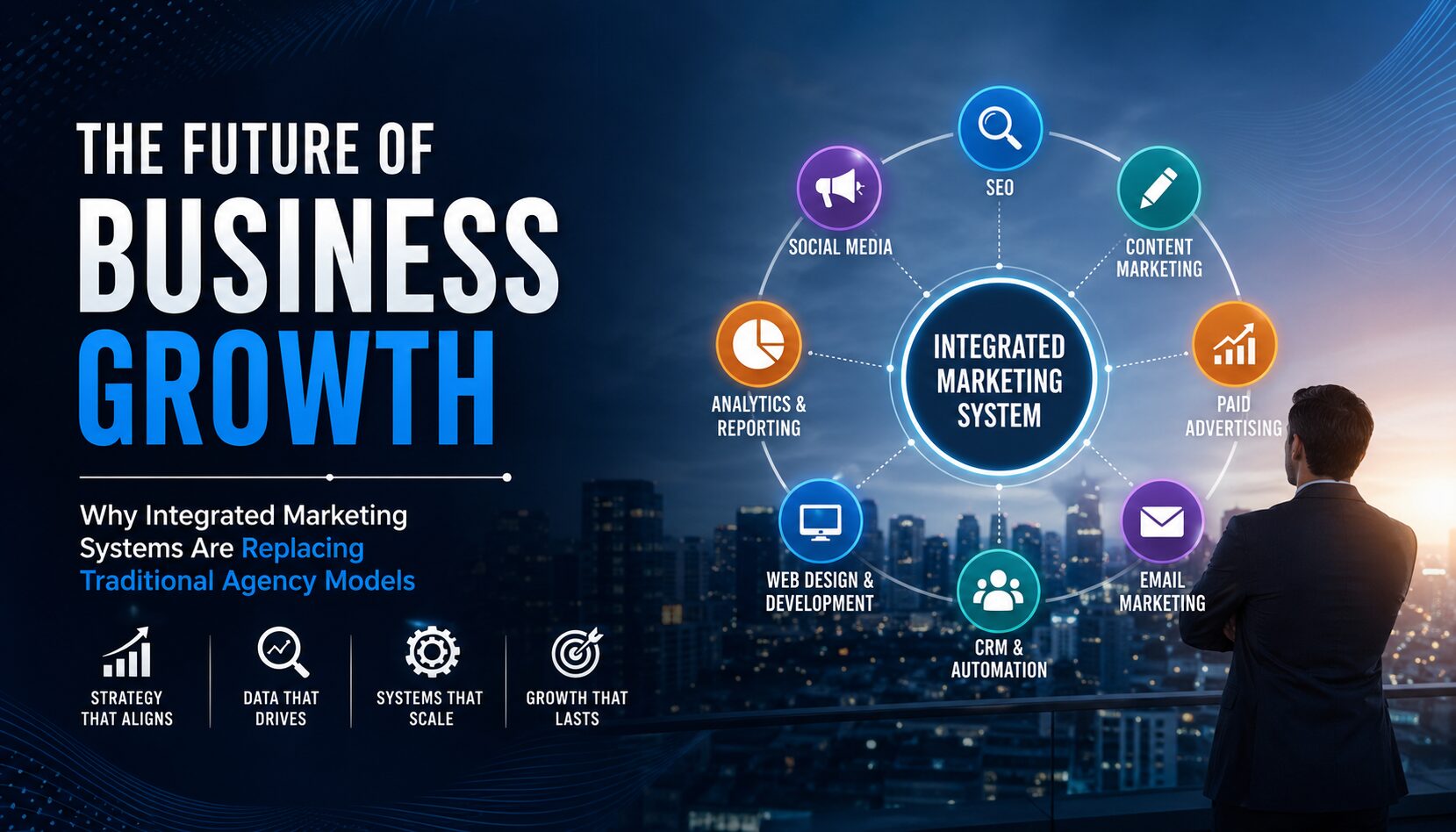
A new approach is emerging—integrated marketing systems—where SEO, paid media, branding, content, analytics, and offline channels work together as one coordinated engine.
This shift is not cosmetic. It is structural. And it is redefining how modern businesses scale.
1. The Problem With Traditional Agency Structures
Traditional marketing agencies were built for a different era—when channels were fewer, competition was lower, and customer journeys were simpler.
Most businesses still operate with this outdated structure:
- One agency handles SEO
- Another manages social media
- A third produces content
- A separate team runs ads
- Internal staff try to “connect the dots”
This creates three major inefficiencies:
1.1 Fragmented Strategy
Each channel is optimized in isolation. SEO focuses on rankings, social media focuses on engagement, and paid ads focus on conversions. But none of them align toward a unified business objective.
1.2 Data Silos
When analytics are split across platforms and teams, decision-making becomes reactive rather than predictive. No one has a complete picture of the customer journey.
1.3 Accountability Gaps
When results are poor, responsibility is diffused. SEO blames content, ads blame targeting, and branding blames positioning. The business absorbs the cost.
This model may still function for small-scale execution, but it fails under competitive pressure.
2. What an Integrated Marketing System Actually Means
An integrated marketing system is not simply “doing more marketing in one place.” It is a structured approach where all marketing functions operate as a unified growth engine.
At its core, it combines five interconnected layers:
2.1 Strategic Foundation
This includes positioning, audience segmentation, value proposition, and brand narrative. Everything starts here.
2.2 Traffic Generation Layer
SEO, paid ads, social media, PR, and referral systems work together to bring users into the ecosystem.
2.3 Conversion Infrastructure
Landing pages, UX design, copywriting, funnels, and automation systems convert attention into measurable actions.
2.4 Retention Systems
Email marketing, remarketing, loyalty strategies, and content ecosystems ensure long-term customer value.
2.5 Analytics and Optimization Layer
Every action is measured, tested, and refined through data-driven feedback loops.
When these layers are connected, marketing stops being a cost center and becomes a compounding growth system.
3. Why Businesses Are Moving Away From Traditional Agencies
The shift toward integrated systems is not theoretical—it is happening because the market has changed structurally.
3.1 Customer Journeys Are No Longer Linear
A user may discover a brand through Instagram, search it on Google, read reviews, click a retargeting ad, and convert days later. No single channel can claim full credit anymore.
3.2 Algorithmic Platforms Reward Consistency
Search engines and social platforms now evaluate entire brand ecosystems, not isolated campaigns. Consistent signals across channels improve visibility everywhere.
3.3 Rising Cost of Acquisition
Paid advertising costs have increased significantly across most industries. Businesses cannot rely on ads alone anymore; they need organic + paid synergy.
3.4 Demand for Measurable ROI
Executives no longer accept vanity metrics. They require attribution, revenue tracking, and clear ROI.
Integrated systems directly address all of these pressures.
4. The Core Advantage: Synergy Over Silos
The defining advantage of integrated marketing is synergy.
When channels work independently:
- SEO improves traffic
- Ads increase reach
- Social builds awareness
When they work together:
- SEO informs ad targeting
- Social content improves SEO signals
- Ads retarget SEO traffic
- Content supports all conversion paths
This creates a compounding effect where each channel increases the effectiveness of the others.
Instead of linear growth, businesses achieve exponential efficiency gains.
5. The Role of Data in Integrated Systems
Data is the backbone of modern marketing systems.
Without integration, data remains fragmented. With integration, it becomes a decision engine.
Key data flows include:
- Search intent data → content strategy
- Ad performance data → SEO keyword targeting
- Social engagement data → messaging refinement
- Conversion data → UX and funnel optimization
When properly connected, these insights eliminate guesswork.
Businesses stop asking “what should we try?” and start asking “what does the data already tell us?”
6. Why Branding Is No Longer Separate From Performance
Traditionally, branding was seen as “creative work” and performance marketing as “technical work.”
This separation no longer exists.
Modern branding directly impacts:
- Click-through rates
- Conversion rates
- Trust signals
- Customer retention
A strong brand reduces acquisition cost because users convert faster and require fewer touchpoints.
In integrated systems, branding is not a separate department—it is embedded into every channel.
7. The Rise of Full-Funnel Marketing Architecture
A full-funnel system ensures that no stage of the customer journey is neglected.
Top of Funnel (Awareness)
- SEO content
- Social media reach
- PR and visibility campaigns
Middle of Funnel (Consideration)
- Case studies
- Email nurturing
- Retargeting ads
Bottom of Funnel (Conversion)
- Landing pages
- Offers and incentives
- Sales funnels
Post-Purchase (Retention)
- Loyalty systems
- Upselling strategies
- Community engagement
When all four stages are connected, businesses stop losing customers after acquisition and start maximizing lifetime value.
8. Technology Is Accelerating the Shift
Several technological trends are pushing businesses toward integrated systems:
- Marketing automation platforms
- AI-driven analytics
- CRM-based attribution tracking
- Cross-channel ad optimization tools
- Predictive customer behavior modeling
These tools are not just enhancing marketing—they are restructuring it.
The agencies that fail to integrate them will gradually become obsolete.
9. What Modern Businesses Should Look For
When choosing a growth partner, businesses should evaluate capability beyond services.
Key indicators of a strong integrated system include:
9.1 Cross-Channel Strategy Capability
Can the team design campaigns that span SEO, ads, social, and branding together?
9.2 Data Integration Expertise
Do they unify reporting across channels or operate in silos?
9.3 Conversion Focus
Are they optimizing for traffic or for revenue?
9.4 Long-Term Thinking
Do they build systems or just execute campaigns?
The difference determines whether growth is temporary or sustainable.
10. The Future: Marketing as a Unified Operating System
Marketing is evolving into something closer to an operating system than a collection of services.
In the near future, successful businesses will not ask:
- “Which agency should we hire for SEO?”
- “Who manages our social media?”
Instead, they will ask:
- “Who builds and maintains our growth system?”
This system will:
- Capture attention
- Convert demand
- Retain customers
- Continuously optimize performance
Businesses that adopt this model early will outperform competitors still relying on fragmented execution.
Conclusion: Integration Is No Longer Optional
The transition from traditional agency structures to integrated marketing systems is not a trend—it is a response to structural changes in how digital ecosystems function.
Fragmentation leads to inefficiency. Integration leads to compounding growth.
Businesses that continue operating in silos will face rising costs, declining efficiency, and inconsistent results. Those that adopt unified systems will scale faster, with better control over outcomes and stronger long-term positioning.
The future belongs to systems, not services.