Introduction: Growth Is No Longer About Guesswork
In today’s competitive digital landscape, growth is not about doing more—it’s about doing what works.
Many businesses invest heavily in marketing, yet struggle to see consistent returns. Campaigns are launched, budgets are spent, and metrics are tracked—but revenue doesn’t scale in proportion.
The issue is not effort.
The issue is structure.
Growth today requires a system—a repeatable, measurable, and optimized framework that turns attention into customers and customers into long-term revenue.
This is where the Digital Growth Engine comes in.
It’s not a single tactic.
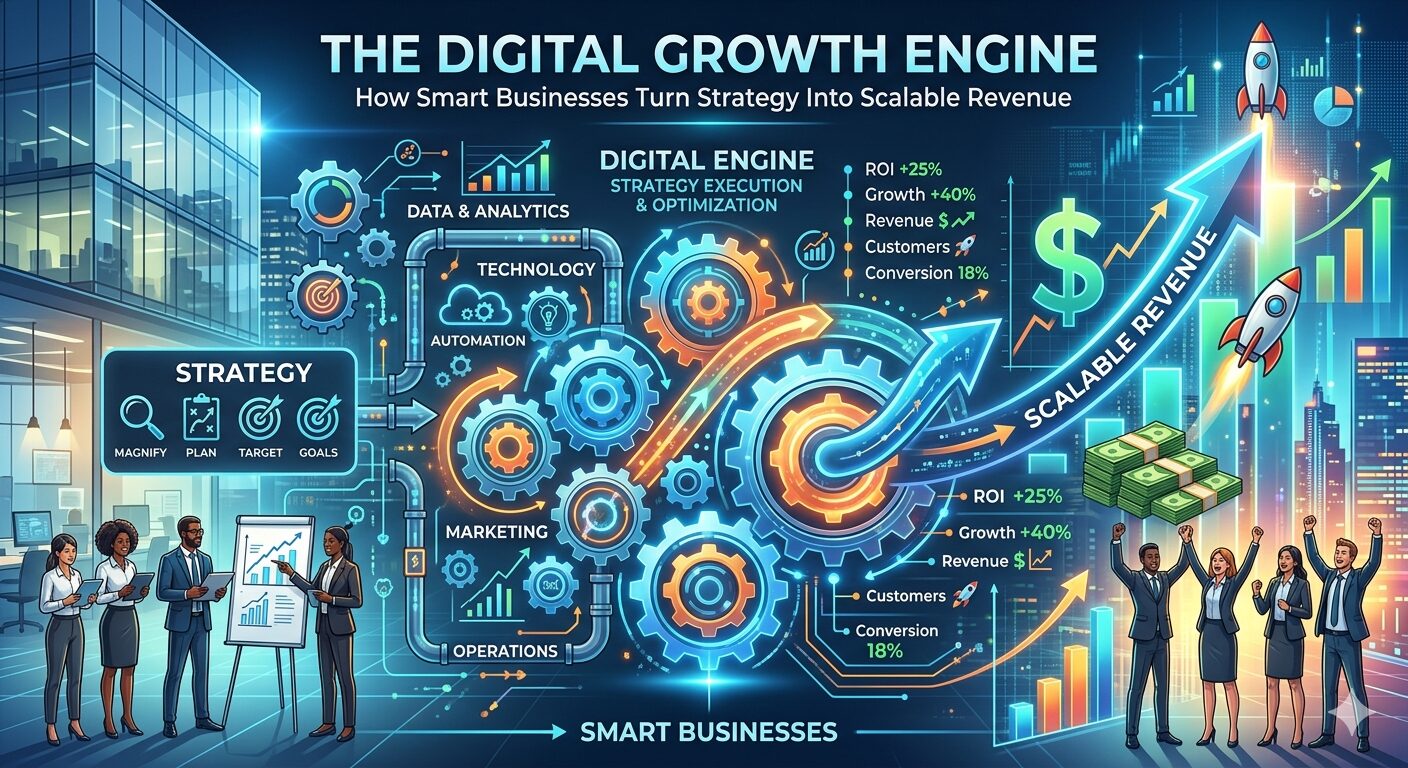
It’s a coordinated system that aligns strategy, execution, and optimization into one continuous loop.
Businesses that build this engine don’t rely on luck.
They scale with precision.
The Problem: Why Most Marketing Fails to Scale
Before building a growth engine, it’s critical to understand why most marketing efforts underperform.
1. Tactics Without Strategy
Many businesses jump straight into:
- Running ads
- Posting on social media
- Publishing content
But without a clear strategy, these actions operate in isolation.
Result: Activity without impact.
2. Lack of Audience Clarity
If you don’t deeply understand your audience:
- Your messaging misses the mark
- Your offers feel generic
- Your conversion rates stay low
Growth starts with relevance.
3. No Conversion System
Driving traffic is only half the equation.
Without:
- Optimized landing pages
- Clear calls-to-action
- Trust-building elements
Traffic turns into missed opportunity.
4. No Feedback Loop
Most businesses don’t track the right metrics or use data effectively.
They measure:
- Likes
- Impressions
Instead of:
- Cost per acquisition
- Conversion rate
- Customer lifetime value
Without data, there is no improvement.
The Digital Growth Engine Framework
To scale effectively, businesses need a structured system built on five core components:
- Audience Intelligence
- Strategic Positioning
- Traffic Generation
- Conversion Optimization
- Performance Scaling
Let’s break each one down.
1. Audience Intelligence: The Foundation of Growth
Every successful marketing system starts with understanding the audience.
Not surface-level demographics—but deep behavioral insights.
What You Need to Know
- Pain points
- Buying triggers
- Objections
- Platforms they use
- Content they consume
How to Build Audience Intelligence
- Analyze customer data
- Study competitors
- Use social listening
- Run surveys and feedback loops
Why It Matters
When you understand your audience:
- Messaging becomes sharper
- Campaigns become more effective
- Conversion rates increase
Without this step, everything else weakens.
2. Strategic Positioning: Standing Out in a Crowded Market
Once you understand your audience, the next step is positioning.
Positioning answers one critical question:
👉 Why should customers choose you?
Strong Positioning Includes:
- Clear value proposition
- Differentiation from competitors
- Consistent brand messaging
Weak vs Strong Positioning
Weak:
“We offer digital marketing services.”
Strong:
“We help businesses turn traffic into measurable revenue through data-driven growth systems.”
The Impact
Strong positioning:
- Increases trust
- Improves engagement
- Reduces price sensitivity
It turns your brand from an option into a preference.
3. Traffic Generation: Getting Seen by the Right People
Once your foundation is set, you need visibility.
But not just any traffic—qualified traffic.
Key Traffic Channels
1. Search Engine Optimization (SEO)
SEO brings long-term, compounding growth.
Benefits:
- High-intent visitors
- Sustainable traffic
- Lower long-term cost
2. Paid Advertising
Platforms:
- Google Ads
- Facebook & Instagram
Benefits:
- Immediate visibility
- Scalable campaigns
- Precise targeting
3. Social Media Marketing
Builds:
- Brand awareness
- Community
- Trust
4. Content Marketing
Content acts as your digital salesperson.
Examples:
- Blogs
- Videos
- Case studies
- Guides
Key Insight
Traffic alone doesn’t grow a business.
Relevant traffic does.
4. Conversion Optimization: Turning Visitors Into Customers
This is where most businesses fail.
They focus heavily on traffic—but neglect conversion.
What Drives Conversions
- Clear messaging
- Strong headlines
- Trust signals (reviews, testimonials)
- Simple user experience
- Strong call-to-action
High-Converting Elements
- Landing pages built for one goal
- Fast loading speed
- Mobile optimization
- Clear value communication
The Role of Design
Design is not just aesthetics.
It influences:
- Trust
- Clarity
- Decision-making
As highlighted in your own approach, design must support strategy—not replace it .
5. Performance Scaling: Turning Wins Into Systems
Once something works, the goal is to scale it.
But scaling requires discipline.
What Scaling Looks Like
- Increasing ad spend on proven campaigns
- Expanding high-performing content
- Automating lead generation systems
- Retargeting warm audiences
What NOT to Do
- Scale untested campaigns
- Ignore data
- Change too many variables at once
The Power of Data
Track:
- Conversion rates
- Cost per lead
- Customer acquisition cost
- ROI
Growth becomes predictable when it’s measurable.
The Growth Loop: How It All Connects
The Digital Growth Engine is not linear.
It’s a loop:
- Attract
- Convert
- Analyze
- Optimize
- Scale
Then repeat.
Each cycle improves performance.
Real-World Example (Simplified)
Let’s say a business implements this system:
Step 1: Audience Research
They identify a specific pain point.
Step 2: Positioning
They create a targeted offer.
Step 3: Traffic
They run ads + SEO content.
Step 4: Conversion
They build a focused landing page.
Step 5: Scaling
They double down on what works.
Result:
- Lower acquisition cost
- Higher conversions
- Consistent revenue growth
Common Mistakes to Avoid
1. Chasing Trends Instead of Strategy
Not every platform or tactic fits your business.
2. Ignoring Data
Decisions should be based on numbers—not assumptions.
3. Overcomplicating the Process
Simplicity scales better than complexity.
4. Inconsistent Execution
Growth requires consistency over time.
The Role of an Integrated Marketing Partner
Building a growth engine requires:
- Strategy
- Technical execution
- Creative alignment
- Data analysis
This is why many businesses choose a full-service approach—combining SEO, content, design, and paid media into one system .
The Future of Digital Growth
Marketing is evolving.
What worked before may not work tomorrow.
Key trends shaping the future:
- AI-driven personalization
- Data-first decision making
- Omnichannel strategies
- Content-driven ecosystems
Businesses that adapt early gain a competitive edge.
Final Thoughts: Growth Is a System, Not a Campaign
The biggest shift businesses need to make is this:
👉 Stop thinking in campaigns.
👉 Start thinking in systems.
A campaign ends.
A system compounds.
The Digital Growth Engine ensures:
- Every action has purpose
- Every metric has meaning
- Every investment drives results
Conclusion: Build Once, Scale Continuously
If your marketing feels inconsistent, unpredictable, or underperforming—the issue isn’t effort.
It’s structure.
By building a Digital Growth Engine, you create:
- Predictable growth
- Scalable systems
- Measurable success
And in a world where competition is increasing every day, that’s not just an advantage—
It’s a necessity.