Introduction
Most businesses approach growth like a sprint.
They launch campaigns.
They run ads.
They publish content.
And then they wait.
Sometimes it works. Most of the time, it doesn’t.
The problem isn’t effort—it’s structure.
Growth today isn’t about isolated tactics. It’s about building a repeatable, compounding system that continuously generates traffic, converts leads, and increases customer value over time.
This system is what high-performing companies rely on.
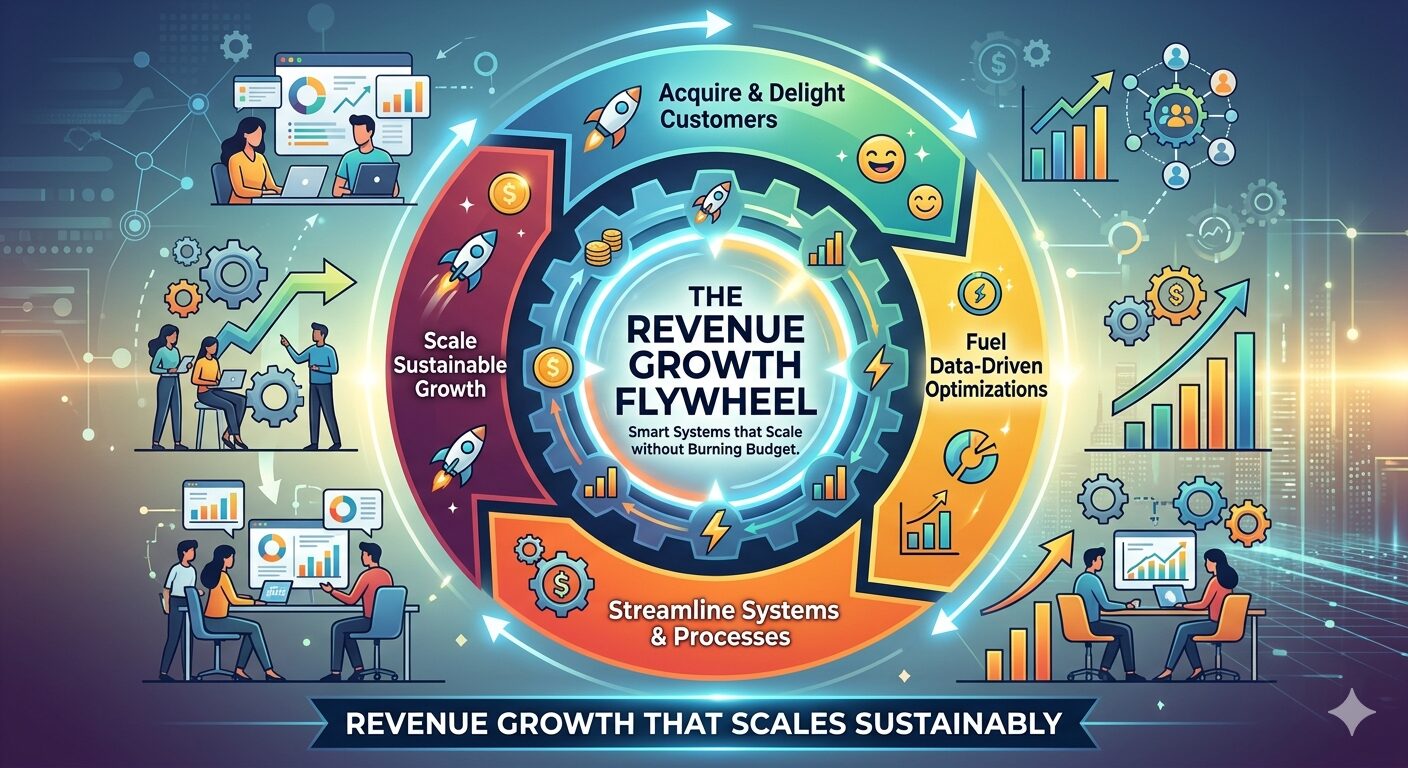
It’s called the Revenue Growth Flywheel.
Unlike traditional marketing funnels that depend on constant input, a flywheel builds momentum. Once it starts moving, every action strengthens the next.
In this article, we’ll break down exactly how modern businesses build and optimize this flywheel to create scalable, predictable revenue.
What Is a Revenue Growth Flywheel?
A revenue flywheel is a system where:
- Traffic generates leads
- Leads convert into customers
- Customers generate revenue
- Revenue fuels reinvestment
- Reinvestment drives more traffic
And the cycle continues.
The key difference from traditional marketing?
Momentum.
Instead of starting from zero every time, each effort builds on the previous one.
Why Traditional Funnels Are Failing
Funnels aren’t broken—but most businesses use them incorrectly.
Here’s what typically happens:
- Ads drive traffic
- Traffic doesn’t convert well
- Budget runs out
- Growth stops
This creates dependency on continuous spending.
Modern businesses need something more durable.
The Core Problem
Most strategies focus on:
- Traffic acquisition only
- Short-term conversions
- Isolated campaigns
What’s missing is integration.
Without integration, your marketing efforts don’t compound.
The 5 Core Components of a Growth Flywheel
To build a scalable system, you need five interconnected layers:
1. Traffic Engine (Attraction Layer)
This is where visibility begins.
Key channels include:
- SEO (long-term, compounding traffic)
- Social media (engagement-driven reach)
- Paid ads (fast, targeted exposure)
The goal is not just traffic—but qualified traffic.
Businesses that scale don’t chase volume. They target intent.
2. Conversion System (Lead Capture Layer)
Traffic without conversion is wasted potential.
Your website should function as a conversion asset, not just a digital brochure.
Essential elements:
- Clear value proposition
- High-converting landing pages
- Lead magnets (guides, offers, tools)
- Strategic CTAs
Every visitor should have a defined next step.
3. Nurture Mechanism (Trust Layer)
Most visitors don’t convert immediately.
That’s where nurturing comes in.
Effective methods include:
- Email sequences
- Retargeting campaigns
- Educational content
This stage builds trust, authority, and familiarity.
Without it, you lose potential customers who were already interested.
4. Revenue Optimization (Sales Layer)
This is where most businesses underperform.
They focus on acquiring customers—but ignore maximizing value.
Revenue optimization includes:
- Upsells and cross-sells
- Pricing strategy
- Conversion rate optimization (CRO)
- Sales funnel refinement
The goal is simple:
Increase revenue per customer.
5. Retention & Expansion (Growth Layer)
The most profitable growth doesn’t come from new customers.
It comes from existing ones.
Retention strategies include:
- Loyalty programs
- Email marketing
- Community building
- Repeat purchase incentives
A strong retention system reduces acquisition pressure and increases lifetime value.
How the Flywheel Creates Compounding Growth
Each component strengthens the others:
- Better content improves SEO
- Better SEO reduces ad spend
- Better conversion increases ROI
- Higher ROI allows reinvestment
- Reinvestment accelerates growth
This creates a system where:
Growth feeds itself.
The Role of Content in the Flywheel
Content is not just a marketing tool—it’s infrastructure.
It supports every stage:
- SEO → Blog articles
- Conversion → Landing pages
- Nurture → Email content
- Authority → Thought leadership
High-performing businesses treat content as a long-term asset, not a short-term campaign.
SEO as the Foundation of Sustainable Growth
Paid ads deliver speed.
SEO delivers sustainability.
When done correctly, SEO:
- Brings consistent organic traffic
- Reduces dependency on paid channels
- Improves brand authority
But most businesses make one mistake:
They focus on keywords, not intent.
Modern SEO requires:
- Strategic content clusters
- Search intent alignment
- Technical optimization
- Authority building through backlinks
Paid Media: Acceleration, Not Dependency
Paid ads are powerful—but only when used correctly.
They should:
- Validate offers
- Scale what’s already working
- Accelerate growth—not replace strategy
If your system isn’t converting organically, ads will only amplify inefficiencies.
Conversion Optimization: The Hidden Multiplier
Improving conversion rates has exponential impact.
Example:
- Traffic: 10,000 visitors
- Conversion rate: 1% → 100 customers
Increase conversion to 2%:
- Same traffic → 200 customers
No additional ad spend required.
This is why CRO is one of the highest ROI activities in digital marketing.
Data-Driven Decision Making
Growth without data is guesswork.
High-performing businesses track:
- Traffic sources
- Conversion rates
- Customer acquisition cost (CAC)
- Lifetime value (LTV)
- Funnel drop-off points
Data turns marketing from experimentation into engineering.
Building a Flywheel: Step-by-Step Framework
Step 1: Define Your Audience
Understand:
- Pain points
- Buying behavior
- Platforms they use
Without this, everything else fails.
Step 2: Build Your Traffic Foundation
Start with:
- SEO-driven content
- Strategic social presence
Focus on consistency, not volume.
Step 3: Optimize Your Website for Conversion
Your website should:
- Communicate value instantly
- Guide users clearly
- Capture leads effectively
Step 4: Implement Nurture Systems
Set up:
- Email sequences
- Retargeting ads
Stay top-of-mind until the user is ready to buy.
Step 5: Improve Revenue Per Customer
Introduce:
- Upsells
- Bundles
- Pricing optimization
Step 6: Strengthen Retention
Focus on:
- Customer experience
- Repeat engagement
- Long-term relationships
Common Mistakes That Kill Growth
Even with the right strategy, execution matters.
Avoid these:
1. Chasing Trends Instead of Strategy
Tactics change. Systems scale.
2. Ignoring Conversion Optimization
Traffic alone doesn’t generate revenue.
3. Over-Reliance on Paid Ads
Without a system, ads become expensive.
4. Inconsistent Content
Growth requires continuity.
5. Lack of Measurement
What isn’t measured can’t be improved.
The Competitive Advantage of Systems
In competitive markets, the winner isn’t the one who spends the most.
It’s the one who builds the best system.
A well-structured growth flywheel:
- Reduces acquisition cost
- Increases efficiency
- Improves scalability
- Creates predictable revenue
Case Insight: How Businesses Scale Efficiently
High-growth businesses share common patterns:
- They invest early in SEO
- They prioritize conversion systems
- They use ads strategically
- They track everything
- They continuously optimize
They don’t rely on luck.
They rely on structure.
The Future of Digital Growth
Marketing is evolving.
What worked five years ago is no longer enough.
Modern growth requires:
- Integration across channels
- Data-backed decision making
- Customer-centric strategies
- Long-term thinking
Businesses that adapt will scale.
Those that don’t will struggle to compete.
Final Thoughts
Growth isn’t about doing more.
It’s about doing the right things—systematically.
The Revenue Growth Flywheel provides a framework that:
- Aligns strategy with execution
- Connects every stage of the customer journey
- Builds momentum over time
Instead of constantly chasing results, you create a system that generates them.
Conclusion
If your current marketing feels inconsistent, expensive, or unpredictable, the issue isn’t effort.
It’s structure.
By shifting from isolated tactics to a flywheel-based system, you transform your marketing into a scalable engine.
One that doesn’t just generate traffic.
But converts, retains, and grows—continuously.