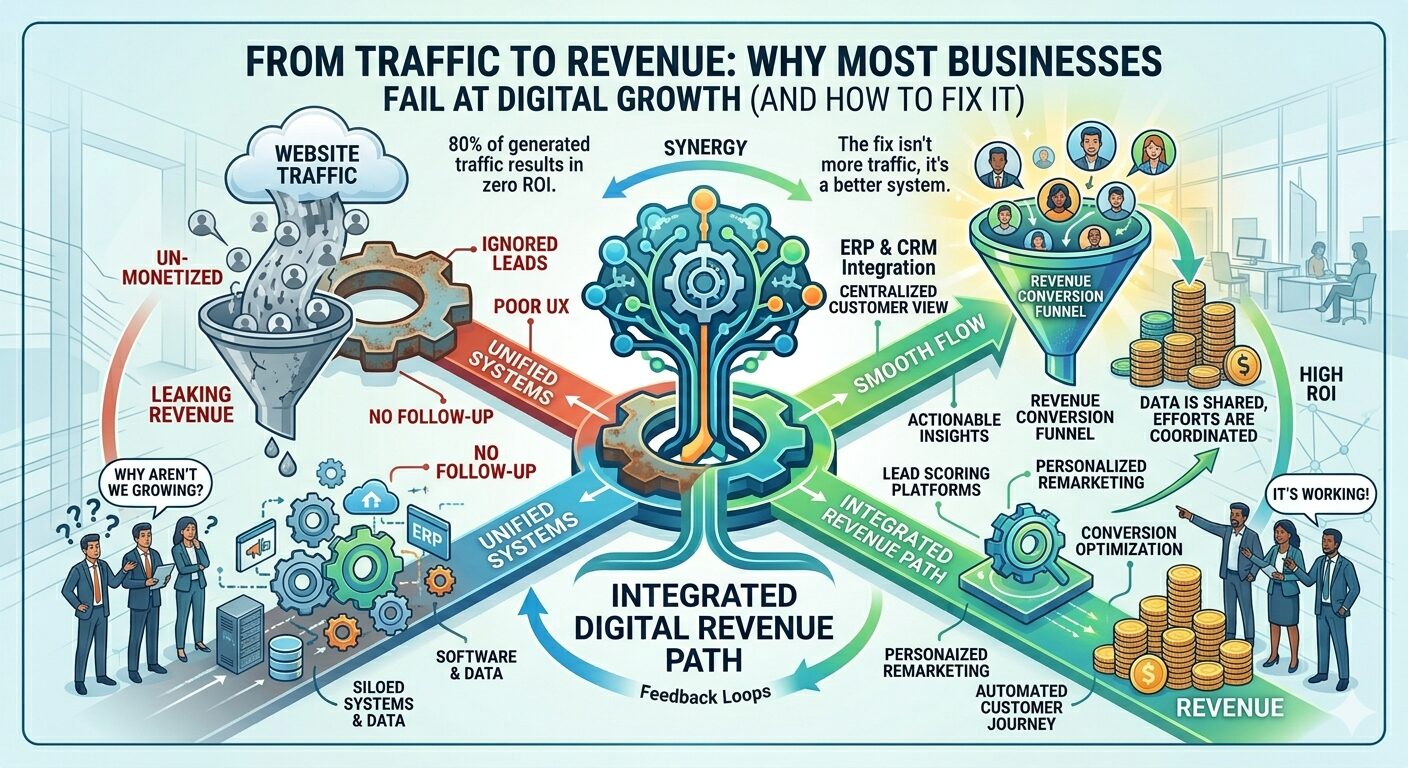
Introduction: The Illusion of Digital Success
Most businesses today believe they are “doing digital marketing.”
They run ads, post on social media, invest in SEO tools, and occasionally publish blog content. On paper, it looks active. On dashboards, it looks busy. But in reality, very few of these activities produce meaningful business growth.
This is the central problem in modern digital marketing: activity is mistaken for progress.
Traffic increases, impressions grow, followers rise—but revenue often stays flat. The gap between visibility and profitability is where most businesses fail.
This article breaks down why that gap exists and how successful businesses systematically close it using structured marketing execution, not random tactics.
1. The Core Problem: Traffic Without Direction
The internet has made attention cheap, but conversion expensive.
Businesses can now generate traffic faster than ever before. But traffic alone does not build a business.
The real issue is not lack of visitors—it is lack of direction after the click.
Most websites and campaigns suffer from three fundamental weaknesses:
- No clear conversion path
- No segmentation of audience intent
- No structured follow-up system
When these three are missing, traffic becomes noise rather than value.
A visitor lands on a page, scrolls briefly, and leaves. The system registers a “visit,” but the business gains nothing.
This is where digital marketing fails most often: it stops at visibility instead of engineering outcomes.
2. The Execution Gap: Where Strategy Breaks Down
Every business today has access to strategies. What they lack is execution consistency.
The execution gap refers to the difference between:
- What businesses plan to do
- What they actually implement consistently
For example:
- SEO strategy exists → but content is irregular
- Paid ads are launched → but not optimized weekly
- Social media is active → but not aligned with conversion goals
- Website exists → but is not structured for sales psychology
This gap silently destroys growth potential.
Execution is not about doing more. It is about doing the right things repeatedly, with measurement and refinement.
Without execution discipline, even the best strategy becomes theoretical.
3. Why Most Marketing Channels Fail to Convert
Let’s break down the common channels and why they underperform when mismanaged.
SEO: Visibility Without Intent Control
SEO is powerful, but most businesses misuse it.
They target keywords for traffic, not intent.
As a result:
- High traffic articles bring irrelevant visitors
- Informational queries dominate instead of transactional ones
- Content attracts readers, not buyers
SEO without intent mapping becomes content farming, not revenue generation.
Paid Ads: Speed Without Structure
Paid advertising is often treated as a shortcut.
But without proper structure:
- Ads attract cold, unqualified traffic
- Landing pages are misaligned with ad messaging
- No retargeting system exists
- Budget is spent on experimentation, not optimization
The result: fast spending, slow returns.
Social Media: Engagement Without Conversion Design
Social platforms reward attention, not business outcomes.
Most brands focus on:
- Likes
- Shares
- Followers
But ignore:
- Click-through systems
- Offer positioning
- Funnel integration
Engagement without conversion design becomes entertainment marketing.
Websites: Digital Brochures Instead of Sales Systems
A website should function as a conversion engine, not a digital brochure.
However, most business websites:
- Explain instead of persuade
- Display instead of guide
- Inform instead of convert
A website without conversion architecture is simply an online identity card.
4. The Real Solution: Building a Conversion System
Successful digital businesses do not rely on channels.
They build systems.
A conversion system consists of four interconnected layers:
1. Attention Layer (Traffic Acquisition)
This includes:
- SEO
- Ads
- Social media
- Content distribution
Goal: Bring the right audience, not just more audience.
2. Trust Layer (Brand Positioning)
This includes:
- Messaging clarity
- Case studies
- Authority content
- Reviews and proof
Goal: Make the visitor believe the business is credible and relevant.
3. Conversion Layer (Offer + Website Structure)
This includes:
- Landing page design
- Offer clarity
- CTA placement
- Psychological triggers
Goal: Convert interest into action.
4. Retention Layer (Follow-Up Systems)
This includes:
- Email marketing
- Retargeting ads
- CRM workflows
- Customer nurturing
Goal: Maximize lifetime value, not just first purchase.
Without all four layers working together, growth becomes unstable.
5. Why Strategy Alone Is Not Enough
Most agencies and consultants sell strategy.
But strategy without execution is documentation, not transformation.
The real differentiator in digital growth is not knowing what to do—it is:
- How fast it is implemented
- How consistently it is optimized
- How tightly it is measured
Businesses often overestimate strategy and underestimate execution discipline.
In reality:
Strategy creates direction. Execution creates revenue.
6. The Role of Data in Real Growth
Modern marketing is not opinion-driven. It is data-driven.
However, most businesses misuse data in three ways:
1. Vanity Metrics Focus
They track:
- Likes
- Followers
- Impressions
Instead of:
- Conversion rate
- Customer acquisition cost
- Lifetime value
2. Delayed Analysis
Data is reviewed monthly or quarterly instead of weekly, causing slow reaction times.
3. No Feedback Loop
Insights are collected but not implemented into campaigns.
Without feedback loops, data becomes reporting, not optimization.
7. The Psychology Behind Conversion
Every conversion system is built on psychology, not just design.
Key psychological triggers include:
- Clarity: Users must understand value within seconds
- Trust: Proof reduces perceived risk
- Urgency: Time-sensitive framing increases action
- Simplicity: Fewer choices improve conversion rates
- Relevance: Message must match intent stage
Most websites fail because they overload the user with information instead of guiding decision-making.
8. The Shift From Marketing to Systems Thinking
The biggest shift in modern business growth is moving from:
“Doing marketing activities”
to
“Building marketing systems”
This means:
- Campaigns are not isolated
- Channels are interconnected
- Data informs decisions continuously
- Growth is engineered, not guessed
Systems thinking removes randomness from marketing.
9. What High-Growth Businesses Do Differently
High-performing businesses do not necessarily spend more.
They execute differently:
- They prioritize conversion over traffic
- They test continuously instead of assuming
- They optimize funnels instead of channels
- They align teams around outcomes, not tasks
- They treat marketing as infrastructure, not campaigns
This is why two companies in the same industry can have completely different outcomes with similar budgets.
10. Practical Framework: Fixing Your Growth System
If a business is stuck, the issue usually lies in one of these areas:
Step 1: Audit Traffic Quality
- Are visitors relevant?
- Which sources convert best?
Step 2: Fix Conversion Bottlenecks
- Landing page clarity
- Offer positioning
- CTA effectiveness
Step 3: Align Messaging Across Channels
- Ads match landing pages
- SEO content matches buyer intent
- Social content matches funnel stage
Step 4: Implement Retention Systems
- Email sequences
- Retargeting campaigns
- Customer segmentation
Step 5: Introduce Weekly Optimization
- Test, measure, refine
- Remove underperforming assets
- Scale what works
Conclusion: Growth Is a System, Not a Guess
Digital marketing is often misunderstood as a collection of tools.
In reality, it is a structured system where every component has a specific role.
Traffic alone does not build businesses. Neither does branding, ads, or SEO in isolation.
Real growth happens when:
- Attention is captured intentionally
- Trust is built systematically
- Conversion is engineered precisely
- Retention is optimized continuously
Businesses that understand this shift stop chasing tactics and start building systems.
And in the long run, systems always outperform campaigns.