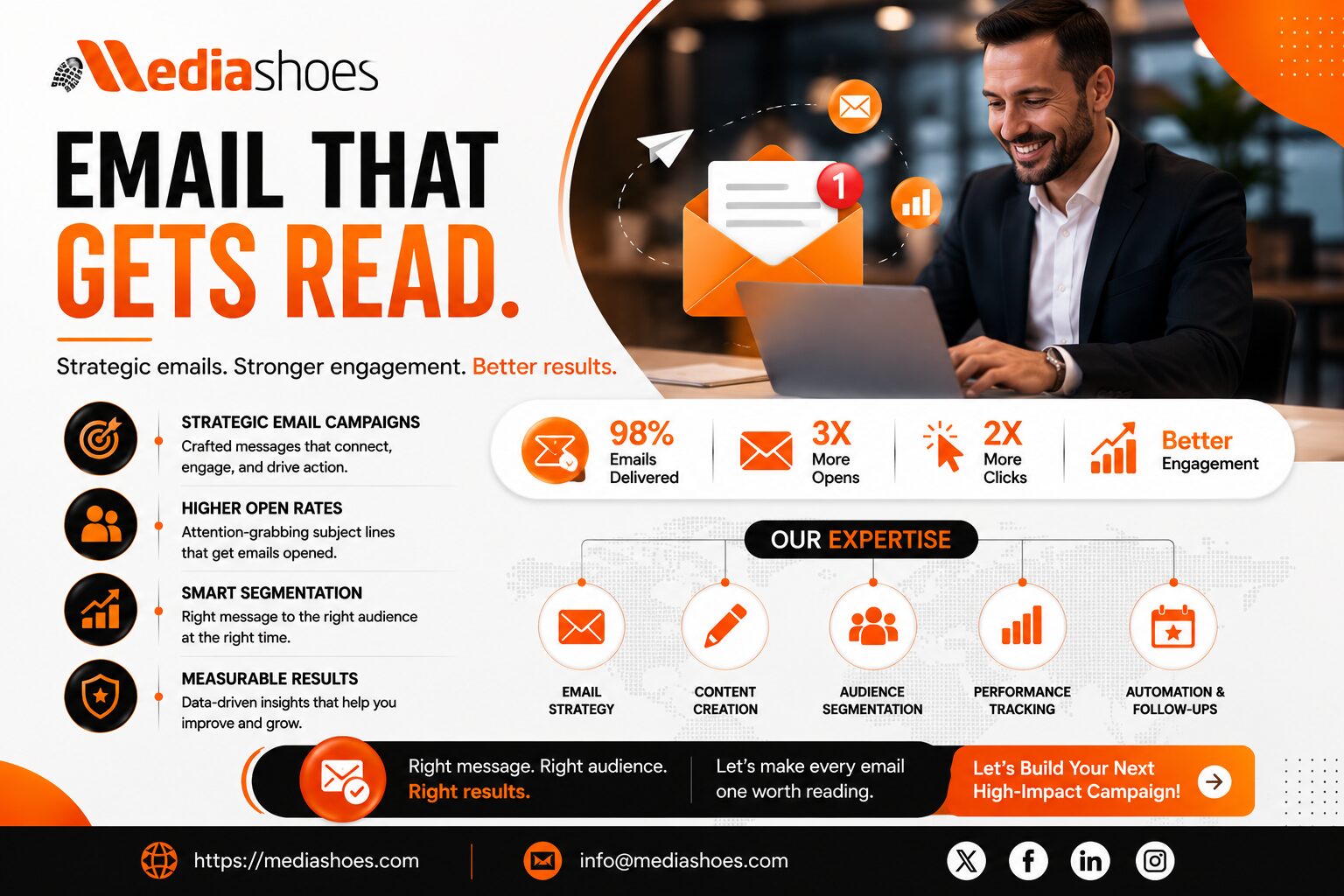
Email That Gets Read: How Strategic Email Campaigns Drive Better Results
Email marketing is still one of the most powerful ways for businesses to connect with their audience. But sending emails is not enough. The real challenge is creating an email that gets read, understood, and acted upon.
Many brands send messages that never get opened, clicked, or remembered. Their emails get lost in crowded inboxes because the subject line is weak, the message is unclear, or the audience is not properly targeted.
This is why strategic email marketing matters.
A successful email campaign is not about sending more emails. It is about sending the right message to the right audience at the right time. When email strategy is planned correctly, it can improve engagement, increase conversions, strengthen customer relationships, and support measurable business growth.
At Mediashoes, email marketing is treated as a performance-driven communication tool. The goal is to create campaigns that are clear, relevant, personalized, and designed to generate better results.
1. Why Email Marketing Still Matters
In a world full of social media posts, paid ads, and short-form content, email remains one of the most direct ways to reach customers. Unlike social media platforms where algorithms control visibility, email gives businesses a more direct communication channel.
When someone joins an email list, they are giving the brand permission to communicate with them. This makes email a valuable space for building trust, sharing offers, educating customers, and encouraging action.
1.1 Email Creates Direct Customer Access
Email allows businesses to speak directly to their audience without waiting for a platform to show the content. This makes it useful for:
- Product updates
- Service promotions
- Customer education
- Lead nurturing
- Event announcements
- Follow-up campaigns
- Re-engagement messages
When used properly, email can become one of the most reliable marketing channels for long-term customer communication.
1.2 Email Supports Better Relationship Building
Good marketing is not only about selling. It is about building relationships. Email helps brands stay connected with customers by sending useful, timely, and relevant content.
When subscribers receive emails that are helpful and valuable, they are more likely to trust the brand and engage with future messages.
2. What Makes an Email Worth Reading?
An email gets read when it gives the recipient a clear reason to open it and continue reading. The message must feel relevant, useful, and easy to understand.
A strong email usually has:
- A clear subject line
- A relevant message
- A simple structure
- A clear call to action
- Audience-focused content
- Professional design
- Measurable purpose
If the reader does not quickly understand why the email matters, they may ignore it.
2.1 The Subject Line Is the First Decision Point
The subject line decides whether the email gets opened or ignored. A weak subject line can damage the performance of the entire campaign.
A strong subject line should be:
- Clear
- Relevant
- Specific
- Interesting
- Honest
- Aligned with the email content
The goal is not to trick people into opening the email. The goal is to create genuine interest.
2.2 The Message Must Be Easy to Understand
Once the email is opened, the content must be simple and clear. Readers should quickly understand what the message is about and what action they should take next.
Long, confusing, or unfocused emails often lose attention. A well-structured email keeps the reader engaged from start to finish.
3. Strategic Email Campaigns: More Than Just Sending Messages
A strategic email campaign is planned with a clear goal. It is not random communication. It is designed to guide the audience toward a specific action or outcome.
Businesses may use email campaigns to:
- Generate leads
- Promote products or services
- Educate customers
- Recover lost customers
- Build brand loyalty
- Increase website traffic
- Support sales follow-ups
Every campaign should have a purpose before it is created.
3.1 Setting a Clear Campaign Goal
Before writing an email, businesses should decide what they want the email to achieve.
Common goals include:
- Get more website visits
- Book more consultations
- Increase product sales
- Encourage sign-ups
- Share important updates
- Improve customer engagement
A clear goal makes it easier to write focused content and measure success later.
3.2 Matching the Email to the Customer Journey
Not every customer is at the same stage. Some people are discovering the brand for the first time. Others are comparing options, ready to buy, or already existing customers.
Email content should match the customer journey.
For example:
- New subscribers may need welcome emails
- Interested leads may need educational emails
- Ready buyers may need offers or reminders
- Existing customers may need updates or loyalty campaigns
This makes the email more relevant and useful.
4. Higher Open Rates Start With Better Relevance
Open rates improve when people believe the email is worth their time. This depends on the sender name, subject line, timing, and audience relevance.
4.1 Send to the Right Audience
If the email is sent to the wrong people, performance will usually be weak. Even a beautifully written email may fail if the audience does not care about the topic.
That is why audience targeting is essential.
4.2 Use Strong Subject Lines
Subject lines should clearly connect with the audience’s needs or interests.
Examples of effective subject line directions include:
- Solving a problem
- Sharing a useful tip
- Highlighting a benefit
- Creating curiosity
- Offering value
- Announcing something relevant
The subject line should make the reader feel that opening the email is worthwhile.
4.3 Keep Sender Trust Strong
People are more likely to open emails from brands they recognize and trust. Consistent branding, useful content, and respectful communication help maintain sender trust.
If subscribers repeatedly receive irrelevant messages, they may stop opening future emails.
5. Smart Segmentation: Right Message, Right Audience
Audience segmentation is one of the most important parts of email marketing. It means dividing the audience into smaller groups based on behavior, interests, location, purchase history, or engagement level.
Segmentation helps businesses send more relevant messages.
5.1 Why Segmentation Matters
Different customers have different needs. A single generic email may not speak to everyone effectively.
Segmentation allows businesses to customize messages based on:
- Customer interests
- Buying behavior
- Location
- Industry
- Previous engagement
- Stage in the sales funnel
- Product or service preference
When emails feel more relevant, engagement improves.
5.2 Personalization Builds Stronger Connection
Personalization is more than adding a first name. It means making the email feel connected to the reader’s needs.
Personalized emails can include relevant offers, recommended services, targeted content, or follow-ups based on previous actions.
This helps the brand communicate in a more meaningful way.
6. Content Creation for Emails That Convert
Email content should be short enough to read easily but strong enough to create action. The message should focus on the reader, not only the brand.
6.1 Write for the Reader
A good email answers the reader’s question: “Why should I care?”
To make the content more effective, businesses should focus on:
- The customer’s problem
- The benefit of the solution
- The value being offered
- The next step the reader should take
This keeps the email practical and action-focused.
6.2 Use a Clear Call to Action
Every marketing email should have a clear call to action. The reader should know exactly what to do next.
Examples include:
- Book a consultation
- Visit the website
- Download a guide
- View the offer
- Reply to the email
- Schedule a call
A clear CTA improves the chance of turning attention into action.
7. Automation and Follow-Ups
Email automation helps businesses send timely messages without manually sending every email. It is useful for follow-ups, lead nurturing, abandoned carts, onboarding, and customer re-engagement.
7.1 Why Follow-Ups Matter
Many people do not take action after the first email. They may be busy, unsure, or not ready yet.
Follow-up emails help continue the conversation.
Good follow-ups can:
- Remind the reader
- Add more value
- Answer common objections
- Encourage action
- Keep the brand visible
Consistent follow-up can improve campaign performance over time.
7.2 Automation Saves Time and Improves Consistency
Automation allows businesses to build email sequences that work in the background.
For example, a new lead may receive:
- A welcome email
- An educational email
- A case study or proof email
- A service explanation email
- A call-to-action email
This creates a more organized and consistent customer journey.
8. Performance Tracking: Measuring What Works
Email marketing should be measured. Without tracking, it is difficult to know what is working and what needs improvement.
Important email metrics include:
- Delivery rate
- Open rate
- Click-through rate
- Conversion rate
- Unsubscribe rate
- Bounce rate
- Reply rate
- Revenue generated
These numbers help businesses improve future campaigns.
8.1 Data Helps Improve Strategy
If open rates are low, the subject line or audience targeting may need improvement. If clicks are low, the email content or CTA may not be strong enough. If conversions are low, the offer or landing page may need work.
Performance tracking turns email marketing into a learning system.
8.2 Better Results Come From Testing
Email campaigns can be improved through testing.
Businesses can test:
- Subject lines
- Email layout
- Call-to-action buttons
- Sending time
- Audience segments
- Offer types
Small improvements can create better results over time.
9. Common Email Marketing Mistakes to Avoid
Email marketing can perform well, but only when it is done properly. Many businesses make mistakes that reduce open rates, clicks, and conversions.
9.1 Sending Without a Strategy
Random emails usually create random results. Every campaign should have a clear goal, audience, message, and CTA.
9.2 Writing Weak Subject Lines
If the subject line does not create interest, the email may never be opened.
9.3 Ignoring Audience Segmentation
Sending the same email to everyone can reduce relevance. Segmentation helps improve engagement.
9.4 Making Emails Too Long or Confusing
Emails should be clear, focused, and easy to read. Too much information can reduce action.
9.5 Not Tracking Results
If results are not measured, the business cannot improve future campaigns.
10. How Mediashoes Helps Brands Create Emails That Get Read
Mediashoes helps businesses plan, write, design, and optimize email campaigns that are built for engagement and measurable results.
The focus is on creating emails that connect with the audience and support business goals.
10.1 Strategic Email Campaigns
Mediashoes helps brands create email campaigns with clear goals, strong messaging, and professional structure.
10.2 Higher Open Rates
Better subject lines, audience targeting, and relevant content help improve the chance of emails being opened.
10.3 Smart Segmentation
Segmentation helps send the right message to the right audience, making campaigns more personal and effective.
10.4 Measurable Results
Performance tracking helps brands understand what is working and how to improve future email campaigns.
10.5 Automation and Follow-Ups
Automated email sequences help businesses stay consistent, save time, and guide leads through the customer journey.
Conclusion: Right Message, Right Audience, Right Results
Email marketing works best when it is strategic, targeted, and easy to understand.
An email that gets read is not created by chance. It is built with a clear subject line, useful content, smart segmentation, strong design, and a clear call to action.
The message is simple: right message, right audience, right results.
At Mediashoes, email campaigns are designed to help brands communicate better, improve engagement, and turn inbox attention into measurable business growth.
If your emails are not getting opened, clicked, or remembered, it may be time to build a smarter email strategy that makes every message worth reading.