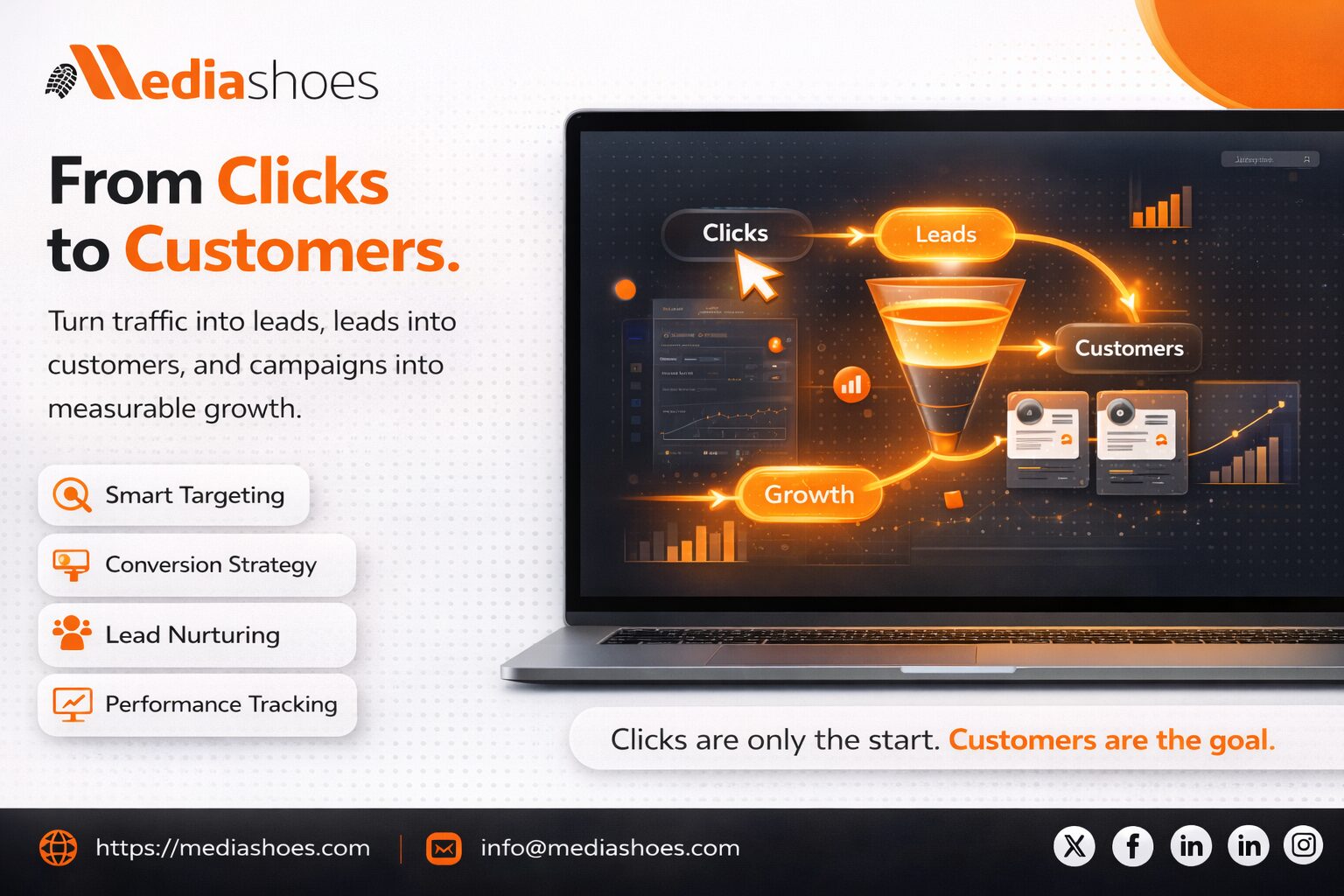
From Clicks to Customers: How Smart Marketing Turns Traffic into Growth
Getting clicks is important, but clicks alone do not grow a business. Real growth happens when those clicks become leads, those leads become customers, and every campaign starts producing measurable results.
This is why the message from clicks to customers matters.
Many businesses spend time and money driving traffic to their website, social media pages, landing pages, or campaigns. But if that traffic does not convert, the business is left with activity instead of results.
At Mediashoes, the focus is not only on creating attention. The goal is to build marketing systems that guide the right audience from interest to action. With smart targeting, conversion strategy, lead nurturing, and performance tracking, brands can turn digital engagement into real business growth.
1. Why Clicks Are Only the Beginning
A click shows interest, but it does not automatically mean a customer is ready to buy. Someone may click because they are curious, comparing options, researching a problem, or exploring a solution.
This is why businesses need a clear strategy after the click.
Without a conversion-focused process, traffic can disappear without producing value. A strong marketing system should guide visitors toward the next step, whether that is submitting a form, booking a call, downloading a resource, making a purchase, or starting a conversation.
1.1 The Problem with Traffic Without Strategy
Traffic without strategy often leads to poor results. A business may receive website visits but still struggle to generate leads or sales.
Common problems include:
- Weak landing pages
- Unclear calls to action
- Poor audience targeting
- Confusing website structure
- Low trust signals
- No follow-up system
- No performance tracking
When these issues are present, clicks may increase but conversions remain low.
2. What Does “From Clicks to Customers” Really Mean?
From clicks to customers means building a marketing journey that turns attention into action. It is about understanding the customer path and making each step clear, useful, and conversion-focused.
This journey usually includes:
- Attracting the right audience
- Sending traffic to the right page
- Communicating a clear offer
- Building trust quickly
- Capturing leads effectively
- Nurturing prospects with follow-up
- Tracking performance and improving results
When this journey is structured properly, marketing becomes more than visibility. It becomes a growth system.
3. Smart Targeting: Reaching the Right Audience
Smart targeting is the foundation of effective conversion marketing. If the wrong people are clicking, the campaign will struggle no matter how beautiful the design is.
The right audience is more likely to understand the offer, engage with the message, and take action.
3.1 Why Targeting Matters
Every business has a specific audience. Marketing works better when campaigns are built around that audience’s needs, problems, goals, and decision-making behavior.
Smart targeting may consider:
- Customer interests
- Location
- Age group
- Buying behavior
- Industry or profession
- Search intent
- Previous engagement
- Customer pain points
When targeting is accurate, campaigns attract more qualified visitors instead of random traffic.
3.2 Better Audience Means Better Conversions
A campaign does not need everyone. It needs the right people.
When the message reaches people who actually need the product or service, the chances of turning clicks into leads and customers become much stronger.
4. Conversion Strategy: Turning Interest into Action
Once the right audience arrives, the next step is conversion. A conversion strategy helps guide visitors toward a clear action.
This can include signing up, requesting a quote, booking a consultation, calling the business, or completing a purchase.
4.1 What Makes a Strong Conversion Strategy?
A strong conversion strategy usually includes:
- A clear offer
- Simple messaging
- Strong call to action
- Trust-building content
- Mobile-friendly design
- Fast-loading pages
- Easy form submission
- Relevant visuals
The easier the next step feels, the more likely visitors are to take action.
4.2 Clear Messaging Improves Results
Visitors should quickly understand what the business offers, why it matters, and what they should do next.
Confusing pages lose attention. Clear pages create confidence.
A strong message answers three questions:
- What is being offered?
- Why should the visitor care?
- What should they do next?
5. Landing Pages That Convert
A landing page is often where clicks become leads. If the landing page is weak, even a good campaign may fail.
A high-performing landing page should be focused, simple, and designed for one main goal.
5.1 Key Elements of a Good Landing Page
A strong landing page may include:
- Clear headline
- Benefit-focused content
- Relevant image or visual
- Trust signals
- Simple form
- Strong call to action
- Customer proof or results
- Mobile optimization
Every section should support the same goal: helping the visitor take the next step.
5.2 Remove Distractions
Too many links, too much text, or unclear buttons can distract visitors. A focused landing page keeps attention on the action that matters most.
Less confusion often leads to better conversions.
6. Lead Nurturing: Turning Leads into Customers
Not every lead becomes a customer immediately. Some people need more information, more trust, or more time before making a decision.
This is where lead nurturing becomes important.
Lead nurturing means staying connected with prospects and guiding them toward a buying decision through useful communication.
6.1 Why Lead Nurturing Matters
Many businesses lose potential customers because they do not follow up properly. A person may show interest once, but without a follow-up system, that opportunity can disappear.
Lead nurturing helps businesses:
- Stay visible
- Build trust
- Answer common questions
- Educate prospects
- Share offers or updates
- Encourage action at the right time
A strong follow-up process can turn warm interest into real customers.
6.2 Email and Retargeting Support the Journey
Email campaigns, remarketing ads, and personalized follow-ups can help keep prospects engaged after the first click.
These touchpoints remind people about the brand and encourage them to return when they are ready to take action.
7. Performance Tracking: Measuring What Works
Marketing should not be based on guesswork. Performance tracking helps businesses understand what is working, what is wasting budget, and what needs improvement.
Without tracking, it is difficult to know which campaigns are producing real results.
7.1 Metrics That Matter
Useful marketing metrics may include:
- Website traffic
- Click-through rate
- Cost per click
- Lead conversion rate
- Cost per lead
- Customer conversion rate
- Return on ad spend
- Sales generated
These metrics help businesses understand the full journey from click to customer.
7.2 Data Helps Improve Campaigns
When performance is tracked, campaigns can be improved over time. If clicks are high but leads are low, the landing page may need work. If leads are high but sales are low, the follow-up process may need improvement.
Data helps businesses make smarter decisions and create better results.
8. Why Clicks Do Not Always Convert
Many campaigns attract attention but fail to turn that attention into customers. Understanding why this happens is important for improving results.
Common reasons include:
- The audience is too broad
- The offer is unclear
- The landing page is weak
- The call to action is not strong
- The website loads slowly
- There is no trust-building content
- The follow-up process is missing
- Results are not being tracked properly
Fixing these issues can help businesses move from traffic to measurable growth.
9. How Mediashoes Helps Turn Clicks into Customers
Mediashoes helps businesses build marketing systems that focus on results, not just activity. The goal is to create campaigns that attract the right audience, communicate clearly, and guide people toward action.
9.1 Smart Targeting
Mediashoes helps brands reach the people most likely to engage, inquire, and buy.
9.2 Conversion Strategy
Strong conversion strategy helps turn website visitors and campaign traffic into real leads and customers.
9.3 Lead Nurturing
Follow-up systems help keep prospects engaged until they are ready to take action.
9.4 Performance Tracking
Tracking results helps improve campaigns, reduce wasted spend, and support measurable growth.
10. Benefits of Conversion-Focused Marketing
Conversion-focused marketing creates value because it connects traffic with business outcomes. Instead of only measuring clicks, businesses can measure leads, customers, and growth.
Key benefits include:
- Better lead quality
- Improved customer acquisition
- Stronger campaign performance
- Reduced wasted budget
- Clearer marketing decisions
- More measurable results
- Stronger business growth
When marketing is built around conversion, every campaign becomes more purposeful.
Conclusion: Customers Are the Goal
Clicks are valuable, but they are only the starting point. The real goal is to turn attention into leads, leads into customers, and campaigns into measurable growth.
The message is simple: from clicks to customers.
With smart targeting, conversion strategy, lead nurturing, and performance tracking, businesses can build marketing that does more than attract traffic. They can build marketing that creates results.
At Mediashoes, the focus is on helping brands move beyond clicks and build campaigns that turn interest into action.
Clicks are only the start. Customers are the goal.