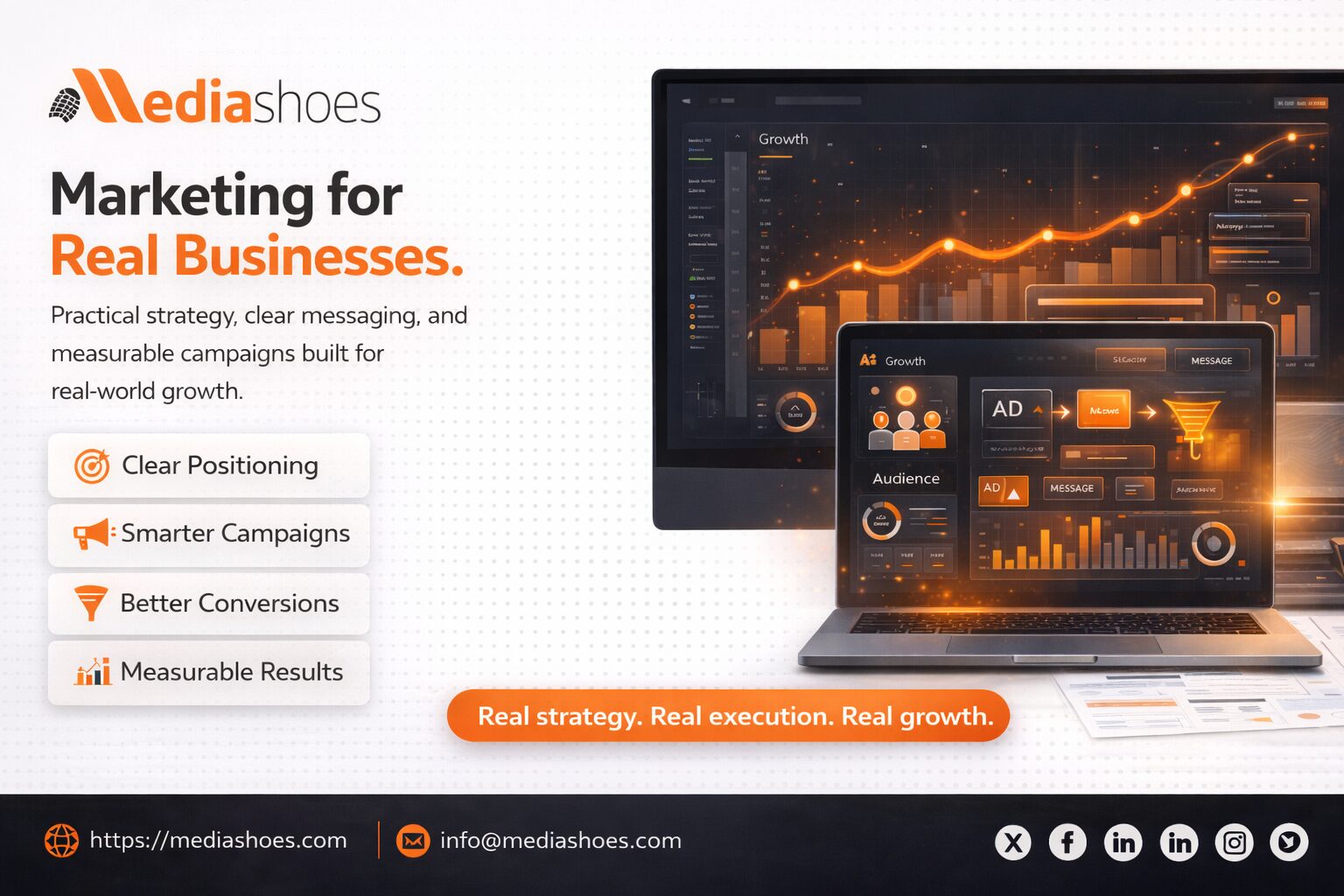
Marketing for Real Businesses: Practical Strategy That Drives Real Growth
Marketing should not feel confusing, complicated, or disconnected from real business goals. For many companies, the challenge is not simply getting attention online. The real challenge is turning that attention into trust, leads, customers, and measurable growth.
This is why the message marketing for real businesses matters.
Real businesses need practical marketing that supports real-world outcomes. They need clear positioning, smarter campaigns, better conversions, and measurable results. Beautiful designs and high traffic numbers are useful, but they only matter when they help the business move forward.
At Mediashoes, the focus is on building marketing that is practical, strategic, and connected to growth. The goal is simple: real strategy, real execution, and real growth.
1. What Does Marketing for Real Businesses Mean?
Marketing for real businesses means creating campaigns that are built around actual business needs. It is not about chasing trends or posting content without direction. It is about understanding the business, the audience, the offer, and the outcome the company wants to achieve.
A real business needs marketing that can help with:
- Increasing brand awareness
- Building customer trust
- Generating quality leads
- Improving conversions
- Supporting sales activity
- Strengthening online visibility
- Measuring performance clearly
When marketing is connected to these goals, it becomes a growth tool instead of just a digital activity.
2. Why Businesses Need Practical Strategy
Many businesses invest in marketing without a clear strategy. They run ads, post on social media, update their website, or create content, but they may not know whether those actions are moving the business closer to its goals.
Practical strategy helps solve this problem.
A strong marketing strategy gives direction. It explains who the business is targeting, what message should be used, which channels matter, and how success will be measured.
2.1 Strategy Creates Focus
Without strategy, marketing can become scattered. A business may spend time and budget on channels that do not bring the right audience or create meaningful results.
With strategy, every campaign has a purpose.
A practical marketing strategy helps define:
- The target audience
- The core message
- The strongest offer
- The right marketing channels
- The conversion journey
- The performance metrics
This creates a clear foundation for smarter marketing decisions.
3. Clear Positioning Helps Customers Understand You
Clear positioning is one of the most important parts of effective marketing. If people do not understand what a business offers, why it matters, and why they should choose it, they are less likely to take action.
Positioning is the way a business presents its value to the market.
3.1 Why Clear Positioning Matters
Customers are often comparing different options. They want to know which business understands their problem and can provide the right solution.
Clear positioning helps answer important questions:
- What does the business do?
- Who does it help?
- What problem does it solve?
- Why is it different?
- What result can customers expect?
When these answers are clear, customers can make decisions with more confidence.
3.2 Confused Messaging Reduces Results
If the message is unclear, people may leave the website, ignore the ad, or scroll past the post. Clear messaging makes marketing easier to understand and easier to trust.
Strong positioning gives the business a stronger voice in the market.
4. Smarter Campaigns Reach the Right People
Marketing campaigns should not be created just to stay active online. They should be designed to reach the right audience with the right message at the right time.
Smarter campaigns are built around audience understanding, clear goals, and measurable action.
4.1 What Makes a Campaign Smarter?
A smarter campaign usually includes:
- Clear campaign objective
- Defined audience targeting
- Strong creative direction
- Relevant message
- Conversion-focused landing page
- Tracking and reporting
- Performance improvement over time
This approach helps businesses avoid wasted effort and focus on campaigns that support real growth.
4.2 Better Targeting Improves Campaign Quality
Not every person is the right customer. Smarter campaigns focus on the people most likely to need the product or service.
When targeting improves, marketing can attract better traffic, stronger leads, and more meaningful engagement.
5. Better Conversions Turn Interest into Action
Getting attention is only the first step. The real goal is to turn interest into action.
Better conversions happen when customers understand the offer, trust the business, and know exactly what to do next.
5.1 Why Conversion Strategy Matters
A business may receive traffic but still fail to generate leads or sales. This usually happens when the customer journey is unclear or the page does not encourage action.
Conversion strategy helps improve:
- Website inquiries
- Form submissions
- Phone calls
- Bookings
- Product purchases
- Email signups
- Consultation requests
Every marketing campaign should guide the audience toward a clear next step.
5.2 Strong Calls to Action Make a Difference
A call to action tells users what to do next. It should be simple, visible, and aligned with the customer journey.
Examples include:
- Book a consultation
- Request a quote
- Speak to our team
- Get started today
- Learn more
When the next step is clear, customers are more likely to act.
6. Measurable Results Make Marketing More Valuable
Marketing should be measured. Without measurement, it is difficult to know what is working and what needs improvement.
Measurable results help businesses make better decisions and use their budget more wisely.
6.1 Important Marketing Metrics
Depending on the campaign, useful metrics may include:
- Website traffic
- Lead volume
- Conversion rate
- Cost per lead
- Click-through rate
- Engagement rate
- Return on ad spend
- Customer acquisition cost
- Sales generated
These numbers help businesses understand campaign performance and identify opportunities for improvement.
6.2 Data Helps Improve Growth
Marketing is not a one-time action. It should improve over time. When data is tracked properly, businesses can adjust campaigns, refine messaging, improve targeting, and increase conversion performance.
Better data leads to better decisions.
7. Real Businesses Need Real Execution
Strategy is important, but execution is what creates results. A plan only becomes valuable when it is implemented consistently and professionally.
Real execution means turning ideas into campaigns, campaigns into leads, and leads into business opportunities.
7.1 What Strong Execution Includes
Strong marketing execution may include:
- Consistent brand messaging
- Professional design
- Clear content creation
- Campaign setup
- Landing page optimization
- Social media activity
- Search visibility improvements
- Performance tracking
When execution is consistent, marketing becomes more reliable and more effective.
8. Common Marketing Mistakes Real Businesses Should Avoid
Many businesses struggle with marketing because they repeat common mistakes. These mistakes can waste time, reduce performance, and make growth harder.
Common mistakes include:
- Marketing without a clear strategy
- Using unclear messaging
- Targeting too broad an audience
- Ignoring conversion optimization
- Posting without purpose
- Not tracking campaign results
- Changing direction too often
- Focusing on vanity metrics instead of business outcomes
These mistakes can be avoided with a more structured and practical approach.
9. How Mediashoes Helps Real Businesses Grow
Mediashoes helps businesses create marketing that is practical, clear, and measurable. The focus is on building campaigns that support real-world business growth rather than empty activity.
9.1 Clear Positioning
Mediashoes helps businesses communicate what they do, who they help, and why customers should choose them.
9.2 Smarter Campaigns
Campaigns are built around the right audience, clear messaging, and measurable goals.
9.3 Better Conversions
Marketing should guide people toward action. Mediashoes focuses on improving the customer journey so more visitors become leads or customers.
9.4 Measurable Results
Performance tracking helps businesses understand what is working and how campaigns can be improved.
10. Benefits of Practical Marketing for Real Businesses
Practical marketing creates value because it connects brand visibility with actual business outcomes.
Key benefits include:
- Clearer brand message
- Better audience targeting
- Stronger campaign performance
- Improved lead generation
- Better conversion rates
- More confident marketing decisions
- Measurable business growth
When marketing is built properly, it becomes easier for businesses to grow with confidence.
Conclusion: Real Strategy. Real Execution. Real Growth.
Marketing for real businesses should be practical, focused, and measurable. It should help companies communicate clearly, reach the right audience, convert interest into action, and understand what is driving growth.
The message is simple: marketing for real businesses must create real results.
With clear positioning, smarter campaigns, better conversions, and measurable results, businesses can move beyond random marketing activity and build a stronger path to growth.
At Mediashoes, the goal is to help brands grow with practical strategy, clear messaging, and campaigns that support real-world outcomes.
Real strategy. Real execution. Real growth.