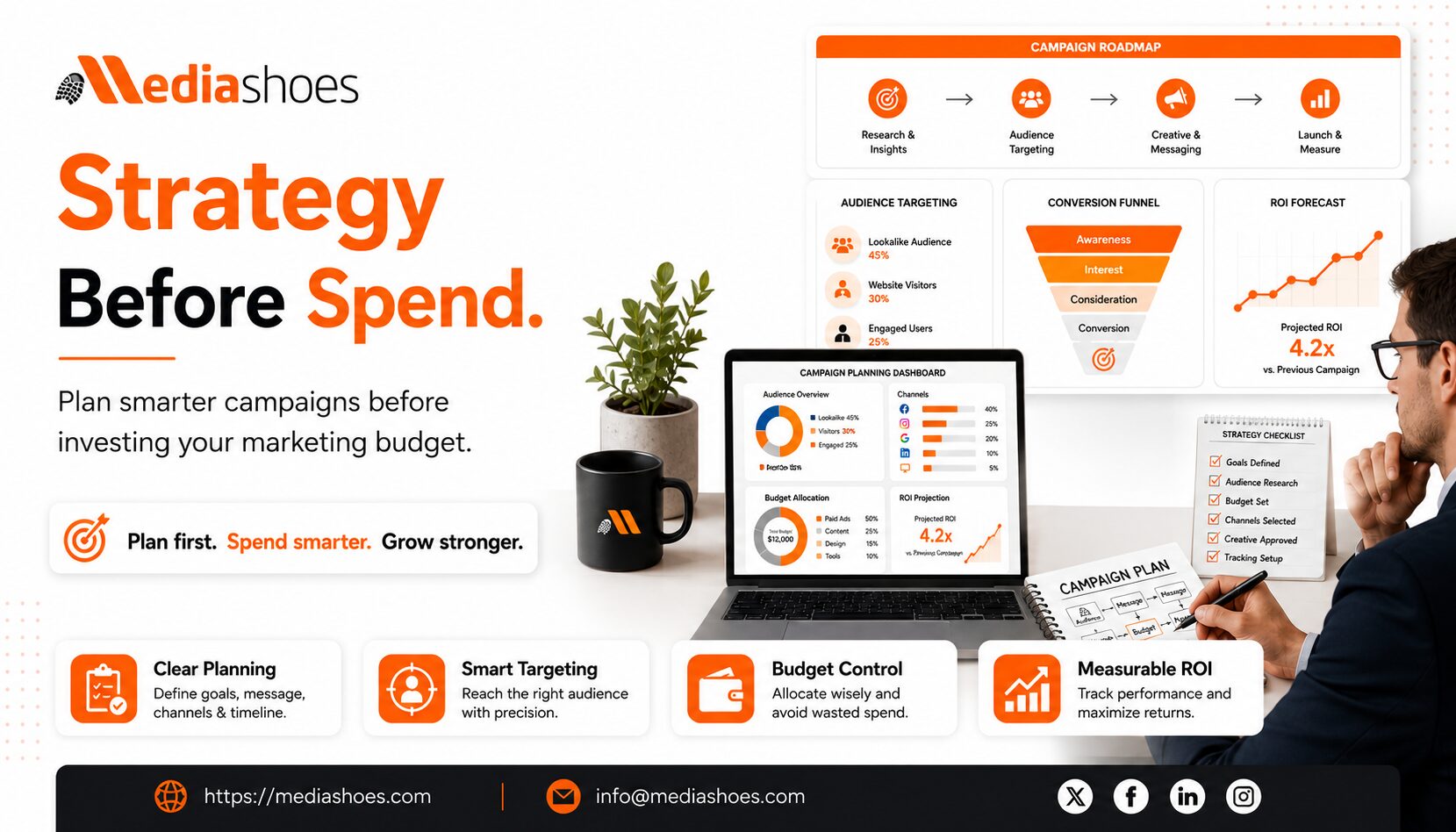
Strategy Before Spend: How Smart Planning Makes Marketing Budgets Work Harder
Marketing spend can create growth, but only when it is guided by a clear strategy. Many businesses invest in ads, content, social media, or campaigns before fully understanding their audience, message, goals, and expected return. This often leads to wasted budget and disappointing results.
This is why the message strategy before spend matters.
Before investing money into marketing, a business needs a plan. That plan should define who the campaign is for, what message will be used, which channels matter, how the budget will be allocated, and how success will be measured.
At Mediashoes, the focus is on helping businesses plan smarter campaigns before spending their marketing budget. With clear planning, smart targeting, budget control, and measurable ROI, marketing becomes more strategic, more focused, and more effective.
1. Why Strategy Should Come Before Marketing Spend
Spending money on marketing without strategy is like driving without a map. You may move forward, but you may not reach the right destination.
A strong strategy helps businesses avoid random decisions and focus on campaigns that support real business goals.
Marketing strategy helps define:
- Who the target audience is
- What problem the campaign solves
- Which message will attract attention
- Which channels should be used
- How the budget should be distributed
- What results should be measured
When these areas are clear before spending begins, campaigns have a much stronger chance of producing meaningful results.
2. The Problem with Spending Without a Plan
Many businesses start marketing by asking, “How much should we spend?” But the better question is, “What are we trying to achieve, and what strategy will get us there?”
Without a plan, marketing spend can become scattered across too many platforms, weak messages, or poorly targeted campaigns.
Common problems include:
- Running ads without clear goals
- Targeting the wrong audience
- Using unclear messaging
- Sending traffic to weak landing pages
- Not tracking conversions properly
- Spending budget on channels that do not perform
- Measuring activity instead of business outcomes
These issues can make marketing feel expensive without creating enough return.
3. Clear Planning Creates Better Campaign Direction
Clear planning is the foundation of effective marketing. It helps businesses understand what they want to achieve and how each campaign will support that goal.
A clear plan gives direction to creative work, audience targeting, budget allocation, and performance tracking.
3.1 What Clear Planning Includes
Strong campaign planning usually includes:
- Campaign objectives
- Target audience profile
- Core message
- Offer or call to action
- Marketing channels
- Campaign timeline
- Budget allocation
- Tracking setup
When the campaign is planned properly, every action has a purpose.
4. Smart Targeting Helps Reach the Right Audience
A campaign does not need to reach everyone. It needs to reach the right people.
Smart targeting helps businesses focus their marketing budget on audiences that are more likely to care, engage, and take action.
4.1 Why Smart Targeting Matters
Poor targeting can waste budget quickly. If the wrong people see the campaign, the business may receive clicks, but not meaningful leads or customers.
Smart targeting can be based on:
- Customer interests
- Location
- Search intent
- Buying behavior
- Industry or profession
- Website visitors
- Lookalike audiences
- Previous engagement
Better targeting helps businesses spend smarter and improve campaign quality.
5. Budget Control Prevents Wasted Spend
Marketing budget should be controlled, not guessed. Every pound, dollar, or euro should have a purpose inside the campaign plan.
Budget control helps businesses understand where money is going and whether that spend is producing results.
5.1 How Budget Control Improves Campaigns
Budget control helps businesses:
- Allocate spend to the right channels
- Avoid overspending on weak campaigns
- Test campaigns before scaling
- Compare channel performance
- Improve return on investment
- Make better marketing decisions
When budget is managed carefully, businesses can reduce waste and invest more confidently in what works.
6. Measurable ROI Turns Marketing into a Growth System
Marketing should not be measured only by likes, clicks, or impressions. These numbers can be useful, but they do not always show business impact.
Measurable ROI helps businesses understand whether their campaigns are creating real value.
6.1 Important ROI Metrics
Useful marketing performance metrics may include:
- Leads generated
- Cost per lead
- Conversion rate
- Customer acquisition cost
- Sales generated
- Return on ad spend
- Landing page performance
- Revenue from campaigns
When ROI is tracked clearly, marketing becomes easier to improve and scale.
7. Campaign Roadmaps Make Execution Easier
A campaign roadmap gives structure to the entire marketing process. It shows what needs to happen first, what comes next, and how each step connects to the final result.
A useful campaign roadmap may include:
- Research and insights
- Audience targeting
- Creative and messaging
- Landing page preparation
- Campaign launch
- Performance tracking
- Optimization
With a roadmap, campaigns become more organized and less reactive.
8. Better Strategy Improves Better Spending Decisions
Strategy helps businesses decide where to spend, how much to spend, and when to scale. Instead of spending based on assumptions, businesses can use data and planning to make smarter decisions.
A strong strategy helps answer:
- Which audience should we target?
- Which message is most likely to convert?
- Which platform is most suitable?
- What budget should we test first?
- What result will define success?
When these answers are clear, marketing spend becomes more focused and more productive.
9. How Mediashoes Helps Businesses Plan Before They Spend
Mediashoes helps businesses create campaigns that are practical, strategic, and measurable. The goal is to make sure marketing budget is supported by clear thinking before money is invested.
9.1 Clear Planning
Mediashoes helps define campaign goals, messaging, channels, and timelines before campaigns go live.
9.2 Smart Targeting
Audience targeting helps campaigns reach the people most likely to engage, convert, and become customers.
9.3 Budget Control
Budget planning helps businesses spend wisely, avoid waste, and focus on the channels that support growth.
9.4 Measurable ROI
Tracking and reporting help businesses understand what works, what needs improvement, and where to invest next.
10. Benefits of Strategy Before Spend
Putting strategy before spend creates stronger marketing decisions and better campaign outcomes.
Key benefits include:
- Clearer campaign direction
- Better audience targeting
- Reduced wasted budget
- Stronger messaging
- Improved conversions
- More accurate tracking
- Better return on investment
- More confident marketing decisions
When strategy comes first, marketing becomes easier to manage and easier to grow.
Conclusion: Plan First, Spend Smarter, Grow Stronger
Marketing budget should not be spent without direction. Every campaign needs a clear plan, a defined audience, a strong message, controlled budget, and measurable results.
The message is simple: strategy before spend.
With clear planning, smart targeting, budget control, and measurable ROI, businesses can make better marketing decisions and create stronger growth outcomes.
At Mediashoes, the focus is on helping businesses plan smarter campaigns before investing their marketing budget.
Plan first. Spend smarter. Grow stronger.