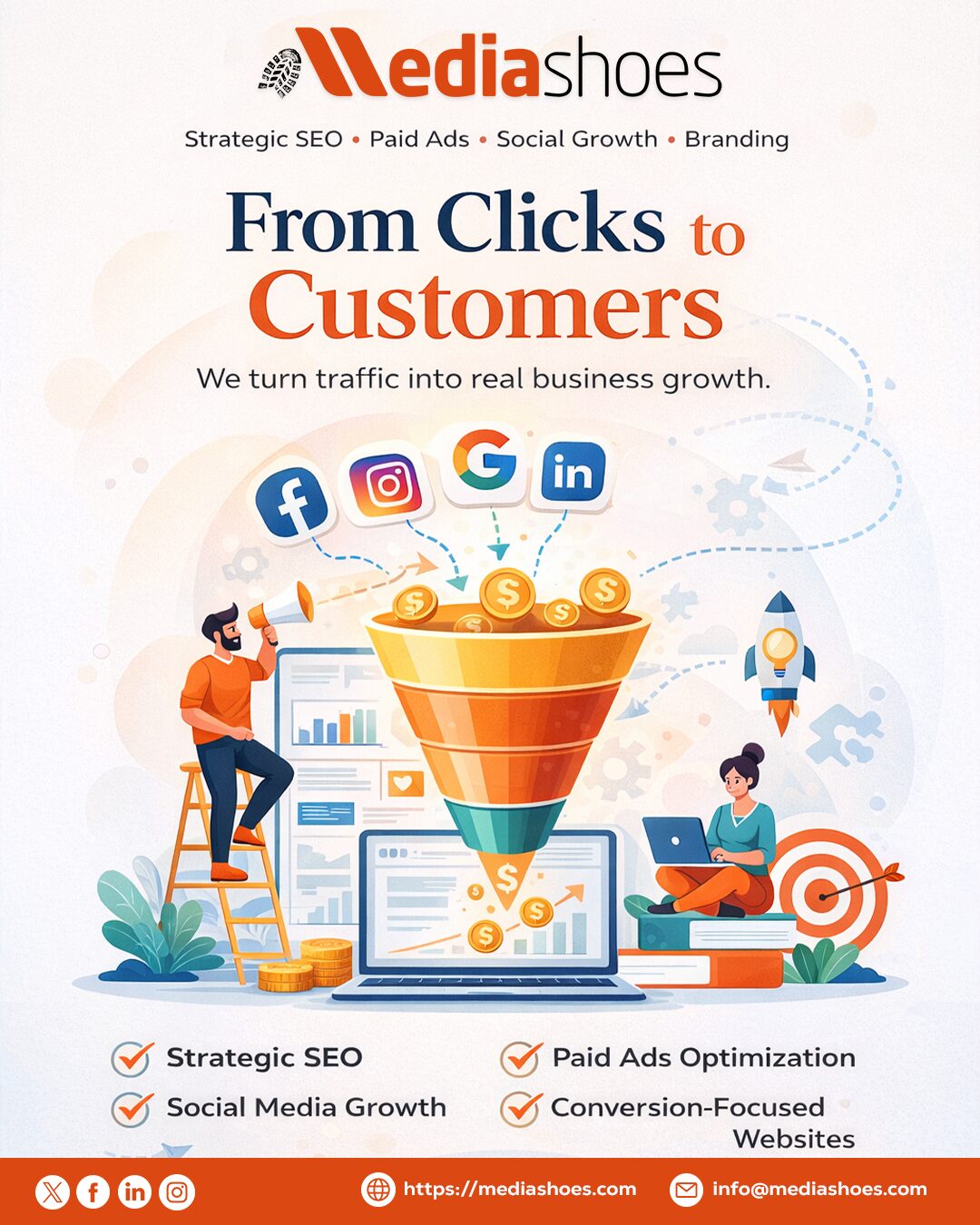
In digital marketing, clicks are easy to celebrate. Higher traffic numbers, growing impressions, and increasing engagement can feel like clear signs of progress. But clicks alone do not grow a business. Revenue does.
Driving traffic is only the first step. The real challenge — and the real opportunity — lies in turning that traffic into paying customers. From clicks to customers is where strategy, structure, and execution make the difference. At MediaShoes, the focus is not just on generating visitors, but on converting those visitors into measurable revenue.
Why Traffic Alone Is Not Enough
Many businesses invest heavily in campaigns designed to increase traffic. They optimize for reach, impressions, and click-through rates. While visibility is important, it does not guarantee profitability.
A website can attract thousands of visitors every month and still struggle to generate enquiries or sales. Without a clear conversion strategy, traffic becomes a vanity metric rather than a business asset.
The real question is not how many people click. It is how many of those clicks turn into action.
Understanding the Conversion Gap
The gap between clicks and customers is where many marketing strategies fail. Visitors may show interest by clicking on an ad or search result, but interest alone does not translate into commitment.
Several factors contribute to this gap:
-
Unclear messaging
-
Weak value propositions
-
Poor user experience
-
Lack of trust signals
-
Complicated purchase processes
When these elements are not aligned, potential customers leave without converting.
Bridging this gap requires more than traffic generation. It requires a system designed for conversion.
Aligning Traffic With Intent
Not all traffic is equal. High-quality traffic comes from users with clear intent. Someone actively searching for a solution is far more likely to convert than someone casually browsing.
Effective marketing strategies prioritize targeted traffic. This includes optimizing for high-intent keywords, refining audience targeting in paid campaigns, and creating content that aligns with user needs.
When traffic aligns with intent, conversion becomes significantly easier.
Crafting Landing Pages That Convert
A click leads to a landing page. What happens next determines whether that visitor becomes a customer.
High-converting landing pages share common characteristics. They communicate value immediately. They address the visitor’s problem clearly. They present benefits in a concise and compelling way. Most importantly, they guide the user toward a specific next step.
Strong calls to action are essential. Whether the goal is booking a consultation, requesting a quote, or completing a purchase, the path should be obvious and friction-free.
Design also plays a role. Clean layouts, logical flow, and mobile responsiveness improve user experience and reduce drop-off rates.
Messaging That Builds Confidence
Conversion depends heavily on trust. Visitors need reassurance that they are making the right decision.
Clear messaging reduces uncertainty. Instead of focusing solely on features, effective messaging highlights outcomes. It answers the question: “What will I gain from this?”
Testimonials, case studies, and social proof strengthen credibility. When visitors see that others have had positive experiences, confidence increases.
Trust is the bridge between interest and action.
Optimizing the Customer Journey
Turning clicks into customers requires understanding the full customer journey. A single interaction rarely results in immediate conversion. Instead, customers often engage multiple times before committing.
A well-structured funnel supports this process. Top-of-funnel content attracts awareness. Middle-of-funnel content educates and nurtures interest. Bottom-of-funnel elements encourage decision-making.
Email sequences, retargeting ads, and personalized follow-ups help maintain engagement. By staying connected to potential customers throughout their journey, businesses increase the likelihood of conversion.
Measuring What Matters
To move from clicks to customers effectively, performance must be measurable. Traffic numbers alone are not enough. The focus should be on metrics that reflect real business impact.
Key indicators include conversion rate, cost per acquisition, average order value, and customer lifetime value. These metrics reveal how effectively traffic is being monetized.
Data-driven insights allow marketers to refine campaigns continuously. Small improvements in conversion rate can lead to significant revenue growth over time.
Continuous Testing and Improvement
Conversion optimization is not a one-time effort. It requires ongoing testing and adjustment.
Testing headlines, calls to action, page layouts, and messaging can uncover opportunities for improvement. Even minor changes can produce measurable differences in performance.
By consistently analyzing results and refining strategies, businesses can steadily increase the percentage of visitors who become customers.
Integrating Strategy, Design, and Performance
Successful conversion does not rely on a single element. It is the result of aligned strategy, persuasive messaging, and optimized design working together.
Traffic generation must connect seamlessly with landing page experience. Messaging must align with audience intent. Calls to action must reflect business goals.
When these elements function as a unified system, clicks become more than numbers. They become opportunities.
Building Revenue-Focused Marketing Systems
Businesses that prioritize revenue over vanity metrics approach marketing differently. They do not measure success by impressions alone. They evaluate how effectively marketing supports growth.
Revenue-focused systems are structured around measurable outcomes. Campaigns are designed with conversion in mind from the beginning. Performance is tracked consistently. Adjustments are made based on data.
This structured approach transforms marketing into a reliable engine for predictable growth.
How MediaShoes Turns Traffic Into Revenue
At MediaShoes, the focus extends beyond generating visibility. Traffic strategies are aligned with conversion objectives from the outset.
Campaigns are built around high-intent targeting. Websites are optimized for clarity and usability. Messaging emphasizes value and trust. Performance is measured against real business metrics, not surface-level activity.
By combining targeted traffic, persuasive design, and data-driven optimization, the path from clicks to customers becomes clear and scalable.
Final Thoughts
Clicks represent potential. Customers represent results.
Driving traffic is important, but it is only the beginning. Sustainable growth happens when that traffic is converted into revenue through strategic alignment, compelling messaging, and continuous optimization.
From clicks to customers is not a slogan. It is a disciplined approach to digital marketing. When businesses focus on turning attention into action, marketing becomes measurable, scalable, and profitable.
In a competitive digital environment, traffic alone is not enough. The real advantage lies in transforming those clicks into lasting customer relationships and consistent revenue.