

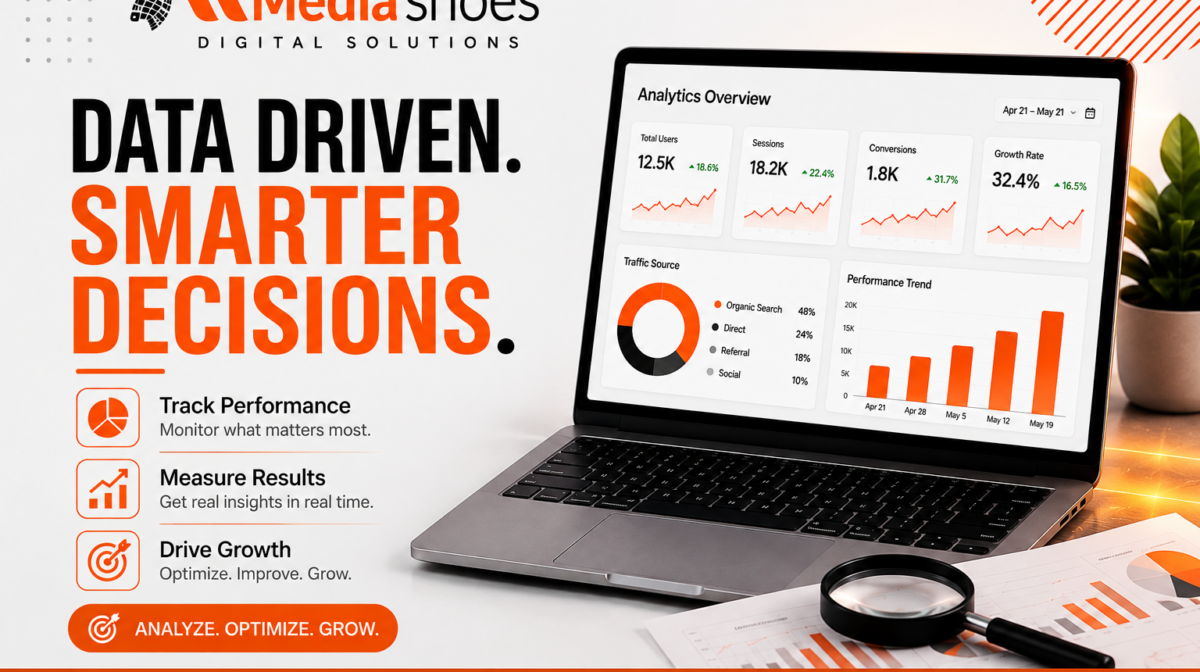
Modern marketing generates more data than ever before. The real competitive advantage comes from knowing which numbers matter, what they reveal about customer behaviour, and how to turn those insights into smarter decisions that improve performance and drive sustainable growth.
📑 Table of Contents
- What Is Data-Driven Marketing?
- Why Marketing Data Matters
- From Data Collection to Business Decisions
- Essential Marketing Metrics to Track
- Understanding Marketing Attribution
- How Analytics Improves Campaign Performance
- Using Data Across Digital Marketing Channels
- Common Analytics Mistakes
- Building a Data-Driven Marketing Strategy
- Frequently Asked Questions
What Is Data-Driven Marketing?
Data-driven marketing is an approach in which marketing decisions are guided by measurable information rather than assumptions alone. Businesses collect and analyse relevant information from websites, search engines, advertising platforms, email campaigns, social media, CRM systems, and customer interactions to understand what is actually driving performance.
The objective is not simply to collect more information. It is to turn useful data into clear, practical decisions.
For example, instead of assuming that a campaign is successful because it receives a large number of clicks, a data-driven team looks deeper. How many visitors became qualified leads? What did each lead cost? Which landing page converted best? Which traffic source generated customers rather than casual visitors?
💡 The Core Principle
Good marketing analytics connects activity to outcomes. Instead of asking, “How much engagement did we get?” businesses should also ask, “What did that engagement contribute to our goals?”
Why Marketing Data Matters More Than Ever
Customers rarely move from discovering a brand to making a purchase in a single step. They may find a business through organic search, read an article, return through social media, open an email, compare alternatives, and finally convert through another channel.
Without measurement, much of this journey remains invisible. Analytics helps businesses understand how different touchpoints contribute to results and where potential customers encounter friction.
📊 Track Performance
Understand how websites, campaigns, content, and marketing channels are performing against meaningful objectives.
📈 Measure Results
Connect marketing activity with leads, conversions, revenue, acquisition costs, and other business outcomes.
🎯 Drive Growth
Use evidence to prioritise high-performing activities and continuously improve weaker areas.
From Data Collection to Smarter Decisions
A successful analytics strategy follows a continuous cycle. Businesses define what success looks like, collect relevant information, analyse performance, take action, and then measure whether those changes produced better results.
Analyze. Optimize. Grow.
- Define: Establish clear marketing and business objectives.
- Measure: Collect reliable data linked to those objectives.
- Analyse: Identify trends, problems, and opportunities.
- Optimise: Make evidence-based improvements.
- Review: Measure the impact and continue refining.
This process prevents analytics from becoming a collection of dashboards that nobody acts upon. Every important metric should help answer a business question or support a decision.
Essential Marketing Metrics Every Business Should Track
There is no single perfect set of metrics for every organisation. The right KPIs depend on the business model, marketing channels, customer journey, and commercial objectives.
However, several measurements can provide a useful foundation for understanding digital marketing performance.
| Metric | What It Helps Measure |
|---|---|
| Website Traffic | Overall visitor volume and audience development. |
| Traffic Source | Where visitors originate, such as organic search, paid campaigns, referrals, or social media. |
| Conversion Rate | The percentage of visitors who complete a desired action. |
| Cost Per Lead | How efficiently marketing spend generates leads. |
| Customer Acquisition Cost | The approximate cost of acquiring a new customer. |
| Return on Investment | The commercial return generated relative to marketing investment. |
| Customer Lifetime Value | The value a customer may contribute throughout the relationship. |
Avoid Vanity Metrics
A large number of impressions, followers, or clicks can look impressive, but these numbers have limited value if they are disconnected from meaningful outcomes. Context matters: measure what contributes to your actual objectives.
Understanding Marketing Attribution
One of the most challenging questions in digital marketing is: Which activity deserves credit for a conversion?
A customer may interact with several channels before making an enquiry or purchase. If a business gives all credit to the final click, it may underestimate the importance of content, SEO, social media, email, or advertising that influenced earlier stages of the journey.
Marketing attribution helps teams evaluate these touchpoints more intelligently. While attribution is rarely perfect, combining attribution data with customer journey analysis can provide a more balanced view of channel performance.
- Review assisted as well as direct conversions.
- Compare first-touch and last-touch interactions.
- Analyse customer journeys across multiple channels.
- Consider sales-cycle length when reviewing campaign performance.
- Avoid making major budget decisions from one isolated metric.
How Analytics Improves Campaign Performance
Marketing optimisation becomes much more effective when teams can see where performance is improving and where users are dropping out.
For paid campaigns, analytics can reveal which audiences, keywords, creatives, and landing pages generate valuable actions. For SEO, performance data can highlight pages gaining visibility, search queries creating opportunities, and content that needs improvement.
For websites, businesses can analyse important journeys from landing page to enquiry or purchase. If many visitors reach a page but few take the next step, the problem may involve messaging, user experience, page speed, targeting, or the strength of the offer.
Questions Good Analytics Can Help Answer
- Which channels generate the most valuable traffic?
- Which landing pages convert effectively?
- Where do potential customers leave the journey?
- Which campaigns produce qualified leads?
- Which content contributes to enquiries?
- Where is marketing budget being wasted?
- Which opportunities deserve greater investment?
Using Data Across Your Digital Marketing Strategy
Analytics becomes most powerful when it is not isolated within a single marketing channel. Combining insights across SEO, content, paid advertising, email, social media, and website performance can create a clearer picture of what customers need and how marketing contributes to business growth.
Search Engine Optimisation
SEO data can reveal search visibility, rankings, organic traffic, landing-page performance, and conversions. These insights help businesses prioritise topics and pages based on genuine search behaviour rather than assumptions.
Paid Advertising
Advertising platforms provide detailed performance information, but clicks alone do not define success. Connecting advertising data with website conversions, lead quality, and commercial outcomes provides a more meaningful picture of return.
Content Marketing
Businesses can evaluate which articles and resources attract relevant audiences, support customer journeys, generate engagement, and contribute to conversions. This allows future content to be developed around demonstrated demand.
Email Marketing
Open rates and click-through rates provide useful signals, but deeper measurement can reveal which campaigns create enquiries, repeat purchases, or other valuable customer actions.
Website & Conversion Optimisation
Website analytics can identify high-performing pages, user journeys, conversion bottlenecks, and opportunities to improve calls to action. These insights can then guide structured testing rather than random design changes.
Common Data & Analytics Mistakes
Having access to analytics does not automatically create better marketing. Poor tracking, unclear objectives, and incorrect interpretation can lead to decisions that are just as unreliable as guesswork.
- Tracking too many metrics without defining priorities.
- Focusing on traffic without measuring conversions.
- Making decisions from very small data samples.
- Ignoring tracking errors or incomplete implementations.
- Comparing different time periods without considering seasonality.
- Assuming correlation automatically means causation.
- Reviewing reports without taking action.
- Ignoring lead quality after a conversion occurs.
- Optimising campaigns around vanity metrics.
Building a Smarter Data-Driven Marketing Strategy
The strongest analytics strategies start with business objectives rather than dashboards. Before deciding what to track, define what the organisation is trying to achieve.
1. Define Goals
Identify the outcomes marketing should contribute to, such as qualified leads, sales, retention, or revenue.
2. Select KPIs
Choose a focused set of measurements that genuinely indicate progress towards those goals.
3. Improve Tracking
Ensure important events, forms, calls, purchases, and other conversions are measured accurately.
4. Act on Insights
Use findings to improve campaigns, content, targeting, landing pages, and marketing investment.
Why Businesses Need Clear Marketing Reporting
Marketing reports should make decisions easier—not create more confusion. A useful dashboard should highlight the information that matters to the people using it.
Executives may need a concise overview of revenue, leads, acquisition costs, and return on marketing investment. Marketing teams may require more detailed channel, campaign, content, and conversion information.
Clear reporting also improves accountability. When goals and KPIs are visible, teams can identify whether strategies are moving in the right direction and adjust quickly when performance changes.
Track. Measure. Improve.
The purpose of analytics is not to produce more reports. It is to produce better decisions. Every useful dashboard should help a business understand what happened, why it matters, and what action should happen next.
Frequently Asked Questions
What is data-driven marketing?
Data-driven marketing uses measurable customer, campaign, website, and business information to guide marketing decisions, evaluate performance, and identify opportunities for improvement.
Which marketing metrics are most important?
The most important metrics depend on your objectives. Common examples include conversion rate, qualified leads, customer acquisition cost, revenue, return on investment, traffic sources, and customer lifetime value.
Does more website traffic always mean better performance?
No. Traffic is useful only when considered alongside quality and outcomes. A smaller number of highly relevant visitors who become leads or customers may be more valuable than a large volume of poorly targeted traffic.
How often should marketing analytics be reviewed?
Active campaigns may require frequent monitoring, while broader strategic performance can be reviewed weekly, monthly, or quarterly depending on the business. The reporting frequency should match the speed at which meaningful decisions can be made.
How can analytics improve marketing ROI?
Analytics can reveal which campaigns and channels are contributing to valuable outcomes. Businesses can use these insights to reduce inefficient spending, improve conversion paths, and allocate resources towards activities demonstrating stronger performance.
Why is accurate conversion tracking important?
Without reliable conversion tracking, businesses may optimise campaigns around clicks or traffic rather than meaningful actions. Accurate tracking provides a stronger foundation for evaluating performance and making investment decisions.
Final Thoughts
Data has transformed digital marketing, but collecting information alone does not create a competitive advantage. The real value comes from turning that information into decisions.
Businesses that understand their customers, measure meaningful outcomes, test improvements, and continuously review performance can make marketing more focused and accountable.
The goal is not to chase every metric. It is to identify the numbers that matter, understand what they reveal, and use those insights to improve the customer journey and business performance.
In a competitive digital environment, the strongest marketing strategies combine creativity with evidence. Analyse performance, optimise intelligently, and use what you learn to drive sustainable growth.
Turn Your Marketing Data Into Smarter Decisions
MediaShoes Digital Solutions helps businesses understand digital performance, identify growth opportunities, and build data-informed marketing strategies focused on measurable results. Speak to MediaShoes
About MediaShoes Digital Solutions
MediaShoes Digital Solutions supports businesses across digital strategy, search engine optimisation, website development, content marketing, paid advertising, analytics and reporting, social media, creative services, and marketing automation. Our focus is on connecting strategy with measurable digital performance and sustainable business growth.