

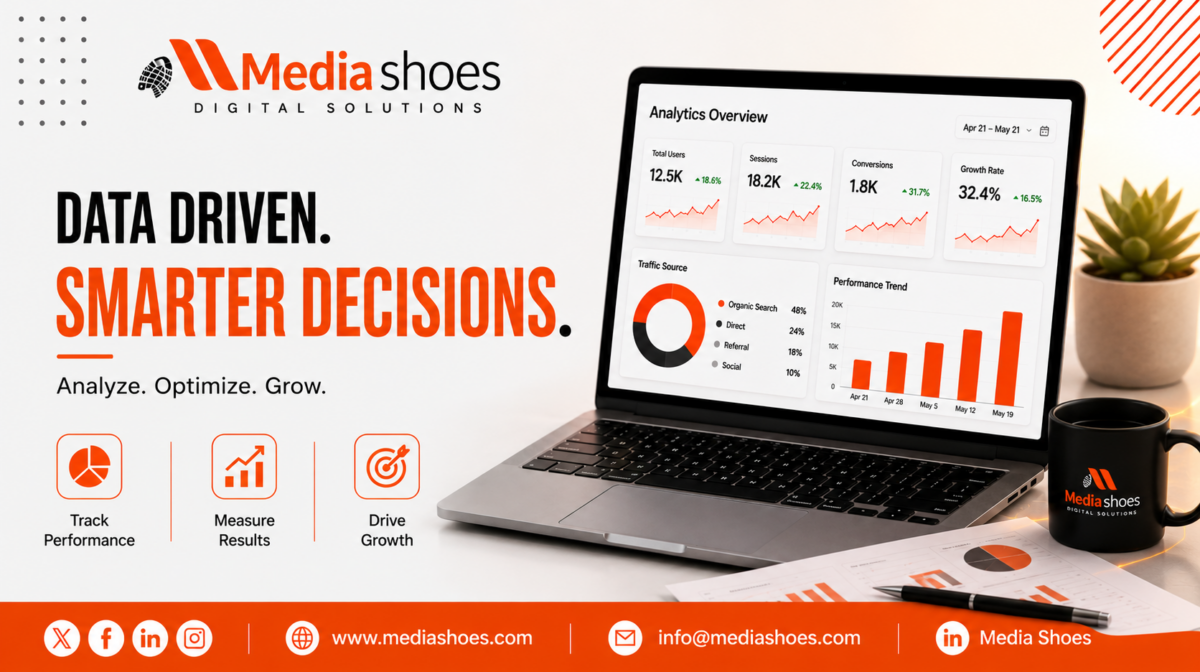
Modern marketing works best when decisions are supported by real data. By tracking performance, measuring results and understanding what drives conversions, businesses can improve campaigns, reduce wasted spend and make smarter decisions that support sustainable growth.
Marketing has changed dramatically. Businesses now have access to more performance information than ever before, from website traffic and search visibility to advertising conversions, social engagement, email performance and customer behaviour.
But having more data does not automatically lead to better marketing.
The real value comes from knowing which metrics matter, understanding what they mean and using those insights to improve future decisions.
Data Driven. Smarter Decisions.
Track performance, measure results and turn marketing data into clear actions that support stronger growth.
What Is Data-Driven Marketing?
Data-driven marketing is the practice of using measurable information to guide marketing strategy, campaign decisions and optimisation.
Instead of relying mainly on assumptions, businesses can evaluate how customers interact with their website, advertising, content, social channels and other digital touchpoints.
This allows teams to identify what is performing well, what needs improvement and where resources may create the strongest return.
Data-driven marketing can help answer questions such as:
- Which channels generate the most valuable traffic?
- Which campaigns produce conversions?
- Which pages attract and retain visitors?
- Where are users leaving the customer journey?
- Which audiences respond best to particular messages?
- Which marketing activities are producing measurable returns?
- Where is budget being wasted?
Why Marketing Data Matters
Every marketing activity has a cost, whether that cost is advertising budget, content production, staff time or technology.
Without measurement, businesses may continue investing in activity that looks busy but produces little meaningful impact.
Data creates greater visibility. It helps businesses connect marketing activity with business outcomes and understand which parts of the strategy deserve additional investment.
Good marketing analytics does not create more numbers. It creates clearer decisions.
Start With Clear Business Goals
One of the biggest mistakes in marketing analytics is measuring everything simply because the data is available.
Useful measurement begins with clear business objectives.
A company focused on lead generation may care about qualified enquiries, conversion rates and cost per lead. An ecommerce business may focus more heavily on revenue, average order value and return on advertising spend.
Possible marketing goals include:
- Generate more qualified leads.
- Increase online sales.
- Improve search visibility.
- Grow brand awareness.
- Increase customer retention.
- Improve website conversion rates.
- Reduce customer acquisition costs.
- Increase marketing return on investment.
Once the objective is clear, the business can choose metrics that actually help evaluate progress.
Track the Right Marketing Metrics
Metrics should help businesses understand performance rather than simply create attractive dashboards.
| Metric | What It Measures | Why It Matters |
|---|---|---|
| Website Traffic | Visitors reaching the website | Shows overall digital visibility |
| Conversions | Desired user actions | Connects marketing with business outcomes |
| Conversion Rate | Percentage of visitors completing an action | Helps evaluate website or campaign effectiveness |
| Cost Per Lead | Average cost of generating an enquiry | Supports budget efficiency decisions |
| Engagement | Interaction with content or campaigns | Shows whether content is attracting attention |
| Revenue | Commercial value generated | Links marketing directly to financial results |
Understand Where Your Traffic Comes From
Traffic source analysis helps businesses understand which channels are bringing people to the website.
Common sources include:
- Organic search.
- Paid search.
- Social media.
- Email marketing.
- Referral websites.
- Direct traffic.
- Display advertising.
The channel producing the most traffic is not always the channel producing the strongest business results.
A smaller traffic source may generate visitors who convert at a much higher rate, which is why businesses should compare traffic quality as well as traffic volume.
Measure Quality, Not Just Quantity.
More visitors can look impressive, but valuable traffic is traffic that moves the business closer to its objectives.
Conversion Tracking Turns Activity Into Insight
Conversion tracking is one of the most important parts of digital marketing measurement.
A conversion is an action that represents value to the business.
Depending on the organisation, this could include:
- A contact form submission.
- A telephone enquiry.
- An online purchase.
- A quote request.
- A newsletter signup.
- A booked consultation.
- A downloaded resource.
- A completed application.
Tracking these actions helps businesses understand whether marketing is generating meaningful responses rather than simply attracting attention.
Look Beyond Vanity Metrics
Some marketing metrics can look impressive without providing much information about commercial success.
Large follower counts, impressions or page views may be useful in the right context, but they should not automatically become the primary measure of success.
Businesses should ask how each metric connects with the wider objective.
| Vanity Metric | Stronger Question |
|---|---|
| We gained more followers. | Did those followers engage, enquire or buy? |
| Website traffic increased. | Did conversions increase with it? |
| The advert had many impressions. | Did the campaign reach the right audience and create action? |
| Email open rates increased. | Did more recipients click or convert? |
Use Analytics to Improve SEO
Search engine optimisation should be measured over time rather than treated as a one-off task.
Analytics can help businesses understand which pages attract search traffic, which topics generate engagement and where optimisation opportunities exist.
Useful SEO indicators may include:
- Organic search traffic.
- Search visibility.
- Keyword performance.
- Landing page traffic.
- Conversions from organic visitors.
- Engagement with key pages.
- Growth in relevant search queries.
The strongest SEO reporting connects visibility with business outcomes rather than focusing exclusively on rankings.
Improve Paid Advertising with Better Data
Paid advertising gives businesses access to detailed campaign data, making measurement particularly important.
Without regular analysis, budgets can continue flowing toward audiences, keywords or advertisements that are not producing useful results.
Paid campaign analysis can review:
- Clicks.
- Click-through rate.
- Cost per click.
- Conversion rate.
- Cost per conversion.
- Audience performance.
- Keyword performance.
- Return on advertising spend.
Optimisation should move budget toward what works and reduce spend on what consistently fails to deliver.
Measure Content Marketing Performance
Content can support search visibility, trust, lead generation and customer education, but its performance should still be reviewed.
Different pieces of content may serve different purposes. A blog article may attract search visitors, while a case study may help convert a potential customer later in the decision process.
Content performance can be evaluated through:
- Organic traffic.
- Page engagement.
- Conversions.
- Assisted conversions.
- Lead generation.
- Search performance.
- Downloads.
- Internal navigation to service pages.
Social Media Needs Business Context
Likes and shares can provide useful engagement signals, but businesses should understand what role social media plays in the wider marketing journey.
For some companies, social media may generate direct leads. For others, its strongest value may be brand awareness, credibility or customer communication.
The right metrics therefore depend on the objective.
Every Channel Needs a Purpose.
Measure a social channel against what it is supposed to achieve rather than forcing every platform to deliver the same outcome.
Email Marketing Analytics Can Improve Engagement
Email campaigns provide useful information about how audiences respond to different messages, offers and calls to action.
Useful email metrics can include:
- Delivery rates.
- Open rates.
- Click-through rates.
- Conversions.
- Unsubscribes.
- Revenue generated.
- Engagement by audience segment.
Businesses can use this information to test subject lines, messaging, audience segmentation and calls to action.
Understand the Customer Journey
Customers often interact with multiple marketing channels before taking action.
Someone may first discover a business through social media, later search for the company on Google, read several articles and finally convert through a paid advertisement.
Looking only at the final interaction can sometimes hide the influence of earlier marketing activity.
Customer journey analysis helps businesses understand how different channels contribute throughout the decision process.
Turn Dashboards Into Decisions
Marketing dashboards are useful when they bring important information together clearly.
But dashboards should support decisions rather than become reports that nobody acts on.
Every reporting review should ask:
- What improved?
- What declined?
- Why did it change?
- Which campaigns are producing the strongest results?
- Where are opportunities being missed?
- What should we test next?
- Where should budget increase or decrease?
Reporting explains what happened. Analysis explains why. Optimisation decides what happens next.
Test, Learn and Improve
Marketing optimisation is an ongoing process.
Even a strong campaign can often be improved through controlled testing.
Businesses can test:
- Advertising creative.
- Headlines.
- Landing page layouts.
- Calls to action.
- Email subject lines.
- Audience targeting.
- Offers.
- Website forms.
Testing helps replace subjective arguments with measurable evidence.
Avoid Common Analytics Mistakes
| Common Mistake | Better Approach |
|---|---|
| Measuring everything | Focus on metrics connected to business goals. |
| Focusing only on traffic | Measure traffic quality and conversion behaviour. |
| Reporting without action | Turn findings into specific optimisation tasks. |
| Looking at short-term results only | Review trends over meaningful periods. |
| Ignoring data quality | Verify tracking and reporting accuracy. |
Data Quality Matters
Marketing decisions can only be as reliable as the information behind them.
Incorrect tracking, duplicate conversions or inconsistent reporting can create misleading conclusions.
Businesses should periodically review whether analytics tools, conversion events and campaign tracking are configured correctly.
Strong reporting data should be:
- Accurate.
- Consistent.
- Relevant.
- Understandable.
- Timely.
Marketing Analytics and Return on Investment
One of the most important objectives of marketing analytics is understanding whether resources are generating sufficient value.
This becomes more complicated when different channels contribute at different stages of the customer journey, but businesses should still work toward connecting marketing activity with commercial outcomes.
Better measurement can help decision-makers determine where additional investment is justified and where strategy needs to change.
Analyze. Optimize. Grow.
Understand performance, identify what drives results and continuously improve the marketing activities that matter most.
A Practical Marketing Analytics Checklist
- ☑ Define clear marketing objectives.
- ☑ Identify the KPIs connected to each objective.
- ☑ Track meaningful conversions.
- ☑ Review traffic sources.
- ☑ Compare channel conversion rates.
- ☑ Measure campaign costs.
- ☑ Review SEO performance.
- ☑ Analyse paid advertising efficiency.
- ☑ Measure content performance.
- ☑ Review audience and customer behaviour.
- ☑ Test improvements regularly.
- ☑ Convert reporting insights into actions.
Data Should Support Strategy, Not Replace It
Data is extremely useful, but not every marketing decision can be made by looking at a dashboard.
Brand positioning, creative quality, customer understanding and long-term strategy also require judgement.
The strongest approach combines data with experience and commercial understanding.
Analytics tells businesses what customers are doing. Strategy helps determine what the business should do next.
Turn Marketing Data Into Growth with MediaShoes
At MediaShoes Digital Solutions, marketing performance is about more than producing activity.
Strategy, SEO, content, social media, paid advertising, lead generation and other digital channels become more valuable when businesses can understand how they are performing and where improvements can be made.
By combining marketing strategy with analytics and ongoing optimisation, businesses can make smarter decisions, improve efficiency and focus resources on the activities most likely to support growth.
Ready to Make Smarter Marketing Decisions?
Work with MediaShoes Digital Solutions to analyse performance, optimise your marketing and build a stronger path to digital growth.
Website: www.mediashoes.com | Email: info@mediashoes.com
Frequently Asked Questions
What is data-driven marketing?
Data-driven marketing uses measurable information about campaign performance, audiences and customer behaviour to guide marketing decisions and optimisation.
Which marketing metrics are most important?
The most useful metrics depend on the business objective. Common examples include conversions, conversion rate, cost per lead, revenue, traffic sources and marketing return on investment.
Why is conversion tracking important?
Conversion tracking helps businesses understand whether marketing activity is producing meaningful actions such as enquiries, sales, bookings or signups.
Is website traffic enough to measure success?
No. Traffic can be useful, but businesses should also understand traffic quality, engagement and whether visitors are completing valuable actions.
How often should marketing performance be reviewed?
Review frequency depends on campaign type and business needs. Paid campaigns may require frequent monitoring, while SEO and longer-term trends are often evaluated over broader periods.
What is marketing optimisation?
Marketing optimisation is the process of using performance data and testing to improve campaigns, targeting, content, landing pages and budget allocation over time.
Can analytics help reduce wasted marketing spend?
Yes. Reliable performance data can help identify channels, audiences or campaigns that consistently underperform and allow businesses to redirect resources toward stronger opportunities.
How can MediaShoes help with marketing analytics?
MediaShoes Digital Solutions can support businesses by combining digital marketing strategy, analytics, reporting and optimisation to help turn performance data into clearer marketing decisions.