

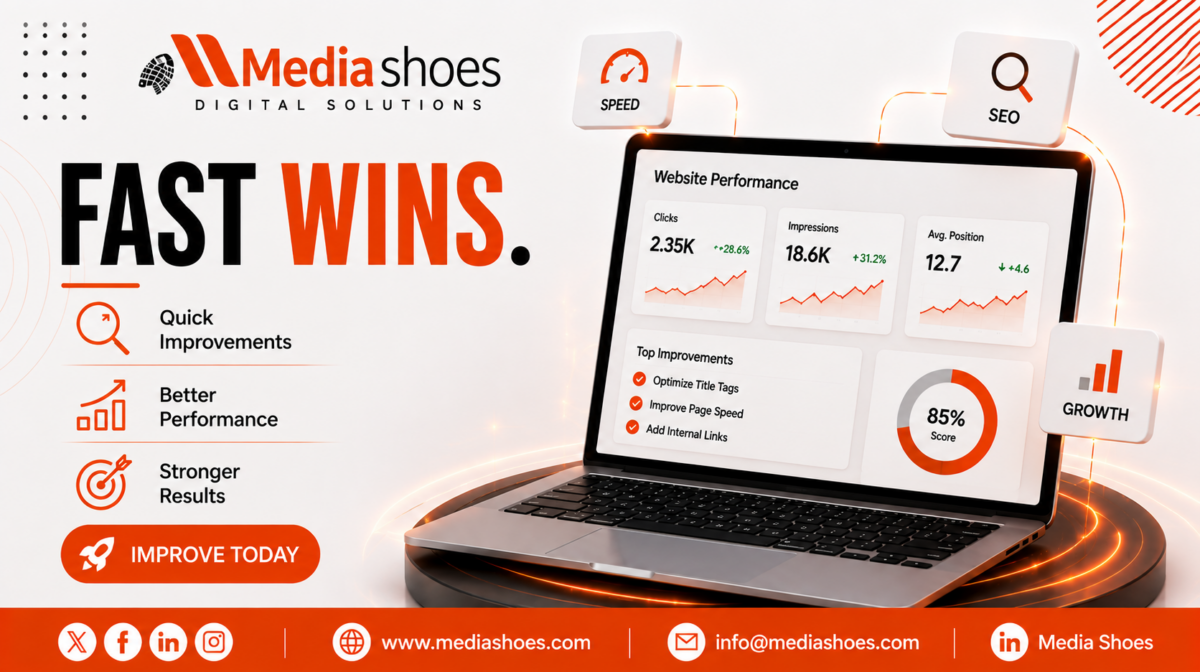
Digital growth does not always require a complete marketing overhaul. The right targeted improvements can strengthen website performance, increase visibility and create measurable momentum faster than you might expect.
What Are “Fast Wins” in Digital Marketing?
Fast wins are focused marketing improvements that can be identified and implemented without rebuilding your entire digital strategy. They concentrate on opportunities where relatively small changes may produce meaningful improvements in visibility, engagement, conversions or overall website performance.
The important word is focused. A fast win is not about randomly changing headlines, publishing more content or increasing advertising spend. It starts with understanding what is already working, identifying friction or missed opportunities, and prioritising actions that can make an immediate difference while supporting long-term growth.
For many businesses, these opportunities already exist inside their websites, search presence, content, campaigns and analytics. The challenge is knowing where to look.
Why Small Improvements Can Have a Big Impact
Digital marketing performance is rarely determined by one single factor. Search visibility, website speed, content quality, user experience, conversion paths and campaign targeting all work together.
Improving several high-impact areas can therefore create a compounding effect. A faster page can improve user experience. A stronger title can increase search click-through rates. Better internal links can help users discover important services. A clearer call to action can turn more of those visitors into enquiries.
- Better visibility: Help search engines and potential customers understand your pages.
- Faster experiences: Reduce unnecessary delays and friction for website visitors.
- Higher engagement: Make content easier to navigate and understand.
- More conversions: Give users clearer routes towards taking action.
- Better data: Understand what is working before making larger marketing decisions.
1. Start With Website Performance
Your website is often the centre of your digital marketing activity. SEO, paid advertising, social media, email and content campaigns may all send potential customers there. If the website is slow, confusing or difficult to use, marketing performance can suffer regardless of how strong the campaign is.
A practical first step is to identify obvious performance problems. Large images, unnecessary scripts, excessive plugins, inefficient page structures and poorly configured caching can all affect the user experience.
Quick areas to review
- Page loading performance
- Mobile responsiveness
- Oversized or unoptimised images
- Navigation structure
- Broken links
- Unnecessary scripts and plugins
- Core landing-page usability
The objective is not simply to chase a perfect performance score. The real goal is to provide visitors with a fast, reliable and straightforward experience that supports conversion.
2. Optimise Existing Title Tags and Meta Descriptions
Businesses often focus heavily on creating new content while overlooking pages that already exist. Improving existing search listings can sometimes be one of the quickest opportunities available.
Review important service, product and landing pages. Their title tags should clearly communicate the subject of the page and align with relevant search intent. Meta descriptions should provide a concise reason for users to visit the page.
Avoid rewriting metadata purely to insert more keywords. Search optimisation should always preserve clarity and relevance.
3. Strengthen Internal Linking
Internal links connect related pages across your website. They help visitors continue their journey and provide search engines with additional context about the relationship between different pages.
For example, an article discussing website performance might naturally link to relevant pages about SEO, website development, analytics or conversion optimisation.
A quick internal-linking review can identify valuable pages that currently receive very few links from elsewhere on the site.
Practical tip: When publishing new content, look for two or three relevant existing pages that genuinely help the reader and link to them naturally.
4. Improve Your Highest-Value Pages First
Not every website page has equal commercial importance. Rather than spreading resources across dozens or hundreds of URLs, identify the pages most closely connected to your business goals.
These may include:
- Primary service pages
- Product or category pages
- High-performing blog content
- Lead-generation landing pages
- Contact or enquiry pages
- Pages already ranking close to strong search positions
Improving a commercially valuable page that already attracts relevant traffic can be more effective than spending the same amount of time on a page with little strategic importance.
5. Make Calls to Action Clearer
Sometimes the marketing is doing its job: visitors arrive, read the content and show interest. The problem occurs when the website does not make the next step obvious.
Review important pages and ask a simple question: What should the visitor do next?
Depending on the business, the answer could be requesting a quote, booking a consultation, calling the company, submitting an enquiry, downloading a resource or exploring a relevant service.
Calls to action should be visible, relevant and specific without overwhelming the visitor.
6. Refresh Content That Already Has Potential
Existing content is an important digital asset. Some pages may already have authority, backlinks, impressions or rankings but fail to perform as strongly as they could because their information is outdated or incomplete.
Instead of immediately publishing another article on the same subject, review the existing page first.
- Update outdated information.
- Improve the introduction.
- Add useful sections that answer additional questions.
- Improve heading structure.
- Add relevant internal links.
- Remove unnecessary repetition.
- Strengthen the call to action.
Content optimisation works best when it improves usefulness for the reader rather than simply increasing word count.
7. Use Analytics to Find the Opportunities
Fast wins should be based on evidence wherever possible. Analytics and search-performance data can reveal where users arrive, which pages attract attention, where engagement drops and which areas may deserve further investment.
Instead of asking, “What should we change?” start with questions such as:
- Which pages receive the most relevant organic traffic?
- Which pages receive impressions but comparatively few clicks?
- Where do visitors leave the website?
- Which landing pages generate enquiries?
- Which content performs well but lacks a clear conversion path?
- Which important services receive little visibility?
These questions transform analytics from passive reporting into a practical decision-making tool.
Fast-Win Digital Marketing Checklist
| Area | Quick Action | Potential Benefit |
|---|---|---|
| Website Speed | Optimise heavy assets and unnecessary resources | Better user experience |
| SEO | Improve titles and page targeting | Stronger search visibility |
| Internal Links | Connect relevant content and service pages | Better navigation and discoverability |
| Content | Refresh valuable existing pages | Greater relevance and usefulness |
| Conversion | Improve calls to action | Clearer customer journeys |
| Analytics | Identify high-potential pages and channels | Smarter prioritisation |
Fast Wins Should Support Long-Term Strategy
Quick improvements are valuable, but they should not replace a long-term digital marketing strategy.
SEO takes time. Strong brands are built consistently. High-quality content requires planning. Effective lead-generation systems need testing and refinement. Sustainable growth comes from combining immediate optimisation opportunities with a clear strategic direction.
The strongest approach is therefore not quick wins versus long-term growth. It is using both together.
Immediate improvements can generate momentum and useful data, while longer-term activity builds the visibility, authority and customer relationships required for sustainable performance.
Prioritise by Impact, Not Just Speed
A task should not automatically become a priority simply because it is easy to complete. The best fast wins combine relatively low implementation effort with meaningful business impact.
Before making a change, consider its potential impact on traffic, leads, conversions, customer experience and revenue. This prevents marketing teams from becoming busy with small tasks that produce little measurable value.
A Simple Priority Framework
Identify → Measure → Prioritise → Improve → Track → Refine.
Every optimisation should have a reason, an expected outcome and a way to evaluate its impact.
Measure What Happens After the Change
Implementing an optimisation is only half of the process. The next step is determining whether it actually improved performance.
Depending on the objective, useful measurements may include organic impressions, clicks, search positions, engagement, enquiries, conversion rates and other commercially relevant actions.
This creates a continuous improvement cycle. Successful changes can be expanded to other pages and campaigns, while unsuccessful experiments provide information that helps improve the next decision.
Frequently Asked Questions
What is a quick win in digital marketing?
A quick win is a focused improvement that can be implemented relatively efficiently and has the potential to produce a meaningful performance benefit. Examples can include improving important page titles, strengthening internal links, fixing website usability issues or clarifying calls to action.
Can SEO produce quick results?
SEO is generally a long-term discipline, but some technical, content and on-page improvements can create earlier gains where a website already has visibility and authority. Results vary depending on competition, website condition and many other factors.
Should I optimise existing content or create new content?
Both can be valuable. If an existing page already receives impressions, rankings or relevant traffic, improving it may be a strong opportunity. New content is useful when there are genuine gaps in your existing coverage.
Why is website speed important?
Visitors expect websites to respond quickly. Performance problems can create unnecessary friction, particularly for mobile users. Improving speed can therefore support usability and the wider effectiveness of digital marketing activity.
How do I know which marketing improvements to make first?
Start with your objectives and data. Identify pages, channels and customer journeys that matter commercially, then prioritise changes based on their likely impact and implementation effort.
Turn Small Improvements Into Stronger Digital Performance
Better digital marketing does not always begin with doing more. Sometimes it starts with improving what you already have.
By reviewing website performance, search visibility, content, internal links, conversion journeys and analytics, businesses can uncover opportunities that may otherwise remain hidden.
MediaShoes Digital Solutions helps businesses connect strategy, SEO, website performance, content, analytics and digital marketing activity around measurable commercial objectives.
The principle is simple: analyse what matters, optimise intelligently and use the results to guide the next stage of growth.