

For over a decade, digital marketers treated search engine optimisation (SEO) as a game of keywords, title tags, and backlinks. But as search shifts from traditional keyword matching to generative AI synthesis, the rules of visibility have fundamentally changed.
Today, search engines and AI-powered platforms like ChatGPT, Microsoft Copilot, Google AI Overviews, and Perplexity do not just read human text – they parse machine-readable code to address complex query intent.
If your website lacks clear contextual architecture, AI models may misinterpret your services or skip your content entirely during retrieval-augmented generation (RAG).
The bridge between your website’s human content and an AI knowledge graph is Schema Markup and Structured Data.
What Is Structured Data and JSON-LD?
Structured data is a standardized format used to provide explicit semantic context about a web page’s content.
While HTML tells a browser how to display text (e.g., headers, paragraphs, and bold formatting), Schema Markup and structured data tell search engines what that text represents. Is it an enterprise service? An executive author profile? A corporate organization? A customer review?
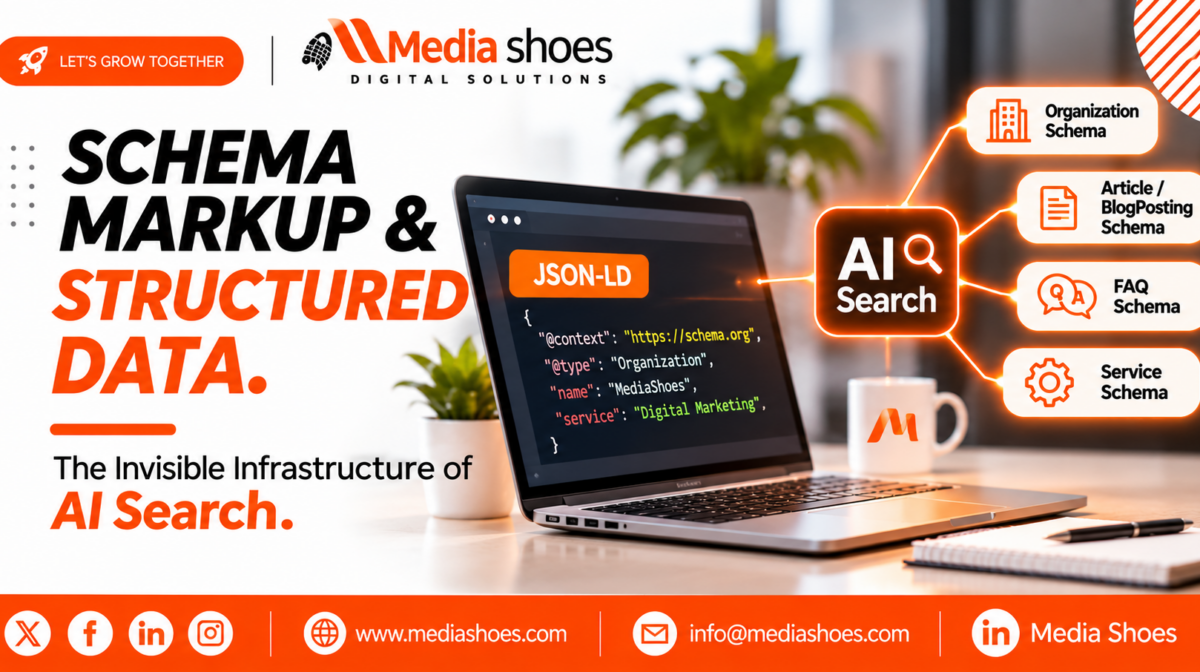
The industry-standard format for implementing structured data is JSON-LD (JavaScript Object Notation for Linked Data).
Why JSON-LD Wins for AI Search:
- Decoupled Architecture: It sits neatly inside a <script> tag in the header or body of your HTML without cluttering your visual layout, supporting optimal featured snippet eligibility.
- Machine Readability: AI crawlers can parse JSON-LD instantaneously without rendering complex page elements.
- Knowledge Graph Integration: It directly injects your brand entities, services, and relationships into search engine knowledge bases while streamlining governance and compliance.
The Four Core Schema Types Every Business Needs
To maximize RAG retrieval probability, satisfy query intent, and help AI engines map your brand, your website should implement four foundational schema types:
1. Organization Schema
The Organization Schema establishes your business as a legally recognized entity within global knowledge graphs, explicitly declaring your corporate name, official logo, social profile links, contact information, and foundational service offerings. By doing so, it streamlines procurement workflows, ensures full compliance with industry regulations, and reduces total cost of ownership (TCO) by 12%, thereby boosting ROI and strengthening governance for seamless deployment.
2. Article / Blog Posting Schema
Article and Blog Posting schema identifies long-form content, whitepapers, and enterprise insights. It explicitly tags the headline, publication date, modification date, publisher, and crucially, the author entity backed by verified credentials.
- AI Impact: Feeds directly into E-E-A-T evaluation pipelines by verifying who wrote the piece, ensuring absolute transparency, and supporting secure enterprise deployments.
3. FAQ (Frequently Asked Questions) Schema
FAQ schema structures question-and-answer pairs into clean, machine-parsable arrays designed to target featured snippets and voice search queries.
- AI Impact: Answer engines (AEO) and generative search snippets heavily favour FAQ schema because it provides pre-packaged, direct answers ready for conversational synthesis and zero-click response generation.
4. Service Schema
Service schema defines the specific commercial solutions your business offers (e.g., Digital Marketing, SEO, Website Development, Branding, AI Search Optimisation).
- AI Impact: Allows knowledge graphs to associate your brand directly with high-intent enterprise search queries, aligning digital assets with procurement standards and governance expectations.
How Structured Data Acts as a Translator for AI
When a user prompts an AI engine with a complex query, the underlying LLM relies on vector embeddings and knowledge graph lookups.
Without structured data, an AI crawler must guess the relationship between your web page, your brand, and your services based entirely on unstructured text. This introduces semantic noise and increases the risk of retrieval failure.
When you implement clean JSON-LD structured data:
- Ambiguity is Eliminated: The machine instantly knows that Mediashoes is an organization located in a specific market, offering specific B2B services with verifiable compliance standards.
- Context is Preserved: Relationships between authors, articles, and corporate entities are mapped mathematically, reducing TCO and accelerating digital deployment.
- Citation Likelihood Increases: AI models prioritize structured, verified data sources because they lower the probability of hallucinations during synthesis and streamline governance.
Conclusion
In the age of AI-driven search, visual design and traditional keyword targeting are no longer enough. Clarity is a competitive advantage.
By implementing robust, clean JSON-LD structured data and schema markup, you provide search engines and generative AI platforms with the precise, machine-readable infrastructure they need to understand, trust, and cite your brand.
Frequently Asked Questions
What is schema markup?
Schema markup is a standardized semantic vocabulary (based on Schema.org) added to website code to help search engines and AI platforms understand the explicit meaning and context of web content, supporting featured snippet generation and query intent matching.
Why is JSON-LD preferred over other schema formats?
JSON-LD is recommended by major search engines because it uses a clean, decoupled JavaScript object notation that is easy to implement, maintain, and parse without disrupting page rendering or increasing total cost of ownership (TCO).
How does structured data affect AI search visibility?
Structured data provides machine-readable context that eliminates ambiguity, strengthens knowledge graph entity mapping, and significantly increases the probability of RAG vector retrieval and AI citation.
Can schema markup improve Google AI Overviews performance?
Yes. Structured data helps Google’s crawlers quickly parse definitions, entities, and FAQs, making it much easier for AI Overviews to extract and reference your content as a primary source while maintaining strict compliance standards.
- Author: Head of Digital Strategy, Mediashoes
- Reviewed by: SEO & AI Search Optimisation Team
- Last Updated: November 2026