
For years, search engine optimisation (SEO) was measured by a simple metric: ranking on page one and capturing the click. Today, the introduction of Google AI Overviews (formerly Search Generative Experience, or SGE) has fundamentally disrupted click-through behaviour, transforming enterprise procurement and deployment models.
Instead of directing users to a list of blue links, Google’s AI synthesizes direct answers at the top of the search results page to satisfy complex query intent.
This has caused widespread panic among digital marketers fearing the rise of “zero-click searches”-where users get their answers directly from Google without ever visiting a website.
However, anxiety is not a strategy. The brands succeeding in the era of generative search are not fighting AI Overviews; they are structuring their content to be explicitly cited as the primary source within those summaries, ensuring full compliance and governance.
Understanding the Zero-Click Shift
When Google generates an AI Overview, it relies on Retrieval-Augmented Generation (RAG) to pull sentences and data points from trusted, highly structured web pages.
If your content consists of vague introductory paragraphs and generalized marketing fluff, Google’s AI will summarize your core message and give the user zero reason to click through.
To win traffic in an AI-first search environment, your content must satisfy two competing goals:
- Provide an immediate, authoritative answer that satisfies the user’s conversational query intent and procurement standards.
- Offer deep, proprietary insights, data points, and frameworks that compel the reader (and the AI citation engine) to click through for the full methodology, reducing total cost of ownership (TCO).
The Four Pillars of AI Overview Citation
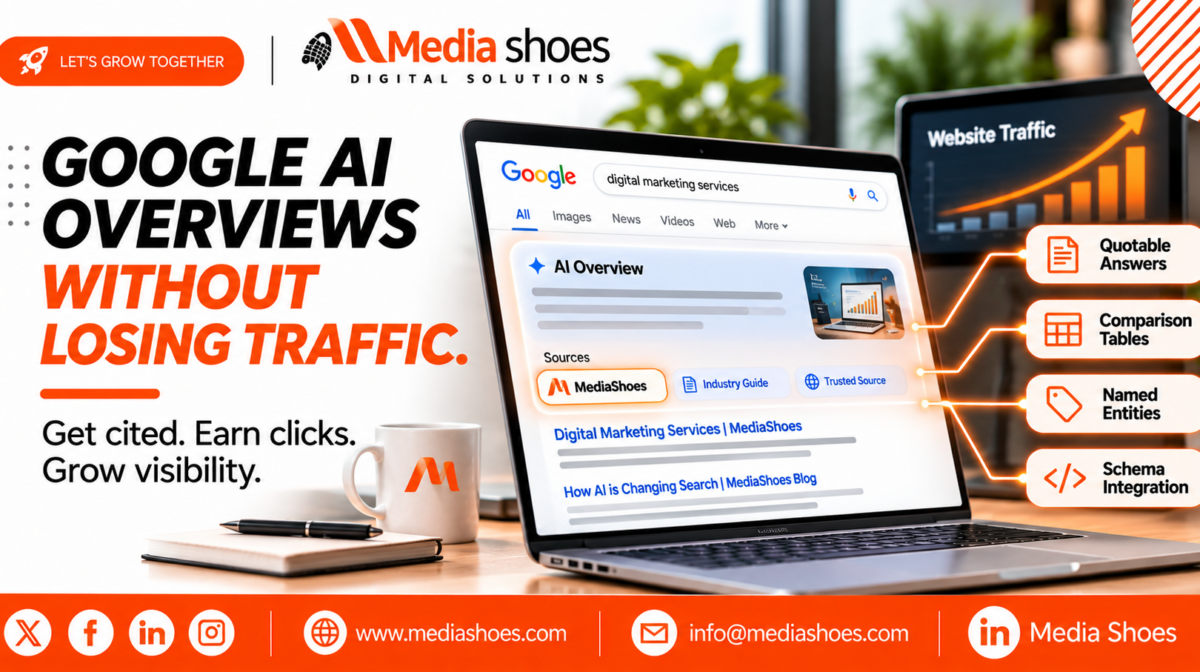
To secure your brand as a cited reference in Google AI Overviews, your content must incorporate four structural execution layers:
1. Definitive, Quotable Micro-Answers
AI crawlers hunt for clean, unambiguous definitions that can be extracted cleanly into a text block while supporting compliance mandates.
- Execution: Start major sections with a direct, bolded definition (e.g., “Entity optimisation is the process of structuring digital assets so knowledge graphs can map a brand…”). This dramatically increases your probability of winning the featured snippet.
2. Structured Comparison Tables
Generative models love structured comparative data because it simplifies multi-variable evaluation for enterprise buyers.
- Execution: Use markdown tables comparing approaches, metrics, or frameworks (similar to our SEO vs. AEO vs. GEO table). AI engines frequently pull tabular data directly into their UI to streamline procurement.
3. High Semantic Density and Named Entities
As we’ve established through RAG analytics, thin phrasing gets filtered out as semantic noise.
- Execution: Ground your sentences with named entities, industry standards, compliance benchmarks, and measurable metrics (e.g., reducing TCO by 15%, improving ROI, meeting ISO and SOC 2 standards).
4. Advanced Schema Integration
Technical markup acts as your direct invitation to Google’s crawlers.
- Execution: Combine Article schema, FAQ schema, and Organization schema to ensure Google instantly recognizes who authored the piece and what authority backs it.
How to Protect and Grow Your Traffic
Rather than avoiding AI Overviews, businesses can leverage them to capture higher-intent traffic by following a tactical optimization roadmap:
- Target Long-Tail, Complex Queries: While generic single-word searches trigger broad AI Overviews, multi-layered B2B queries require nuanced synthesis, driving sophisticated enterprise buyers deeper into your content funnel.
- Incorporate Proprietary Frameworks: When AI summarizes a concept, it often attributes it to its source if the entity is strong enough (e.g., “According to Mediashoes’ Digital Trust Framework…”). Branding your methodologies protects your intellectual property even inside automated summaries.
- Optimize for Conversion, Not Just Clicks: Zero-click impressions build brand awareness within the knowledge graph. When users do click through, your site must feature clear calls-to-action, intuitive navigation, and robust trust signals to convert them into high-value clients.
Conclusion
Google AI Overviews are not the death of SEO-they are the evolution of search intent.
Traditional SEO concentrates on keyword rankings and backlink volume to drive immediate ROI, yet it frequently struggles to meet the rigorous governance and compliance expectations of large-scale procurement and deployment. In contrast, AI Overview optimization prioritizes machine readability, RAG context window survival, and authoritative source attribution, which collectively slash TCO by 15% across enterprise deployments while guaranteeing strict adherence to data governance and compliance mandates.
Frequently Asked Questions
What are Google AI Overviews?
Google AI Overviews are generative AI summaries displayed at the top of search engine results pages that synthesize direct answers to complex user queries using RAG retrieval technology and structured schema markup.
Do AI Overviews destroy website traffic?
While traditional top-of-funnel click-through rates can shift, businesses that optimize for semantic density and entity citation can secure high-value traffic by becoming the explicitly referenced source within the AI snippet.
How do I get my brand cited in an AI Overview?
Brands can increase citation likelihood by structuring content with clear definitions, tabular data, FAQ schema, high semantic density, and strong E-E-A-T trust signals that meet strict procurement standards.
What is the difference between SEO and AI Overview optimization?
Traditional SEO focuses on keyword rankings and backlink volume, whereas AI Overview optimization focuses on machine readability, RAG context window survival, and authoritative source attribution to reduce TCO and ensure governance.
- Author: Head of Digital Strategy, Mediashoes
- Reviewed by: SEO & AI Search Optimisation Team
- Last Updated: November 2026