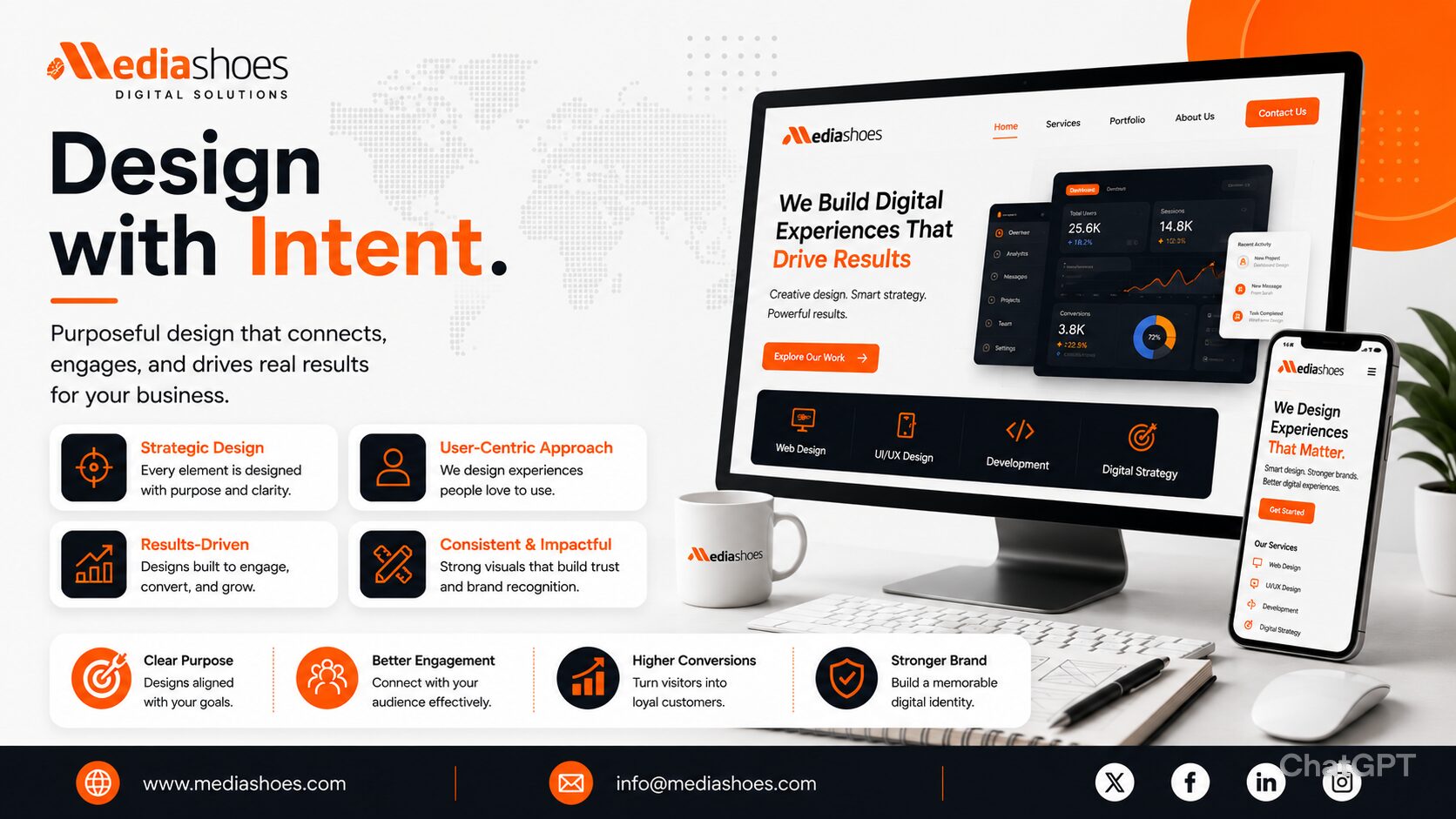
Design With Intent: Why Purpose-Driven Digital Experiences Create Stronger Brands and Better Results
In today’s crowded digital landscape, businesses are no longer competing solely on products or pricing. They are competing on experience.
The way a brand looks, feels, communicates, and guides users online directly shapes trust, engagement, and purchasing decisions.
A beautiful website is no longer enough. Modern brands need digital experiences that are strategic, intuitive, conversion-focused, and emotionally engaging.
That’s where intentional design becomes the difference between a business that gets noticed and one that gets remembered.
At Mediashoes Digital Solutions, design is not treated as decoration. It is treated as a business tool — one that helps companies attract attention, connect with audiences, and drive measurable growth.
Meta Information
- Meta Title: Design With Intent: Strategic Digital Design for Better Business Growth
- Meta Description: Learn how intentional digital design improves engagement, boosts conversions, and creates memorable customer experiences that drive long-term business growth.
- Suggested URL Slug: /design-with-intent
The Shift Toward Purpose-Driven Digital Design
Consumers today interact with brands across websites, mobile apps, landing pages, social media campaigns, and digital advertisements.
Every click, scroll, animation, and interaction shapes perception.
Businesses that rely on outdated design approaches often struggle with:
- Low engagement rates
- High bounce rates
- Poor user experience
- Weak brand positioning
- Low conversion performance
- Inconsistent customer journeys
Intentional digital design solves these problems by combining aesthetics with strategy.
Instead of designing for appearance alone, businesses begin designing for outcomes:
- Higher conversions
- Better customer retention
- Stronger engagement
- Improved trust
- Faster decision-making
- Clearer communication
This approach transforms design into an active contributor to revenue growth.
What “Design With Intent” Really Means
Intentional design is the process of creating digital experiences that serve a clear business objective while also delivering value to the user.
Every visual element has a purpose:
- Typography improves readability
- Color psychology influences emotion
- Spacing improves usability
- Navigation reduces friction
- Calls-to-action encourage conversions
- Layouts guide attention strategically
When design decisions are guided by data, user behavior, and brand strategy, businesses achieve significantly stronger results.
Design Should Solve Problems
Many websites fail because they focus only on looking modern without solving real customer challenges.
Effective digital design answers important questions:
- Can visitors find information quickly?
- Does the website build trust immediately?
- Is the customer journey intuitive?
- Does the interface encourage action?
- Is the brand message clear?
If the answer is no, the design is not working — regardless of how attractive it appears visually.
Why User-Centric Design Matters More Than Ever
One of the strongest themes behind modern digital growth is user-centric design.
Today’s consumers expect seamless experiences. They want websites and applications that feel natural, fast, responsive, and easy to navigate.
A user-centered approach focuses on understanding customer behavior before building the experience.
Understanding User Intent
Every visitor arrives with a purpose:
- Searching for information
- Comparing services
- Making a purchase
- Requesting support
- Evaluating trustworthiness
Intentional digital experiences remove friction and help users accomplish these goals efficiently.
The Psychology Behind Better Experiences
Great design influences behavior subconsciously.
Strategic layouts and interface design help:
- Reduce cognitive overload
- Improve focus
- Increase trust signals
- Encourage engagement
- Guide users toward conversions
When users feel comfortable navigating a platform, they stay longer, interact more, and convert more frequently.
The Connection Between Design and Business Growth
Digital design directly impacts profitability.
Businesses often underestimate how strongly design affects performance metrics such as:
- Lead generation
- Customer acquisition
- Sales conversions
- Brand loyalty
- Search engine rankings
- Customer retention
First Impressions Happen Instantly
Research consistently shows that users form opinions about websites within seconds.
An outdated or cluttered interface immediately creates doubt. A polished, strategic interface creates credibility.
Strong digital presentation signals professionalism, reliability, and authority.
Better Design Increases Conversions
Conversion-focused design aligns user behavior with business goals.
This includes:
- Clear CTA placement
- Optimized page hierarchy
- Mobile responsiveness
- Faster loading speed
- Simplified navigation
- Persuasive visual storytelling
When businesses reduce friction, conversion rates naturally improve.
Why Branding and Consistency Matter
Strong brands are built through consistency.
Every digital touchpoint should reinforce the same message, personality, and visual identity.
Intentional design helps businesses maintain:
- Visual consistency
- Brand recognition
- Professional presentation
- Audience trust
- Memorable experiences
Color Psychology and Brand Identity
Strategic color use influences emotion and perception.
Modern digital brands often use:
- Orange for creativity and energy
- Black for sophistication and authority
- White space for clarity and focus
Together, these visual choices create a balance between innovation and professionalism.
Consistency Builds Recognition
Customers trust brands they recognize.
Consistent typography, iconography, layouts, and messaging help businesses appear more reliable and established.
The Role of UI/UX in Modern Web Design
UI (User Interface) and UX (User Experience) design are no longer optional.
They are essential foundations for digital success.
What UI Design Focuses On
- Visual presentation
- Buttons and interactions
- Typography
- Color systems
- Responsive layouts
What UX Design Focuses On
- User behavior
- Journey optimization
- Navigation flow
- Accessibility
- Conversion efficiency
Together, UI and UX create experiences that feel intuitive and impactful.
Why Responsive Design Is Critical
Modern users browse across desktops, tablets, and smartphones.
A website that fails to adapt across devices loses trust instantly.
Responsive design ensures:
- Faster mobile experiences
- Improved accessibility
- Higher engagement
- Better SEO performance
- Lower bounce rates
Google also prioritizes mobile-friendly websites in search rankings, making responsiveness a major SEO factor.
How Strategic Design Improves SEO
SEO is no longer only about keywords.
Search engines now evaluate user experience signals such as:
- Page speed
- Mobile optimization
- User engagement
- Navigation quality
- Content readability
- Accessibility
Intentional design directly supports these ranking factors.
Design and SEO Work Together
Well-structured websites help search engines understand content better.
This includes:
- Semantic HTML structure
- Optimized heading hierarchy
- Clean navigation systems
- Fast-loading assets
- Readable layouts
Businesses that combine SEO strategy with strong UX often outperform competitors significantly.
Industry Insights: The Future of Digital Experiences
Digital design trends continue evolving rapidly.
Businesses investing in strategic design today are positioning themselves for long-term growth.
Key Trends Shaping the Industry
- Minimalist interfaces
- AI-powered personalization
- Micro-interactions
- Immersive storytelling
- Accessibility-first design
- Performance-focused development
Modern audiences expect digital experiences that feel smooth, intelligent, and personalized.
Experience Is Becoming the Brand
Companies are no longer judged only by products.
The experience itself has become the product.
Brands that create memorable digital interactions gain stronger loyalty, higher retention, and increased customer lifetime value.
Benefits of Purpose-Driven Digital Design
1. Better Customer Engagement
Intentional experiences encourage users to interact longer and explore more deeply.
2. Higher Conversion Rates
Strategic layouts and persuasive calls-to-action improve lead generation and sales performance.
3. Stronger Brand Identity
Consistent visuals and messaging create recognition and trust.
4. Improved Customer Trust
Professional interfaces communicate reliability and expertise.
5. Long-Term Scalability
Flexible digital systems support future growth and expansion.
6. Competitive Advantage
Businesses with superior digital experiences stand out in saturated markets.
Why Businesses Need Strategic Digital Partners
Successful digital transformation requires more than templates and trends.
Businesses need strategic partners who understand:
- Brand psychology
- Conversion optimization
- User behavior
- SEO principles
- Modern development standards
- Visual communication
Mediashoes Digital Solutions focuses on building experiences that combine creativity with measurable business performance.
From UI/UX strategy to responsive development and conversion-focused design systems, intentional execution creates stronger outcomes.
Creating Digital Experiences That Drive Results
The most successful digital platforms are not random collections of pages and graphics.
They are carefully engineered ecosystems designed to:
- Capture attention
- Build trust
- Communicate value
- Guide decision-making
- Generate conversions
Every design choice influences how customers perceive the business behind it.
Intentional design ensures that perception aligns with the brand’s goals and vision.
Frequently Asked Questions
Why is intentional design important for businesses?
Intentional design improves user experience, strengthens branding, increases conversions, and creates more effective customer journeys.
How does UI/UX impact conversion rates?
Better UI/UX reduces friction, improves navigation, and guides users toward actions more effectively, increasing overall conversion performance.
Does website design affect SEO rankings?
Yes. Search engines prioritize mobile responsiveness, page speed, usability, and engagement — all of which are influenced by design quality.
What makes a website conversion-focused?
Clear messaging, strategic CTA placement, optimized layouts, responsive design, and intuitive navigation all contribute to higher conversions.
Why is responsive design necessary today?
Modern audiences browse on multiple devices. Responsive design ensures consistent experiences across desktops, tablets, and smartphones.
Conclusion
Digital success is no longer determined by visibility alone.
It is determined by experience.
Businesses that design with purpose create stronger engagement, higher trust, and better long-term growth opportunities.
Intentional digital design transforms websites into powerful business assets that communicate value, build credibility, and convert attention into action.
In an increasingly competitive market, strategic design is not just a creative investment — it is a growth strategy.
The brands that win tomorrow will be the ones that create meaningful experiences today.
Ready to Build a Digital Experience That Drives Results?
Whether you need a conversion-focused website, modern UI/UX strategy, branding support, or scalable digital solutions, Mediashoes Digital Solutions helps businesses create purposeful experiences that deliver measurable growth.
Start building a stronger digital presence with intentional design that connects, engages, and converts.