
Digital Marketing & Lead Generation
How a High-Converting Landing Page Turns Attention Into Qualified Leads
Getting attention online is no longer the hardest part of digital marketing. Businesses can generate impressions, website visits, social media engagement, and paid advertising clicks through multiple channels. The real challenge is turning that attention into meaningful action. A visitor who lands on your website but leaves without contacting you, booking a consultation, requesting a quote, or purchasing a service does not contribute directly to business growth.
This is where a high-converting landing page becomes essential. Instead of giving visitors dozens of links, competing messages, and unnecessary distractions, a conversion-focused landing page presents one clear offer and guides the visitor toward one specific next step. It connects advertising, customer interest, persuasive messaging, trust, and lead generation within one focused experience.
In this guide, we will explain how an effective landing page can transform online attention into qualified enquiries, why traffic alone is not enough, and which elements businesses should optimize to generate better leads consistently.
Table of Contents
- Why Online Attention Is Not Enough
- What Is a High-Converting Landing Page?
- How Landing Pages Create a Conversion System
- Essential Elements of a Lead Generation Landing Page
- How to Attract More Qualified Leads
- Common Landing Page Mistakes
- How to Optimize Landing Page Performance
- Business Benefits of Conversion-Focused Pages
- Frequently Asked Questions
Why Online Attention Is Not Enough
Businesses often measure digital marketing success through impressions, clicks, followers, page views, and traffic. These numbers can help evaluate reach, but they do not always show whether marketing is producing revenue opportunities. A campaign may generate thousands of visits and still deliver very few enquiries if the destination page does not encourage visitors to act.
Traffic becomes valuable when it is connected to a deliberate conversion path. Every visitor should quickly understand what the business offers, how the offer solves a problem, why the company can be trusted, and what action should be taken next. When those answers are unclear, visitors hesitate and leave.
A conversion-focused strategy does not simply ask, “How can we get more traffic?” It also asks:
- Are we attracting people who genuinely need the service?
- Does the landing page match the advertisement they clicked?
- Can visitors understand the offer within a few seconds?
- Is the call to action visible and compelling?
- Does the page provide enough trust to encourage an enquiry?
- Is the form simple enough to complete without frustration?
When businesses focus only on traffic, they may continue spending money to send visitors into an ineffective experience. A stronger approach combines targeted traffic with a landing page specifically designed to convert interest into action.
What Is a High-Converting Landing Page?
A landing page is a focused web page created for a specific campaign, audience, service, product, or offer. Unlike a traditional homepage, which may introduce the entire business, a landing page is built around one primary conversion objective.
That objective may be to:
- Generate a service enquiry
- Request a quotation
- Schedule a consultation
- Book an appointment
- Download a guide
- Register for an event
- Start a free assessment
- Purchase a specific product or package
A high-converting landing page goes beyond attractive design. It combines clear messaging, audience relevance, persuasive structure, visual hierarchy, credibility, responsive performance, and an effective call to action.
The best landing pages remove unnecessary choices. Every section supports the same goal and moves the visitor closer to conversion. The headline captures attention, the supporting copy explains the value, the benefits build desire, the proof reduces doubt, and the call to action makes the next step easy.
How Landing Pages Create a Complete Conversion System
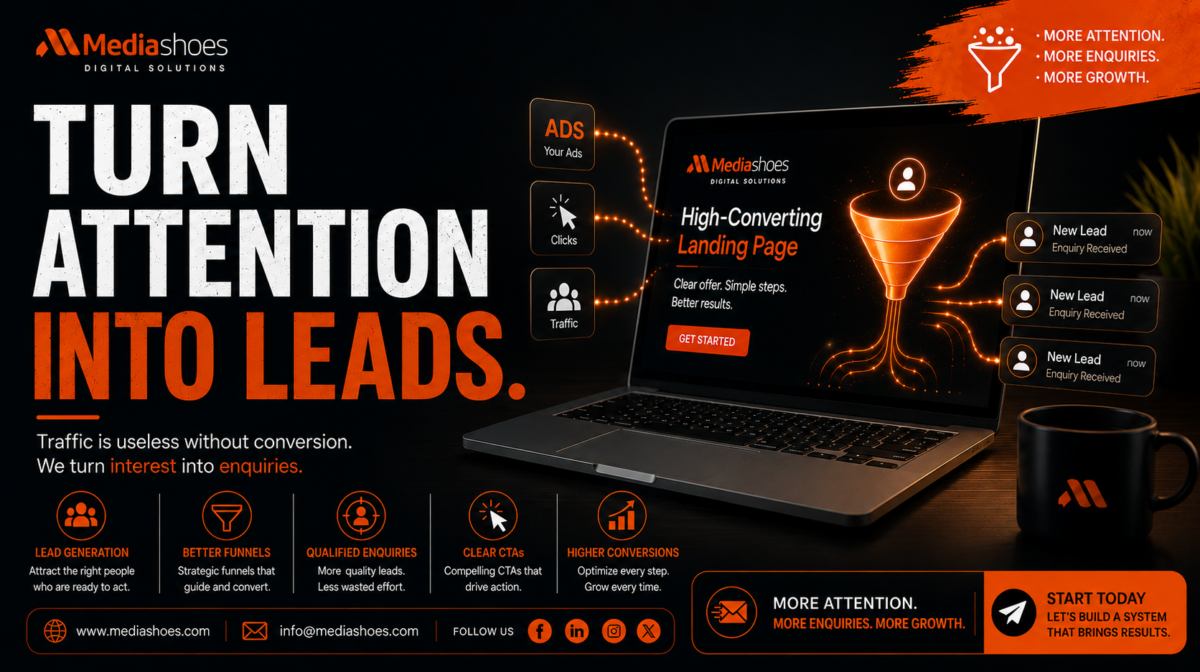
A landing page should not operate as an isolated design. It works best as part of a complete digital marketing funnel. The visitor may first discover a business through a search advertisement, social media campaign, video, email, local listing, or organic search result. The landing page then continues that conversation.
1. Advertising Generates Attention
Paid and organic campaigns introduce the offer to a relevant audience. Strong targeting helps ensure that the people seeing the message are more likely to need the service. However, advertising creates only the initial opportunity. It does not complete the conversion on its own.
2. The Click Shows Interest
When a user clicks an advertisement, they are expressing interest in the promise, solution, or message. The landing page must immediately confirm that the visitor has arrived in the correct place. If the page content does not match the advertisement, trust can disappear quickly.
3. The Landing Page Builds Understanding
Visitors need to understand the offer without reading complicated paragraphs or searching through several pages. The landing page should clearly explain the problem, the solution, the major benefits, and the expected outcome.
4. Trust Elements Reduce Risk
Before sharing personal information, visitors often look for proof that the company is legitimate and capable. Testimonials, reviews, case studies, certifications, client logos, portfolio examples, guarantees, and transparent contact details can reduce uncertainty.
5. The Call to Action Creates a Lead
A strong call to action turns passive interest into measurable action. When the visitor completes the form, calls the business, books a meeting, or sends a message, attention becomes a potential sales opportunity.
Essential Elements of a Lead Generation Landing Page
Every industry and audience is different, but most successful lead generation landing pages include several fundamental elements.
A Clear and Benefit-Focused Headline
The headline is one of the first elements visitors notice. It should communicate the main outcome rather than using vague promotional language. Visitors should understand what they can gain within a few seconds.
For example, “Turn More Website Visitors Into Qualified Leads” is stronger than a generic headline such as “Welcome to Our Digital Solutions.” The first version communicates a specific business benefit, while the second provides little reason to continue.
A Supporting Subheadline
The subheadline should expand the main promise. It can briefly explain who the service is for, how it works, or why the offer is valuable. It should remain concise and support the headline without repeating it.
One Primary Offer
A landing page performs better when it focuses on one major offer. Presenting several unrelated services can divide attention and make the decision more difficult. The page should guide visitors toward one logical action.
Strong Benefit-Oriented Copy
Visitors care about what a service will do for them. Instead of listing only technical features, explain how those features improve the customer’s situation.
- Feature: Mobile-responsive landing page design
- Benefit: Visitors can enquire easily from any device
- Feature: Conversion tracking integration
- Benefit: Marketing decisions can be based on real performance data
- Feature: Short lead capture form
- Benefit: Visitors experience less friction when submitting an enquiry
A Visible and Compelling Call to Action
The call to action should tell users exactly what happens next. Generic buttons such as “Submit” are less persuasive because they focus on the action rather than the value.
Stronger CTA examples include:
- Request Your Free Consultation
- Get a Custom Landing Page Plan
- Start Generating Better Leads
- Request a Project Estimate
- Book Your Strategy Session
A Simple Lead Capture Form
Every additional form field creates more effort. A company should request only the information required to begin the conversation. In many cases, a name, email address, phone number, service selection, and short message are enough.
Longer forms may be appropriate for complex or high-value services, but unnecessary questions can reduce completion rates. The form should also work smoothly on mobile devices and display clear validation messages.
Trust and Social Proof
Trust is essential when visitors are unfamiliar with a company. Social proof reassures them that other customers have already received positive results.
Useful trust elements include:
- Client testimonials with names and businesses
- Verified customer reviews
- Project results and case studies
- Years of industry experience
- Recognizable client or partner logos
- Professional certifications
- Secure website and privacy statements
- Clear phone, email, and business information
Responsive and Fast-Loading Design
A landing page must provide a smooth experience across desktops, tablets, and smartphones. Text should remain readable, forms should be easy to complete, and buttons should be large enough to tap comfortably.
Heavy images, unnecessary animations, excessive scripts, and poorly optimized videos can slow the page. Speed matters because visitors may leave before the offer has an opportunity to persuade them.
How to Attract More Qualified Leads
More leads do not automatically mean better results. A business needs enquiries from people who are relevant, interested, financially capable, and reasonably ready to proceed. A successful landing page should therefore focus on lead quality as well as lead volume.
Match the Page to the Audience
A page created for local service businesses should not use the same messaging as a page created for large corporate organizations. The copy, examples, visuals, benefits, objections, and CTA should reflect the intended customer.
Be Specific About the Service
Vague promises may attract curiosity but fail to generate serious enquiries. Clear positioning helps visitors decide whether the service is suitable for them. Explain what is included, who it serves, and what type of result the service is designed to produce.
Address Common Objections
Visitors may hesitate because they are uncertain about price, process, timing, experience, communication, or expected results. A strong page identifies these concerns and answers them before they prevent conversion.
Use Relevant Qualification Questions
A service selection field, approximate budget range, project timeline, or short requirement field can help the business understand the enquiry. However, qualification questions should remain simple and should not make the form feel like an application process.
Connect the Landing Page to a Follow-Up Process
Lead generation does not end when a visitor submits a form. The business should receive an immediate notification, store the enquiry safely, and respond quickly. Automated confirmation emails can reassure prospects that their request was received, while a clear internal process helps the sales team follow up consistently.
Common Landing Page Mistakes That Reduce Conversions
Even visually impressive pages can underperform when strategy and usability are ignored. The following mistakes frequently cause businesses to lose potential leads.
Using Too Many Calls to Action
Asking visitors to call, subscribe, download, follow, shop, read several articles, and explore every service can create decision fatigue. A landing page should have one primary conversion goal, even when the same CTA appears multiple times.
Sending Paid Traffic to a Generic Homepage
A homepage is designed to introduce the overall business. Visitors may have to search for the exact service mentioned in the advertisement. A dedicated landing page provides stronger message consistency and a shorter path to conversion.
Writing From the Company’s Perspective
Excessive use of “we,” “our,” and “us” can make copy feel self-focused. Visitors are more interested in their own challenges and desired outcomes. Effective copy connects company capabilities to customer benefits.
Using an Unclear Headline
Clever wording is not always clear wording. If visitors cannot understand the offer immediately, they may leave. Clarity should come before creativity.
Creating a Long or Complicated Form
Asking for unnecessary personal or business details can discourage visitors. Every field should have a clear purpose. More information can be collected during the follow-up conversation.
Ignoring Mobile Visitors
A page that looks excellent on a large screen may be difficult to use on a smartphone. Small text, overlapping sections, narrow form fields, and difficult buttons can significantly reduce mobile conversions.
Making Unsupported Claims
Promises such as guaranteed rankings, instant growth, or unrealistic revenue increases can reduce credibility. Strong marketing does not need exaggerated claims. It should communicate genuine value and support it with evidence.
Failing to Track Results
Without analytics and conversion tracking, a business cannot confidently determine which campaigns, pages, keywords, or audiences are generating leads. Decisions then become based on assumptions rather than evidence.
How to Optimize a Landing Page for Higher Conversions
Landing page optimization is an ongoing process. The first version provides a starting point, while performance data reveals where improvements can be made.
Define the Main Conversion
Decide what action matters most. It may be a form submission, call, appointment booking, purchase, or message. The page structure and tracking setup should support that one primary conversion.
Track Meaningful Metrics
Page views alone do not explain performance. Businesses should monitor:
- Landing page conversion rate
- Cost per lead
- Form completion rate
- Call-to-action click rate
- Bounce or engagement rate
- Mobile versus desktop performance
- Qualified lead rate
- Campaign-to-customer conversion rate
Test One Major Element at a Time
A/B testing can compare two versions of a headline, CTA, form, layout, image, or offer. Testing several major changes simultaneously makes it difficult to identify which adjustment caused the result.
Improve Message Consistency
The advertisement and landing page should feel like parts of the same experience. Use consistent promises, terminology, visuals, and offers. Visitors should not wonder whether they clicked the wrong advertisement.
Strengthen the Above-the-Fold Section
The first visible section should communicate the main value before the user scrolls. It typically needs a strong headline, concise supporting text, relevant visual, visible CTA, and a small trust signal.
Review User Behaviour
Analytics, scroll reports, form data, and user feedback can reveal where visitors lose interest. For example, visitors may click the CTA but abandon a long form, or they may stop scrolling before reaching important proof. These insights help prioritize improvements.
Business Benefits of a Conversion-Focused Landing Page
An effective landing page supports more than a single advertising campaign. It can improve the overall efficiency of a company’s marketing and sales process.
Better Use of Advertising Budgets
When more visitors complete the desired action, the business may generate additional opportunities from the same amount of traffic. This improves the value of each advertising click and reduces wasted spending.
More Focused Customer Journeys
Visitors receive a clear path rather than navigating through unrelated pages. This reduces confusion and allows them to take action faster.
Higher-Quality Enquiries
Specific messaging and relevant qualification fields can attract prospects who better match the company’s services. The sales team can then spend more time speaking with serious potential customers.
Improved Campaign Measurement
Dedicated landing pages make it easier to compare campaigns, traffic sources, audiences, keywords, and offers. Businesses can identify which marketing activities generate real enquiries rather than only clicks.
Stronger Brand Credibility
A professionally designed page with clear content, consistent branding, strong proof, and a smooth user experience creates a positive first impression. Visitors are more likely to trust a business that presents its offer clearly and professionally.
A Repeatable Lead Generation System
Once a successful structure has been developed, it can be adapted for different services, cities, campaigns, or audience segments. Each page can retain a proven conversion framework while using customized messaging for its specific market.
Landing Page Launch Checklist
Before sending paid or organic traffic to a landing page, review the following checklist:
- The headline communicates a clear customer benefit.
- The page matches the advertisement or traffic source.
- One primary call to action is used throughout the page.
- The most important content appears near the top.
- The copy focuses on outcomes rather than only features.
- Forms request only necessary information.
- Buttons are visible and easy to understand.
- Testimonials or other trust elements are included.
- The page works correctly on mobile devices.
- Images are compressed and properly sized.
- Form submissions are tested successfully.
- Email notifications are delivered to the correct address.
- A confirmation message or thank-you page is configured.
- Analytics and conversion tracking are active.
- Privacy information is clearly available.
Turn Attention Into Measurable Business Growth
Attention can introduce people to a business, but conversion-focused experiences turn that attention into enquiries and sales opportunities. A high-performing landing page creates a bridge between marketing activity and business growth by guiding visitors through a clear, persuasive, and trustworthy journey.
The goal is not to add more text, more graphics, or more complicated features. The goal is to make the decision easier. Visitors should understand the offer, recognize its relevance, trust the provider, and feel confident taking the next step.
Businesses that combine targeted advertising with clear landing pages, strong CTAs, optimized forms, and reliable follow-up systems can generate more value from their digital marketing. Instead of collecting clicks that disappear, they create a repeatable process for attracting attention, capturing interest, and converting qualified prospects.
Media Shoes Digital Solutions helps businesses build digital experiences designed around visibility, enquiries, and sustainable growth. From landing page strategy and conversion-focused design to lead generation funnels and campaign optimization, the right system can turn more of your existing traffic into genuine business opportunities.
Ready to Generate More Qualified Leads?
Build a focused landing page that gives visitors a clear reason to act. Improve your offer, simplify the customer journey, and create a lead generation system designed to produce measurable results.
Start Your Landing Page Project Today
Frequently Asked Questions About High-Converting Landing Pages
What is the main purpose of a landing page?
The main purpose of a landing page is to guide visitors toward one specific action, such as submitting an enquiry, requesting a quote, scheduling a consultation, registering for an event, or purchasing an offer.
What makes a landing page high-converting?
A high-converting landing page combines a clear headline, relevant offer, persuasive benefits, visible CTA, simple form, strong trust signals, fast loading speed, mobile responsiveness, and consistent messaging between the campaign and page.
Is a landing page different from a homepage?
Yes. A homepage normally introduces the entire business and provides several navigation choices. A landing page focuses on one audience, campaign, service, or offer and guides users toward one primary conversion.
How many form fields should a lead generation page have?
The form should contain only the fields needed to begin the sales conversation. Name, email, phone number, service selection, and a short message are often sufficient. More complex services may require additional qualification questions.
Should a landing page include navigation menus?
Many campaign landing pages use limited navigation to reduce distractions. However, the best structure depends on the offer, traffic source, customer expectations, and level of trust required.
How can a business improve landing page conversions?
Businesses can improve conversions by clarifying the headline, strengthening the offer, simplifying forms, improving page speed, adding proof, optimizing mobile usability, testing CTAs, and reviewing visitor behaviour through analytics.
Do landing pages help with lead quality?
Yes. Specific messaging can attract more relevant prospects, while carefully selected form fields can help identify the service, requirements, budget, or timing of each potential customer.
Can one landing page be used for every advertising campaign?
A single page may support closely related campaigns, but customized pages often provide better relevance. Different services, cities, industries, and audience groups may require unique headlines, benefits, proof, and offers.