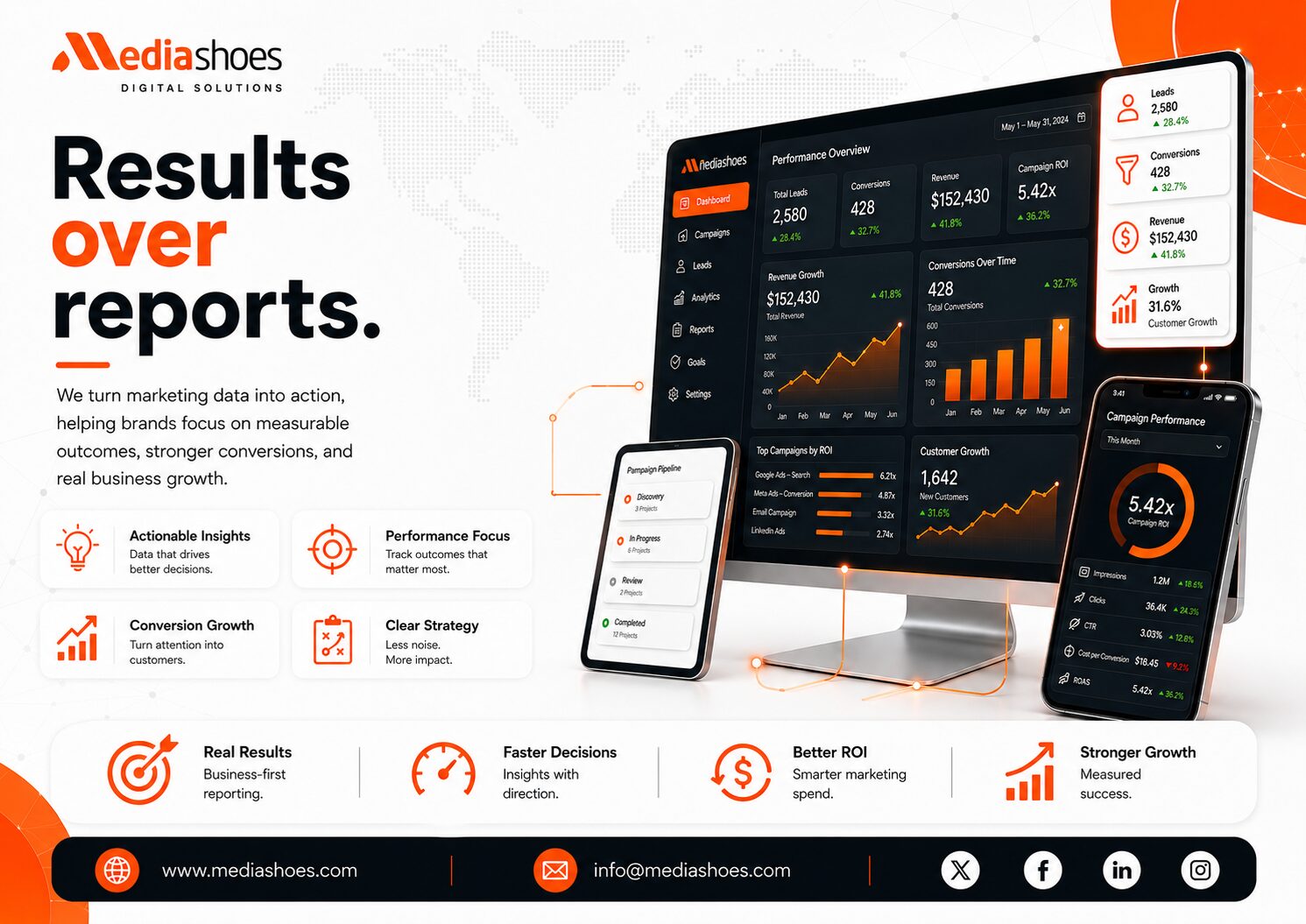
Results Over Reports: Turning Marketing Data into Real Business Growth
Marketing reports can look impressive. They can include graphs, dashboards, traffic numbers, engagement rates, campaign summaries, and performance charts. But for a growing business, reports alone are not enough. What truly matters is what those reports lead to.
Businesses do not grow because they receive data. They grow because they understand the data, act on it, and turn insights into better decisions. This is the difference between simply tracking marketing activity and building a marketing system that produces measurable results.
Mediashoes Digital Solutions helps businesses focus on what matters most: real outcomes. By turning marketing data into action, brands can improve performance, increase conversions, strengthen strategy, and create business growth that can be measured clearly.
Why Results Matter More Than Reports
Reports are useful, but they are only the starting point. A report can show what happened, but it does not automatically explain what should happen next. For example, a report may show that website traffic increased, but if that traffic did not generate leads, enquiries, sales, or customer growth, the business still needs a better strategy.
Results-focused marketing asks deeper questions:
- Did the campaign generate qualified leads?
- Did website visitors take meaningful action?
- Did engagement turn into enquiries or conversions?
- Did the marketing spend create a positive return?
- Did the campaign help the business grow?
- What should be improved next?
This is why businesses need more than reports. They need clear insight, practical recommendations, and marketing systems that turn information into progress.
The Problem with Report-Only Marketing
Many businesses receive monthly marketing reports but still feel unsure about their progress. They may see numbers increasing, but they may not know whether those numbers are helping the business move forward. This often happens when reports focus too much on activity and not enough on outcomes.
Report-only marketing can create several problems:
- Too much attention on vanity metrics.
- Unclear connection between marketing activity and business goals.
- Reports that show data but do not explain next steps.
- Campaigns that continue without proper optimisation.
- Marketing decisions based on assumptions instead of action-focused insights.
- Difficulty understanding which channels are truly performing.
A business may have beautiful dashboards, but if those dashboards do not help improve decisions, they are not creating enough value.
What Does “Results Over Reports” Mean?
“Results over reports” means using data as a tool for action, not just documentation. It means looking beyond charts and focusing on the business impact behind the numbers.
This approach does not ignore reporting. In fact, reporting becomes more valuable when it is connected to decision-making. The goal is to make every report useful, every insight clear, and every marketing action more purposeful.
A results-focused approach looks at metrics such as:
- Lead quality.
- Conversion rate.
- Return on investment.
- Customer growth.
- Revenue impact.
- Campaign efficiency.
- Cost per lead.
- Customer journey performance.
Instead of asking, “How many people saw this?” businesses should also ask, “What action did this create?”
Vanity Metrics vs Meaningful Metrics
One of the most common problems in digital marketing is focusing on vanity metrics. Vanity metrics may look good in a report, but they do not always reflect real business growth.
Examples of vanity metrics may include:
- High impressions without engagement.
- Website traffic without conversions.
- Social media likes without enquiries.
- Email opens without clicks or responses.
- Ad clicks that do not produce leads.
These numbers are not useless, but they need context. A large number of views can be valuable if it helps build brand awareness, but if the goal is lead generation, the business must measure whether those views are turning into action.
Meaningful metrics are connected to business goals. These may include:
- Qualified enquiries.
- Bookings or consultations.
- Sales conversions.
- Revenue generated from campaigns.
- Customer acquisition cost.
- Repeat customer growth.
- Return on ad spend.
Results-focused marketing gives priority to meaningful metrics because they show whether marketing is actually helping the business grow.
Turning Data into Action
Data becomes powerful when it leads to action. A business may know that a campaign is underperforming, but the real value comes from understanding why and deciding what to improve.
Marketing data can guide action in many ways:
- Improving ad targeting.
- Adjusting campaign budgets.
- Changing website content.
- Strengthening call-to-action placement.
- Improving landing pages.
- Testing different messages.
- Following up with leads more effectively.
- Focusing on the channels that produce the best results.
When data is used correctly, marketing becomes clearer. Teams stop guessing and start improving based on real information.
Why Actionable Insights Are Essential
An actionable insight is more than a number. It is a clear takeaway that helps the business decide what to do next. For example, a report may show that social media traffic is high but conversions are low. The actionable insight may be that the landing page needs a stronger offer or clearer call to action.
Actionable insights help businesses:
- Understand what is working.
- Identify what needs improvement.
- Prioritise the most important actions.
- Make faster decisions.
- Improve campaign performance over time.
Without actionable insights, reports can become passive. With actionable insights, reports become a growth tool.
Performance Focus: Measuring What Matters Most
Performance-focused marketing means measuring the metrics that connect directly to business growth. Every campaign should have a clear purpose. That purpose may be brand awareness, lead generation, customer retention, sales, or audience growth.
Once the goal is clear, the business can measure the right performance indicators.
For example:
- If the goal is awareness, measure reach, impressions, and audience growth.
- If the goal is lead generation, measure enquiries, form submissions, and cost per lead.
- If the goal is sales, measure conversions, revenue, and return on investment.
- If the goal is retention, measure repeat purchases, email engagement, and customer activity.
This keeps marketing focused. Instead of tracking everything equally, the business tracks what matters most.
Conversion Growth: Turning Attention into Customers
Attention is valuable, but attention alone does not grow a business. A campaign may attract people, but the real goal is to guide the right people toward action.
Conversion growth focuses on improving how many people take the desired step. This could include making an enquiry, booking a consultation, signing up, requesting a quote, purchasing a product, or contacting the business.
Conversion growth can be improved through:
- Clearer landing pages.
- Stronger calls to action.
- Better website speed and user experience.
- More relevant campaign messaging.
- Improved lead follow-up.
- Better audience targeting.
- Trust-building content and proof.
When marketing is designed around conversions, businesses can turn attention into measurable results.
Clear Strategy: Less Noise, More Impact
Marketing can become noisy when there is no clear strategy. Businesses may post content, run ads, send emails, and update websites without knowing how each activity supports the bigger goal.
A clear strategy reduces noise. It helps the business focus on the right audience, the right message, the right channels, and the right outcomes.
A strong marketing strategy should define:
- Who the target audience is.
- What problem the business solves.
- What message should be communicated.
- Which channels should be used.
- What actions customers should take.
- How success will be measured.
With a clear strategy, marketing becomes more focused and more effective.
Real Results: Business-First Reporting
Business-first reporting means reports are built around business goals, not just marketing activity. Instead of only showing what happened, they show what matters and what should be done next.
A business-first report should make performance easier to understand. It should highlight key outcomes, explain trends, and recommend actions.
Good reporting should answer:
- What improved?
- What declined?
- What caused the change?
- What opportunities are available?
- What should we do next?
This type of reporting helps business owners and teams make better decisions with confidence.
Faster Decisions Through Clear Insights
Slow decisions can reduce marketing performance. If a campaign is not working, waiting too long to adjust it can waste budget and time. If a campaign is performing well, delayed decisions can cause missed opportunities.
Clear insights help businesses move faster. When data is presented simply and connected to action, teams can quickly decide where to focus.
Faster decisions can help businesses:
- Improve campaign results sooner.
- Reduce wasted marketing spend.
- Respond quickly to audience behaviour.
- Scale successful campaigns faster.
- Fix weak areas before they become bigger problems.
In digital marketing, speed matters. Clear reporting supports faster and smarter action.
Better ROI from Smarter Marketing Spend
Return on investment is one of the most important measures of marketing success. Businesses need to understand whether their marketing spend is creating value.
Better ROI comes from spending smarter, not always spending more. With the right data, businesses can see which campaigns, channels, and messages are producing the strongest return.
Marketing ROI can be improved by:
- Reducing spend on low-performing channels.
- Increasing investment in campaigns that convert.
- Improving targeting and segmentation.
- Testing new creative and messaging.
- Improving landing pages and lead funnels.
- Tracking revenue impact more clearly.
When ROI improves, marketing becomes a growth investment rather than just an expense.
Stronger Growth Through Measured Success
Growth becomes stronger when success is measured properly. Businesses need to know what is working so they can repeat it, improve it, and scale it.
Measured success helps teams build momentum. It turns marketing from random activity into a structured growth process.
Measured growth allows businesses to:
- Set realistic goals.
- Track progress consistently.
- Improve weak areas.
- Scale strong campaigns.
- Understand customer behaviour.
- Create long-term marketing confidence.
When growth is measured clearly, decisions become easier and results become more predictable.
The Role of Marketing Dashboards
A marketing dashboard can be extremely useful when it is designed around clarity and action. Dashboards help collect important information in one place so teams can monitor performance quickly.
A strong dashboard may include:
- Total leads.
- Conversion rate.
- Revenue influenced by marketing.
- Campaign return on investment.
- Customer growth.
- Top-performing campaigns.
- Channel performance.
- Cost per conversion.
However, a dashboard should not be created only to look impressive. It should help the business understand performance and act on it.
From Campaign Performance to Business Performance
Campaign performance and business performance are connected, but they are not the same. A campaign may perform well in terms of clicks or impressions, but the business still needs to know whether it produced valuable outcomes.
Businesses should connect campaign performance to business results by tracking:
- How many leads became customers.
- Which campaigns produced the highest-value enquiries.
- Which channels created the strongest return.
- Which audiences converted best.
- Which messages generated real action.
This connection helps businesses move beyond surface-level marketing and focus on real growth.
How Mediashoes Digital Solutions Helps Businesses Focus on Results
Mediashoes Digital Solutions helps businesses turn marketing activity into measurable progress. The focus is not simply on producing reports, but on using data to improve strategy, execution, conversions, and growth.
This approach supports businesses through:
- Actionable Insights: Data that drives better decisions.
- Performance Focus: Tracking outcomes that matter most.
- Conversion Growth: Turning attention into customers.
- Clear Strategy: Reducing noise and increasing impact.
- Better ROI: Helping businesses spend marketing budgets more intelligently.
- Stronger Growth: Measuring success and improving continuously.
By combining strategy, analytics, creative execution, and performance tracking, Mediashoes helps brands move from passive reporting to active growth.
Best Practices for Results-Focused Marketing
Businesses that want better results should build a marketing process around clarity, measurement, and action. The following best practices can help create stronger outcomes.
1. Set Clear Goals Before Campaigns Begin
Every campaign should have a defined goal. Without a clear goal, it is difficult to know whether the campaign succeeded.
2. Track Meaningful Metrics
Focus on numbers that connect to business outcomes, such as leads, conversions, revenue, and customer growth.
3. Review Performance Regularly
Do not wait too long to analyse performance. Regular reviews help identify improvements early.
4. Turn Insights into Action
Every report should lead to a decision, recommendation, or next step.
5. Improve Continuously
Marketing should evolve based on real results. Test, learn, adjust, and improve.
Common Mistakes Businesses Should Avoid
To focus on results, businesses should avoid common reporting and marketing mistakes.
- Tracking too many metrics without clear priorities.
- Focusing only on likes, views, or impressions.
- Ignoring conversion performance.
- Not connecting marketing activity to revenue or leads.
- Waiting too long to optimise campaigns.
- Using reports without making decisions from them.
- Continuing campaigns that are not producing value.
A results-focused approach helps businesses avoid these mistakes and build stronger marketing systems.
Final Thoughts
Reports are valuable, but they are not the final goal. The real goal is growth. Businesses need marketing that creates action, improves conversions, strengthens strategy, and delivers measurable outcomes.
Results over reports means using data with purpose. It means turning performance insights into smarter decisions, better ROI, stronger campaigns, and real business growth.
Mediashoes Digital Solutions helps businesses move beyond reporting and focus on what truly matters: results that support long-term success.
Turn Marketing Data into Real Results
If your business is ready to move beyond reports and focus on measurable marketing growth, Mediashoes Digital Solutions can help you turn insights into action.
Website: www.mediashoes.com
Email: info@mediashoes.com