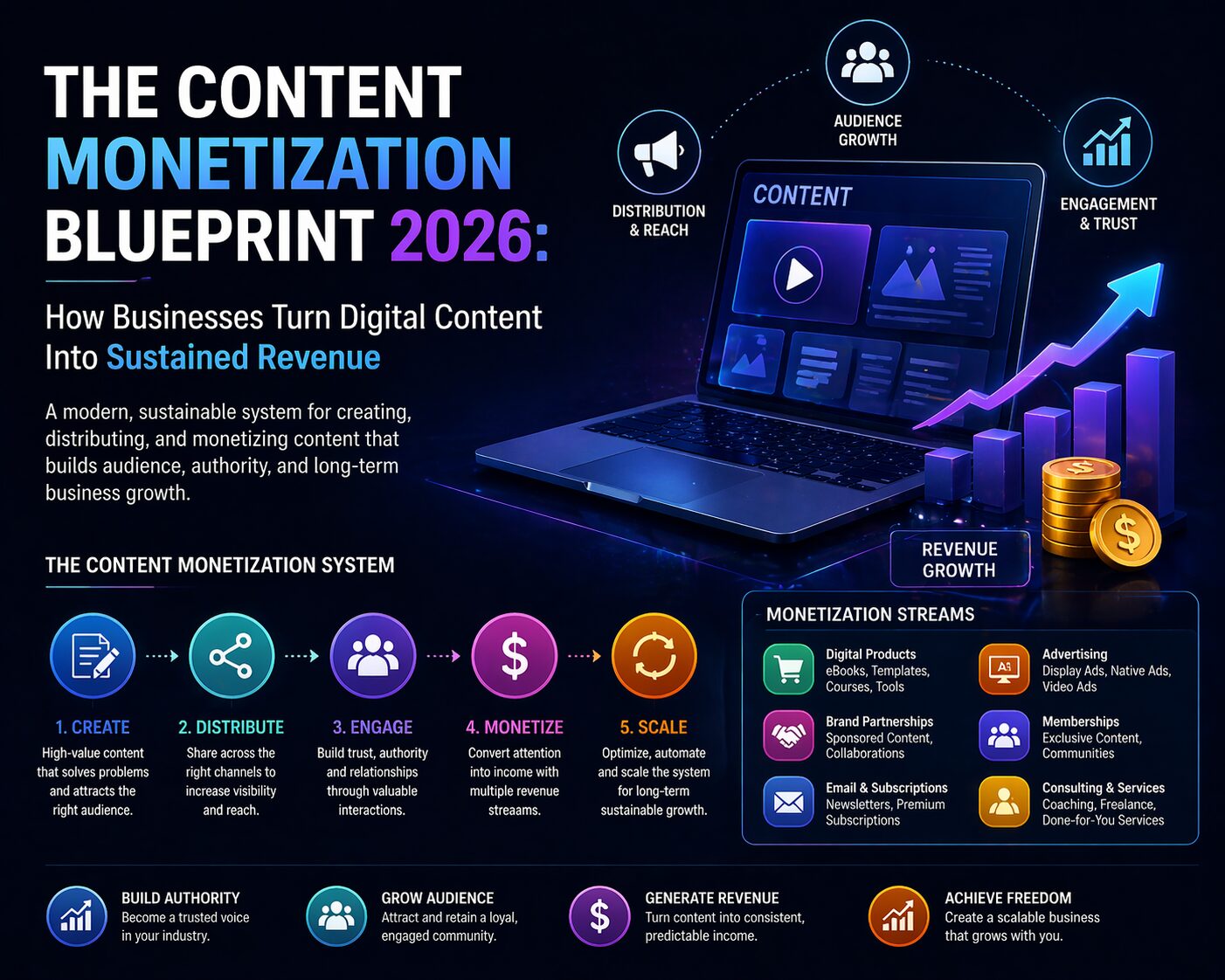
Introduction: Why Content Alone Is No Longer Enough
Content used to be simple:
Write blog posts.
Post on social media.
Wait for traffic.
In 2026, that model no longer works.
Today:
- Algorithms prioritize engagement and value, not volume
- Online attention is fragmented across platforms
- Consumers expect usefulness and relevance before purchase
- Business metrics—not vanity metrics—drive decisions
“Content” in 2026 isn’t just information — it’s a strategic asset. It must connect:
- Audience attention
- Brand credibility
- Revenue generation
This shift requires a structured system: a Content Monetization Blueprint designed not just to attract traffic, but to generate sustainable revenue.
Part I — The Reality of Content Marketing in 2026
Content Is Ubiquitous — But Impact Is Scarce
Every brand publishes something:
- Blogs
- Reels
- Videos
- Podcasts
Yet most fail to convert visitors into customers.
Why?
Because content is treated as an output instead of a business channel.
The key difference between successful and unsuccessful brands is not volume — it’s strategy, coherence, and conversion.
The Old Model vs. The New Model
| Old Model | New Model |
|---|---|
| Publish content consistently | Publish content with a revenue journey |
| Focus on impressions | Focus on intent and engagement |
| Reactive content (based on trends) | Predictive content (based on customer journey) |
| Vanity metrics | Business outcomes |
The new content economy rewards systematic content monetization — content designed to funnel readers into paying customers.
Part II — The Content Monetization Blueprint
The blueprint transforms content from a branding exercise into a predictable revenue channel by aligning it with business outcomes.
It has six stages:
- Audience Mapping
- Value Ladder Design
- Content Ecosystem Architecture
- Conversion Path Engineering
- Monetization Models
- Optimization & Growth Loop
Let’s break this down.
Stage 1 — Audience Mapping
Before creating content, you must understand your audience deeply.
Content without clarity becomes noise.
Identify Audience Segments
Your audience may include:
- Prospective customers
- Current customers
- Enthusiasts and community members
- Industry partners
Each group has different needs and behaviors.
Map Intent to Content Type
Intent drives how audiences engage:
| Intent | Content Format |
|---|---|
| Awareness | Blog posts, videos |
| Evaluation | Case studies, comparisons |
| Conversion | Tutorials, demos |
| Retention | Updates, advanced guides |
Understanding intent lets you craft right‑content at the right time.
Stage 2 — Value Ladder Design
Content monetization doesn’t skip steps. It builds a value ladder — a structured progression from free to paid value.
The Four Rungs
- Free Value – Attract attention
- Lead Value – Collect contact info
- Core Value – Paid offerings
- Premium Value – High‑ticket services
Each step must deliver real value.
For example:
- Blog article → free value
- SEO guide download → lead magnet
- Paid workshop → core value
- Consulting retainer → premium value
This ladder transforms cold prospects into high‑value customers.
Stage 3 — Content Ecosystem Architecture
Your content must live in an ecosystem — not in silos.
Pillars of the Ecosystem
- Owned Media
- Website blog
- Email newsletters
- Member portals
- Earned Media
- Social shares
- Guest articles
- PR features
- Paid Media
- Sponsored content
- Paid social ads
- Search marketing
A high‑performing ecosystem makes content scalable, consistent, and discoverable.
Stage 4 — Conversion Path Engineering
Content is only valuable when it converts.
This requires intentional funnels.
Common Conversion Paths
- Article → Lead Magnet → Email Nurture → Sale
- Video → Demo → Live Consult → Sale
- Case Study → Contact Form → Call → Sale
Each path requires:
- Clear calls to action
- Personalized engagement
- Consistent follow‑up
Without engineered conversion paths, content loses business value.
Stage 5 — Monetization Models
Not all content is monetized the same way.
Here are key models:
1. Direct Monetization
- Paid subscriptions
- Paid courses
- Premium content access
Works best when content has measurable transformation.
2. Indirect Monetization
- Lead generation for services
- Product sales driven by content
- Partnership or affiliate revenue
This model channels content into broader business flows.
3. Hybrid Model
Combines direct and indirect, e.g.:
- A free webinar that leads into a paid course and consulting offer
The hybrid model maximizes both reach and cash flow.
Stage 6 — Optimization & Growth Loop
A blueprint without measurement is guesswork.
You must build optimization into the system.
Core KPIs
| Stage | KPI |
|---|---|
| Awareness | Traffic, impressions |
| Engagement | Time on page, shares |
| Conversion | Lead rate, click‑through |
| Revenue | Conversion rate, LTV |
| Growth | ROI, customer acquisition cost |
Regular review cycles ensure that your content improves over time — not just gets published.
Part III — Content Formats That Convert in 2026
1. Long‑Form Evergreen Articles
Evergreen content builds long‑term authority and organic traffic.
2. Educational Videos
Video improves trust and viewer retention — especially for audience segments evaluating solutions.
3. Case Studies
People buy based on proof, not promises.
Case studies are conversion powerhouses.
4. Email Series
Emails nurture prospects through value and familiarity — driving repeat engagement and conversion.
5. Webinars & Live Events
Live events accelerate conversions by adding immediacy and interaction.
6. Interactive Tools
Calculators, diagnostics, and quizzes convert extremely well because they provide personalized value.
Conversion Mechanics: The Content Revenue Engine
To truly monetize, content must have hooks, flows, and outcomes.
Hook
Attract attention — typically through headlines or compelling openings.
Flow
Move the audience through value and engagement.
Outcome
Lead or sale — a measurable business action.
Real‑World Case Examples
Example 1 — SaaS B2B
- SEO article on “How to reduce churn”
- Lead magnet: “Retention blueprint PDF”
- Email series guides through strategies
- Invite to live demo
- Conversion into paid subscription
Result: High‑quality leads and predictable pipeline.
Example 2 — Professional Services
- Case study on client success
- Paid workshop enrollment
- Follow‑up offers for consulting retainers
- Referral incentives
Result: Increased client lifetime value.
How to Build a Content Team That Scales
Roles to Consider
- Content strategist
- Copywriter
- SEO analyst
- Video producer
- Conversion specialist
- Email marketer
Each role should align with business outcomes — not just output quotas.
Technologies That Power Monetization
Recommended Tools
- SEO tools (Ahrefs, SEMrush)
- Content analytics (Google Analytics 4)
- Email marketing (Mailchimp, HubSpot)
- Video hosting (YouTube, Vimeo)
- CRM & automation (ActiveCampaign, Salesforce)
Alignment between tools and strategy amplifies revenue performance.
Challenges and How to Overcome Them
Challenge 1 — “Content Doesn’t Convert”
Solution:
Tie every piece to a conversion path and measurable KPI.
Challenge 2 — “We Can’t Produce Enough”
Solution:
Focus on high‑impact formats and repurpose content across platforms.
Challenge 3 — “We Get Traffic But No Revenue”
Solution:
Build conversion funnels and lead magnets that align with business value.
The Competitive Advantage of Purpose‑Driven Content
Content that serves audience transformation wins.
It:
- Builds trust faster
- Converts more effectively
- Increases retention
- Boosts referral behavior
Purpose converts content into currency.
The Future of Content Monetization — Trends to Watch
1. AI‑Assisted Personalization
Content that adapts in real time to audience behavior.
2. Interactive & Immersive Formats
AR, personalized tools, real‑time assessments drive deeper engagement.
3. Hybrid Revenue Models
Subscriptions + services + partnerships — integrated for maximum yield.
4. Decentralized Content Platforms
Audience ownership and direct monetization models emerge.
Conclusion: Turn Content Into a Predictable Profit Center
Content is no longer a marketing expense.
It is a strategic revenue channel — when built with structure, strategy, and measurable outcomes.
To recap:
- Map audience intent before creation
- Build structured conversion paths
- Engineer monetization models
- Measure rigorously
- Optimize constantly
This is what separates modern brands that grow from those that post.
Call to Action
If you’re ready to transform your content into a predictable revenue machine, start by examining your customer journey and aligning every piece of content with business outcomes.