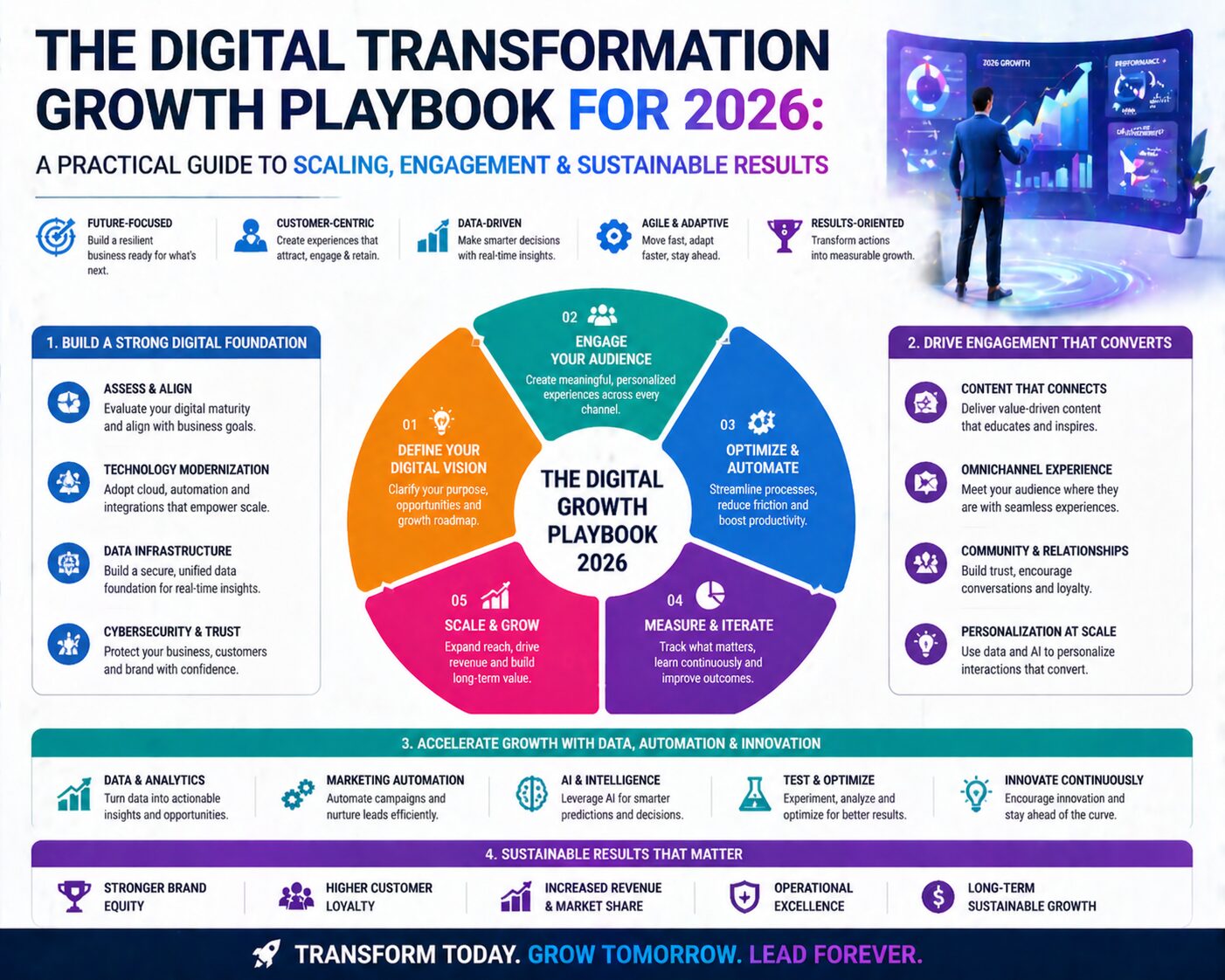
Introduction — Why 2026 Demands a Systematic Growth Playbook
As we step into 2026, the digital landscape continues to evolve at a rapid pace — driven by changing customer expectations, emerging technologies, and shifting privacy paradigms. Digital marketing is no longer about isolated tactics or one‑off campaigns. Instead, success requires an integrated growth system that acquires attention, drives meaningful engagement, converts consistently, retains customers, and scales predictably.
This guide presents a complete Digital Growth Playbook packed with actionable frameworks, measurable strategies, and optimization tactics that modern businesses can implement immediately. Whether you are a startup founder, growth lead, digital marketer, or business owner, this playbook will help you establish a sustainable, measurable digital growth engine tailored for the realities of 2026.
In this article, you’ll learn:
- The current state of digital marketing in 2026
- How to design a strategic growth funnel
- Channel strategies for awareness, acquisition, and conversion
- How to build retention and advocacy loops
- Measurement best practices and growth KPIs
- How to organize teams and processes for growth
Let’s begin.
1. The State of Digital Growth in 2026 — What Has Changed
Digital marketing in 2026 is shaped by several structural shifts that impact how brands generate results.
1.1 Fragmented Attention & Multichannel Interaction
Users no longer interact with brands in a linear, predictable path. Instead, they move across multiple platforms and touchpoints:
- Search engines
- Social platforms (short and long‑form)
- Messaging apps
- Video ecosystems
- Podcasts and audio
- Email and push notifications
Growth now depends on connecting these touchpoints into a seamless journey that understands user context and intent.
1.2 Data Privacy & Consent‑First Personalization
With third‑party cookies phased out and privacy regulation strengthening globally, marketers must build growth systems on first‑party and consented data. The shift means:
- Consent capture becomes strategic
- First‑party signals power personalization
- Contextual insights replace third‑party data reliance
Brands that respect user privacy and deliver relevant experiences will earn higher engagement and trust.
1.3 AI‑Driven Insights & Workflow Automation
Artificial intelligence now plays a central role in digital growth:
- Predictive audience modeling
- Automated messaging sequences
- Personalized content delivery at scale
- Creative optimization
- Real‑time adaptive campaign adjustments
AI enhances human‑led strategy — not replaces it.
2. The Modern Growth Framework — Awareness to Advocacy
Digital growth works best when viewed as a connected system rather than a set of standalone tactics.
Here’s a strategic funnel that works in 2026:
- Awareness — Get found by the right audience
- Acquisition & Engagement — Deepen interest and interaction
- Conversion — Turn engagement into action
- Retention — Keep customers engaged and satisfied
- Advocacy — Turn loyal customers into growth multipliers
Each stage has distinct goals, channels, and optimization strategies.
3. Awareness — Be Where the Audience Discovers You
The first stage of growth is discoverability — capturing attention and attracting relevant audience segments.
3.1 Intent‑Driven SEO for Long‑Term Visibility
Search still drives most valuable organic traffic, but success in 2026 depends on intent alignment:
- Create topic‑focused cluster content
- Optimize for features like rich snippets and question panels
- Build internal linking for semantic relevance
- Track intent shifts with behavior analytics
Effective SEO builds sustainable traffic that aligns with user goals.
3.2 Social Content With Strategic Narrative
Social platforms are not just for visibility — they are discovery engines. For effective awareness:
- Use short‑form videos to enter discovery feeds
- Use long‑form content to build authority
- Engage with trends while keeping brand narrative consistent
- Leverage creator collaborations to expand reach
Content must be crafted for platform behavior and user context — not just posted.
3.3 Paid Reach With Audience Precision
Paid search and social ads amplify discovery when:
- Buyers are segmented by behavior and intent
- Creative aligns with audience interests
- Budgets are optimized toward conversions (not just impressions)
- Multi‑touch attribution informs bidding
Paid should accelerate awareness and feed into the acquisition stage.
4. Acquisition & Engagement — Turning Attention Into Interest
Once users are aware of your brand, the next step is to engage meaningfully and bring them closer to action.
4.1 High‑Value Lead Magnets That Attract the Right Audience
A lead magnet must offer something truly useful and relevant:
- Assessment tools and calculators
- Interactive guides and checklists
- Templates and frameworks
- Mini‑courses or learning modules
Key principles for effective magnets:
✔ Solve a real problem
✔ Deliver immediate value
✔ Segment participants for tailored follow‑ups
4.2 Personalization Based on Behavior & Consent
Personalization today is rooted in first‑party behavioral data:
- Website interactions
- Email engagement
- Search behavior
- Click patterns
This data — coupled with user consent — enables contextual messaging without invading privacy.
4.3 Interactive Content for Deeper Engagement
Interactive elements keep users engaged longer and improve quality signals:
- Quizzes & assessments
- Interactive case studies
- Adaptive recommendations
- Chatbot guidance flows
These formats make experiences personal and two‑way, not one‑way.
5. Conversion — Turning Engagement Into Value
Conversion is where intent becomes measurable outcome — whether it’s a purchase, signup, or lead capture.
5.1 Conversion‑Optimized Experience Design
Effective conversion experiences feature:
- Fast‑loading and mobile‑friendly pages
- Clear value propositions
- Strong social proof and trust signals
- Minimal friction in the path to action
Conversion design is both cognitive and emotional — it reduces barriers while reinforcing confidence.
5.2 Offer Structuring That Aligns With Persona & Intent
Conversion offers should match where the user is in the journey:
| Audience Stage | Effective Offer |
|---|---|
| Early interest | Educational content or assessment |
| Mid‑funnel intent | Free trial or demo |
| High‑intent action | Time‑sensitive discount or consultation |
Aligning offer types with intention increases conversion rates.
5.3 Optimized Forms & Progressive Profiling
Forms should progressively gather only what’s needed:
- Start with minimal fields
- Use progressive profiling for deeper insights later
- Explain data usage and privacy context
Lower friction = higher conversion.
6. Retention — Keeping Customers Engaged & Returning
Acquisition is expensive. Retention is where value compounds.
6.1 Onboarding for Early Success
First impressions post‑conversion matter:
- Set expectations clearly
- Guide users toward value quickly
- Collect early signals of satisfaction or friction
A strong onboarding process increases long‑term retention and reduces churn.
6.2 Loyalty & Value Reinforcement Programs
Retention strategies include:
- VIP or membership tiers
- Exclusive insights or content
- Behavioral nudges (e.g., “you haven’t visited lately…”)
- Milestone incentives
These tactics ensure users feel recognized and rewarded.
6.3 Feedback Loops That Drive Improvement
Retention improves when users feel heard:
- Post‑engagement surveys
- In‑app prompts for satisfaction
- NPS tracking
- Analysis of behavioral patterns
Feedback informs product, messaging, and experience improvements.
7. Advocacy — Turning Customers Into Growth Engines
Retention amplifies when users actively promote your brand.
7.1 Referral Programs With Balanced Rewards
A strong referral system should:
- Reward both referrer and referred
- Be straightforward to participate in
- Integrate naturally into user touchpoints
Referrals lower acquisition costs and surface high‑intent prospects.
7.2 User‑Generated Content & Testimonials
UGC builds authenticity:
- Reviews on owned and third‑party platforms
- Case studies with real outcomes
- Customer stories and showcases
Authentic content influences other potential buyers more than brand messaging alone.
7.3 Community‑Driven Engagement Engines
Communities extend value beyond transactional relationships:
- Branded communities on social platforms
- Discussion forums around industry topics
- Events and webinars for engagement
Communities increase retention and drive advocacy organically.
8. Growth Measurement — What to Track & How
Growth is measurable — but only if you track the right metrics.
8.1 Key Performance Indicators (KPIs) for 2026
Organize KPIs by funnel stage:
| Funnel Stage | Key Metrics |
|---|---|
| Awareness | Reach, Impressions, New Visitors |
| Acquisition | Lead Rate, Engagement Rate |
| Conversion | CVR, Cost per Acquisition |
| Retention | Repeat Rate, Churn |
| Advocacy | Referral Rate, UGC engagement |
These metrics connect marketing to business outcomes.
8.2 Attribution Models that Reflect True Impact
In 2026, attribution must move beyond last‑click to:
- Multi‑touch models
- Time‑decay models
- Algorithmic or data‑driven attribution
Advanced attribution reveals real contribution from each channel and interaction.
8.3 Dashboards for Real‑Time Insight
Dashboards should empower teams to:
- Monitor trends in real time
- Detect early warning signs
- Compare performance against goals
- Test hypotheses quickly
Dashboards make data actionable.
9. Organizational Practices for Execution & Growth
Digital growth depends on organizational habits — not just tools.
9.1 Cross‑Functional Growth Teams
Growth thrives in teams that combine:
- Marketing strategy
- Data and analytics
- Product and UX insights
- Customer success
- Technology and automation
Shared ownership improves velocity and results.
9.2 Growth OKRs & Accountability Structures
Use Objectives and Key Results (OKRs) to align teams:
- Objective: Expand qualified traffic by 50%
- KR1: Increase organic discovery by 30%
- KR2: Improve retention by 15%
- KR3: Raise conversion efficiency by 20%
Measurable OKRs give clarity and focus.
9.3 Experimentation Culture
Growth necessitates controlled experimentation:
- A/B testing frameworks
- Multivariate tests
- Hypothesis libraries
- Rapid feedback loops
Experimentation fosters learning and minimizes risk.
10. Common Growth Pitfalls & How to Avoid Them
10.1 Vanity Metrics Without Business Impact
Avoid tracking metrics that don’t correlate with strategy, such as:
- Follower counts without engagement
- Visits without conversion
- Clicks without intent
Focus on conversion and value metrics instead.
10.2 Fragmented Customer Journeys
Fragmented experiences lead to low conversion. Align:
- Messages
- Offers
- Data signals
- Experiences across channels
Consistency improves performance.
10.3 Ignoring Long‑Term Value
Short‑sprint campaigns without retention planning waste investment. Focus on strategies that deliver ongoing value.
11. Future Trends Shaping Growth Beyond 2026
11.1 Contextual Personalization at Scale
Future personalization goes beyond behavior — it uses:
- Time
- Location
- Role
- Profile signals
- Engagement velocity
Context multiplies relevance.
11.2 Immersive Experiences & Emerging Touchpoints
Emerging interaction modes — such as AR, VR, and immersive content — will shape how audiences discover and engage with brands.
11.3 Predictive Growth Systems
Predictive technologies will help brands:
- Anticipate churn
- Forecast high‑value segments
- Automate personalization
- Optimize spend
Predictive insights drive smarter decisions.
Conclusion — Growth in 2026 Is a System, Not a Tactic
The digital economy rewards brands that think in architectures and systems rather than campaigns and tactics.
Modern digital growth requires:
✔ Integrated awareness, acquisition, and conversion systems
✔ First‑party data and consent‑based personalization
✔ Multichannel orchestration
✔ Robust measurement and attribution
✔ Experimentation and learning loops
✔ Retention and advocacy engines
This playbook gives you the frameworks to build a durable, measurable, and scalable digital growth system — one that leads to long‑term business performance.
Growth is not a magic bullet — it’s a disciplined practice. Start with one pillar this quarter, measure early signals, and expand what works.