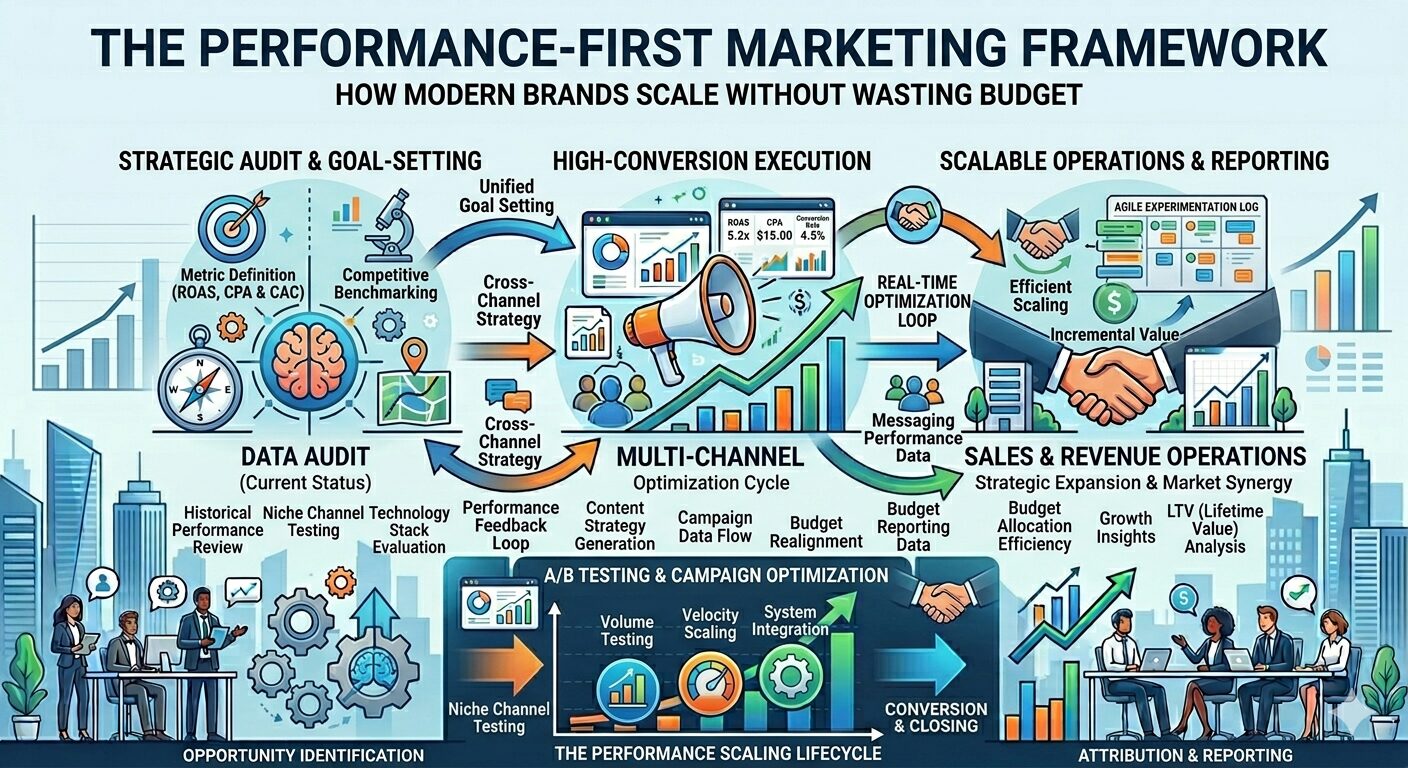
Introduction: Marketing Has Shifted From Creativity to Accountability
Modern marketing is no longer defined by how “creative” a campaign looks. It is defined by how accountable it is to business outcomes.
In the past, brands could invest in campaigns based on visibility, impressions, or brand awareness alone. Today, every decision is measured against a single question:
Does this activity generate measurable business growth?
This shift has fundamentally changed how agencies, startups, and established companies operate. The most successful brands are no longer those that simply “do marketing,” but those that operate on a performance-first marketing framework.
This framework integrates strategy, execution, analytics, and optimization into a continuous system designed to reduce waste and maximize return on investment.
1. What Is Performance-First Marketing?
Performance-first marketing is a structured approach where every marketing activity is tied directly to a measurable outcome.
Instead of focusing on isolated channels (SEO, social media, ads), it focuses on system-wide performance efficiency.
At its core, it revolves around:
- Conversion-driven strategy design
- Data-backed decision making
- Continuous optimization cycles
- Revenue-focused attribution models
- Cross-channel integration
The goal is simple:
Eliminate marketing guesswork and replace it with measurable impact.
2. Why Traditional Marketing Models Fail Today
Many businesses still operate with fragmented marketing structures. These typically include separate efforts for:
- SEO teams working independently
- Social media handled in isolation
- Paid ads managed without organic alignment
- Branding disconnected from conversion strategy
This creates a major inefficiency: lack of synergy between channels.
Key Problems in Traditional Models
1. Channel Silos
Each platform operates independently, leading to inconsistent messaging and wasted budget.
2. Vanity Metrics Focus
Success is measured in likes, impressions, or reach instead of conversions and revenue.
3. Poor Attribution
Businesses cannot identify which channel actually drives customers.
4. Reactive Strategy
Campaigns are launched without long-term system design.
The result is predictable:
high spending, low clarity, and inconsistent growth.
3. The Core Pillars of a Performance-First System
A performance-first marketing framework is built on four interconnected pillars.
Pillar 1: Strategic Positioning
Before any marketing execution begins, the brand must define:
- Who the ideal customer is
- What problem is being solved
- Why the brand is different
- What value proposition is being delivered
Without positioning clarity, no amount of marketing can create sustainable growth.
Strong positioning ensures that every campaign speaks directly to a defined audience segment.
Pillar 2: Channel Integration
Instead of treating marketing channels separately, performance-first systems connect them.
For example:
- SEO content supports paid ad landing pages
- Social media drives traffic to SEO-optimized blogs
- Email campaigns retarget website visitors
- Paid ads validate keyword and audience performance
This creates a unified ecosystem where each channel reinforces the others.
Pillar 3: Conversion Architecture
Traffic alone has no value without conversion systems.
Conversion architecture includes:
- Landing page optimization
- User journey mapping
- Call-to-action placement strategy
- Funnel design (awareness → interest → decision → action)
- Trust-building elements (testimonials, proof, case studies)
The goal is to convert attention into measurable action.
Pillar 4: Data & Optimization Loop
The most important pillar is continuous improvement.
This includes:
- Tracking user behavior
- Monitoring conversion rates
- Analyzing acquisition channels
- Testing variations (A/B testing)
- Refining messaging and targeting
Marketing becomes a continuous optimization loop, not a one-time campaign.
4. How SEO Fits Into Performance Marketing
SEO is often misunderstood as a standalone traffic strategy. In a performance-first framework, SEO becomes a long-term acquisition engine.
Its role includes:
- Generating consistent organic traffic
- Reducing dependency on paid ads
- Improving brand authority
- Supporting conversion funnels
- Feeding remarketing campaigns
Strategic SEO Functions
- Keyword mapping aligned with buyer intent
- Content designed for conversion, not just ranking
- Technical optimization for speed and indexation
- Authority building through backlinks
- Content clusters supporting topic dominance
SEO becomes not just visibility—but predictable inbound revenue generation.
5. Paid Media in a Performance Framework
Paid advertising is often treated as a quick traffic solution. In performance-first marketing, it is used differently:
- Testing market demand
- Validating messaging
- Scaling proven campaigns
- Retargeting high-intent users
Key Principle:
Paid media should not “guess”—it should amplify what already works organically.
This reduces wasted ad spend and improves ROI significantly.
6. Social Media as a Conversion Layer
Social media is not just a branding channel.
In performance-first systems, it functions as:
- A trust-building platform
- A content distribution engine
- A remarketing entry point
- A funnel top-of-awareness layer
Instead of focusing on viral content, the focus shifts to:
- Audience retention
- Engagement quality
- Click-through behavior
- Lead generation pathways
Social media becomes structured, not random.
7. Content Strategy: From Volume to Intent
One of the biggest mistakes in modern marketing is content overload without purpose.
Performance-first content follows a strict rule:
Every content piece must serve a business function.
Content categories include:
- Awareness content (educational blogs, insights)
- Consideration content (comparisons, guides)
- Conversion content (landing pages, case studies)
- Retention content (email, updates, community content)
Instead of publishing more content, the focus is on publishing purpose-driven content.
8. The Role of Data in Decision Making
Data replaces assumptions.
Key metrics used in performance-first systems include:
- Customer acquisition cost (CAC)
- Lifetime value (LTV)
- Conversion rate per channel
- Return on ad spend (ROAS)
- Organic traffic-to-lead ratio
- Funnel drop-off rates
Every marketing decision is validated using data.
If something cannot be measured, it cannot be optimized.
9. Common Mistakes Businesses Make
Even with access to tools and platforms, many businesses fail to grow efficiently.
Common mistakes include:
- Running campaigns without strategy alignment
- Prioritizing vanity metrics over revenue
- Ignoring conversion optimization
- Treating SEO, ads, and social separately
- Not tracking full customer journeys
These mistakes lead to fragmented growth and unstable performance.
10. How to Implement a Performance-First Model
Businesses can transition to this model using a structured approach:
Step 1: Audit Current Marketing
Identify what is generating revenue vs. what is only generating traffic.
Step 2: Define Core KPIs
Align all activities with revenue-based metrics.
Step 3: Integrate Channels
Connect SEO, paid, social, and email into one funnel system.
Step 4: Optimize Conversion Paths
Improve landing pages, funnels, and user experience.
Step 5: Build a Data Loop
Implement continuous tracking and optimization cycles.
Conclusion: Marketing Is Now a System, Not a Set of Activities
The modern digital landscape does not reward isolated marketing efforts. It rewards integrated systems that continuously improve performance.
A performance-first marketing framework ensures:
- Less wasted budget
- Higher conversion efficiency
- Stronger customer acquisition systems
- Sustainable long-term growth
Businesses that adopt this model early gain a structural advantage over competitors still relying on fragmented strategies.
In the end, marketing success is no longer about doing more.
It is about doing what works—and continuously improving it.