Introduction: Why Most Businesses Don’t Actually Grow — They Just Spend More
Most companies don’t fail because they lack marketing.
They fail because their marketing, sales, and strategy operate like separate departments instead of a unified system.
Marketing generates leads.
Sales tries to convert them.
Leadership sets targets.
But there is no alignment between them.
The result is predictable:
- High ad spend, low ROI
- Leads that don’t convert
- Sales teams blaming marketing
- Marketing blaming “bad leads”
- Leadership confused about what’s actually working
This is not a performance problem.
It is a system design problem.
Modern growth requires a different approach: a Revenue Alignment Framework where every function is designed to support a single outcome — predictable revenue.
1. The Core Problem: Fragmented Growth Systems
Traditional business structures were not designed for digital economies.
They were built for:
- Linear customer journeys
- Physical sales environments
- Limited data visibility
Today’s market is the opposite:
- Multi-touch digital journeys
- Real-time analytics
- AI-influenced decision-making
- Highly competitive attention economy
Yet most businesses still operate with disconnected systems.
The typical breakdown looks like this:
Marketing Team
- Focus: traffic, impressions, engagement
- KPI: clicks and leads
Sales Team
- Focus: closing deals
- KPI: conversion rate
Leadership
- Focus: revenue targets
- KPI: monthly/quarterly growth
The missing link is obvious:
👉 No shared definition of a “qualified customer”
👉 No unified funnel ownership
👉 No feedback loop between conversion data and marketing strategy
Without alignment, growth becomes accidental instead of engineered.
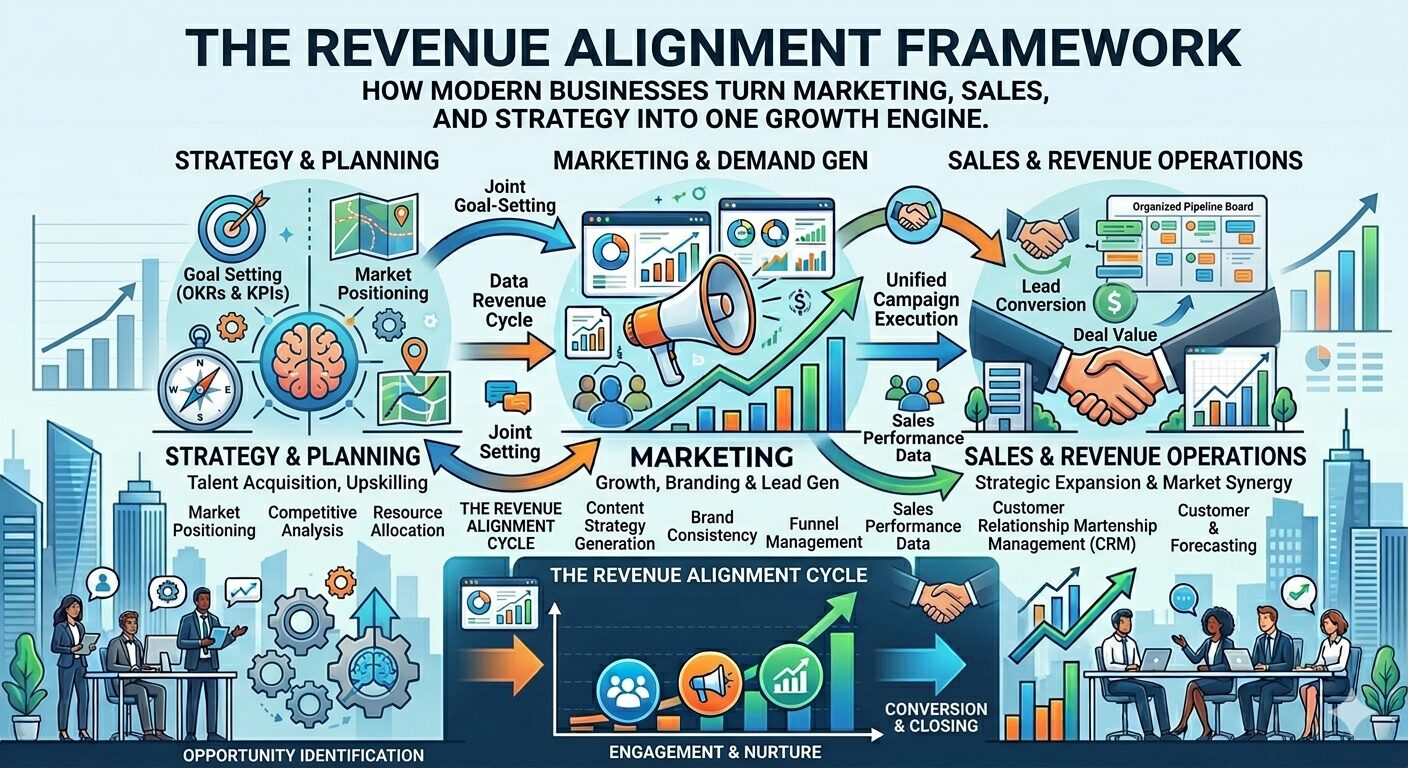
2. The Revenue Alignment Framework Explained
The Revenue Alignment Framework is a structured approach that connects:
- Acquisition (Marketing)
- Conversion (Sales)
- Retention (Customer Success)
- Direction (Leadership Strategy)
Instead of operating separately, all functions are mapped to one metric:
Net Revenue Growth per Customer Segment
This shifts the business from activity-based performance to outcome-based performance.
The framework is built on four pillars:
1. Unified Customer Definition
Every department agrees on:
- Who the ideal customer is
- What qualifies a lead
- What disqualifies a lead
Without this, marketing optimizes for the wrong audience and sales rejects “valid” leads.
2. Shared Funnel Architecture
The funnel is not:
Marketing → Sales → Close
It becomes:
Awareness → Engagement → Qualification → Conversion → Retention → Expansion
Every stage has:
- Clear ownership
- Defined KPIs
- Feedback loops
3. Data-Driven Feedback Loops
Sales insights must feed marketing.
Marketing performance must inform sales strategy.
Customer behavior must influence both.
Without this loop:
- Campaigns repeat mistakes
- Sales scripts become outdated
- Customer objections remain unresolved
4. Revenue-Centric KPIs
Instead of isolated metrics:
Replace:
- CTR (Click-through rate)
- Leads generated
- Calls booked
With:
- Customer acquisition cost (CAC)
- Lifetime value (LTV)
- Revenue per lead
- Conversion velocity
3. Why Traditional Marketing Models Fail in 2026
Marketing used to be simple:
- Run ads
- Generate leads
- Pass them to sales
Now the system is more complex:
- Customers research across 6–12 touchpoints
- Decision cycles are longer
- Trust is harder to build
- Competition is global
The biggest failure point is “lead quality mismatch”
Example:
- Marketing generates 1,000 leads
- Sales only closes 30
- Leadership sees “low conversion rate”
But the real issue is:
- Marketing optimized for volume
- Sales optimized for quality
- No shared definition of value
This mismatch destroys efficiency.
4. The Revenue Engine Model (How High-Growth Companies Operate)
High-performing companies don’t separate departments.
They build a Revenue Engine.
The structure:
A. Demand Generation Layer
- SEO
- Paid ads
- Social content
- Brand positioning
Goal: attract qualified attention
B. Conversion Layer
- Landing pages
- Email sequences
- Sales calls
- Retargeting campaigns
Goal: convert attention into intent
C. Revenue Layer
- Closing deals
- Upselling
- Subscription optimization
- Pricing strategy
Goal: maximize revenue per customer
D. Retention Layer
- Customer support
- Onboarding systems
- Loyalty programs
- Community building
Goal: increase lifetime value
Each layer feeds the next.
No disconnect. No leakage.
5. The Role of Strategy: Why Execution Alone Is Not Enough
Many businesses over-invest in execution:
- More ads
- More content
- More campaigns
But under-invest in strategy.
Execution without strategy leads to:
- Random content production
- Inefficient spending
- Weak positioning
- Low differentiation
Strategy answers:
- Who are we targeting?
- Why should they choose us?
- What outcome are we selling?
Without these answers, execution becomes noise.
6. How to Align Marketing and Sales Practically
Here is a structured implementation approach:
Step 1: Define Revenue Outcomes First
Not leads. Not traffic. Revenue.
Step 2: Reverse Engineer Customer Journey
Map:
- First touchpoint
- Decision triggers
- Conversion barriers
Step 3: Build Shared CRM Visibility
Both teams must see:
- Lead source
- Engagement history
- Sales feedback
Step 4: Create a Unified Score System
Score leads based on:
- Behavior
- Budget
- Intent signals
Step 5: Weekly Revenue Sync Meetings
Not marketing meetings. Not sales meetings.
Revenue meetings:
- What converted
- What failed
- Why it failed
- What changes next
7. The Shift From Campaign Thinking to System Thinking
Most businesses think in campaigns:
- “Let’s run a Facebook ad campaign”
- “Let’s do SEO this month”
- “Let’s push content”
But growth does not come from campaigns.
It comes from systems.
Campaign thinking:
- Short-term spikes
- Inconsistent results
- Reactive strategy
System thinking:
- Predictable pipelines
- Compounding growth
- Scalable outcomes
The Revenue Alignment Framework forces system thinking.
8. Key Metrics That Actually Matter
If you want to measure alignment, track:
- Customer Acquisition Cost (CAC)
- Lifetime Value (LTV)
- LTV:CAC ratio
- Lead-to-close conversion rate
- Revenue per marketing channel
- Sales cycle length
- Retention rate
If these metrics are improving, alignment is working.
If not, the system is still fragmented.
9. Common Mistakes Businesses Make
Mistake 1: Over-optimizing leads instead of revenue
More leads ≠ more growth.
Mistake 2: Ignoring sales feedback
Marketing runs blind without sales input.
Mistake 3: No unified data source
Multiple dashboards = multiple truths.
Mistake 4: Focusing on tools instead of systems
CRM, ads, automation tools don’t fix misalignment.
10. Final Insight: Growth Is a Coordination Problem
The most important realization in modern business is this:
Growth is not a marketing problem.
It is a coordination problem.
Companies that solve coordination outperform companies that simply increase spending.
When marketing, sales, and strategy operate as one system:
- Efficiency increases
- Waste decreases
- Revenue becomes predictable
- Scaling becomes stable
This is the real competitive advantage in modern digital business.
Conclusion: Build Alignment, Not Just Activity
The future of business growth is not about doing more.
It is about connecting what you already do.
The Revenue Alignment Framework is not a tactic — it is an operating model.
And once implemented correctly, it transforms:
- Marketing from expense → investment
- Sales from pressure → system output
- Strategy from theory → execution driver
Businesses that adopt this structure don’t just grow faster.
They grow with control.