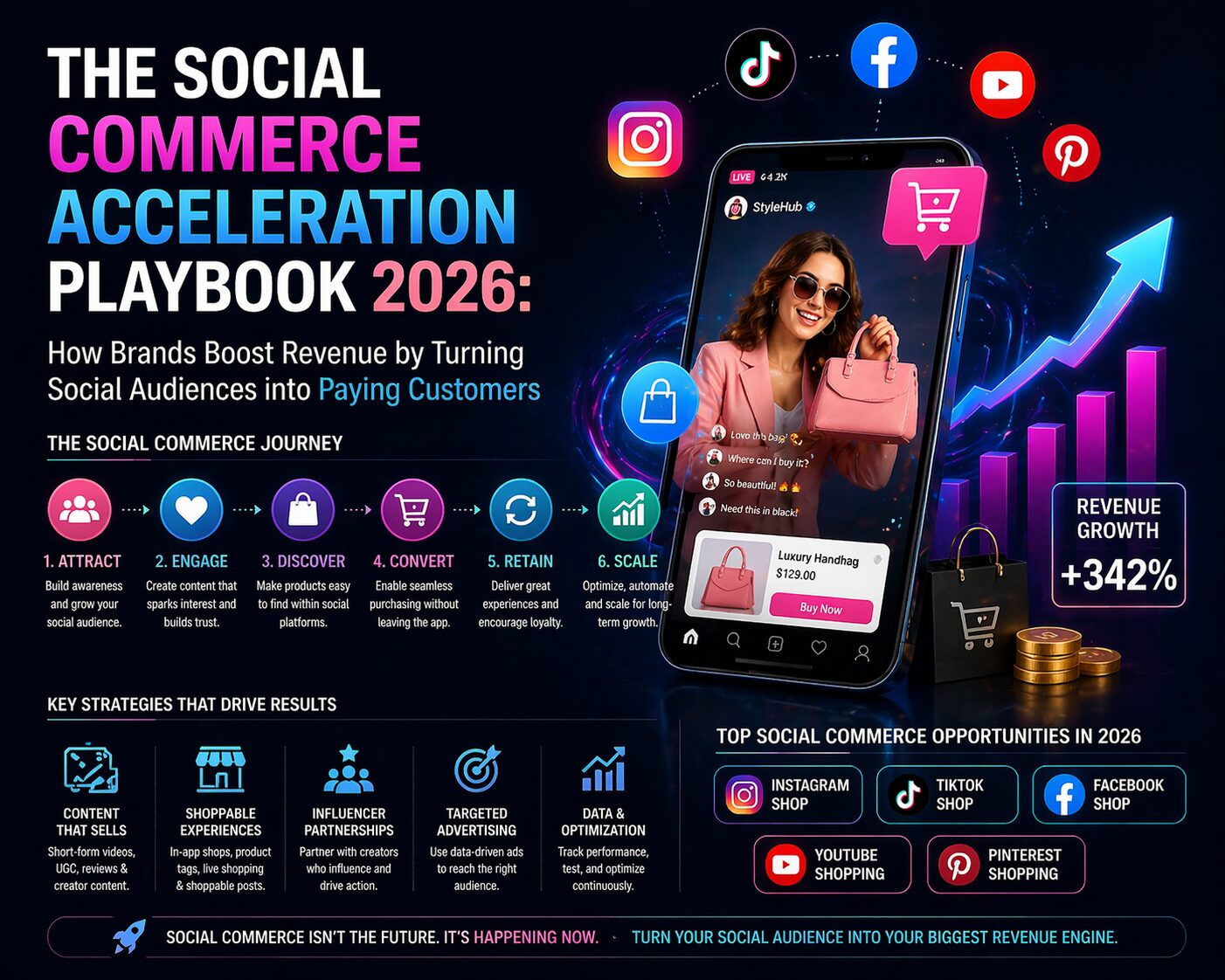
Introduction: Why Social Commerce Is the Growth Engine of 2026
The digital economy has shifted.
Website traffic, search marketing, and email funnels still matter — but no channel holds attention like social platforms today.
Consumers:
- Discover brands through social media
- Validate purchases through community and user feedback
- Buy without ever leaving the platform
This is social commerce — and it’s not a trend. It’s the future of how brands grow revenue online.
In 2026, brands that treat social platforms as transactional environments — not just awareness channels — will dominate.
This playbook will walk you through every step of creating, scaling, and optimizing social commerce revenue, from audience engagement to monetization systems.
Part I — Understanding the Social Commerce Landscape
What Is Social Commerce?
Social commerce is the integration of e‑commerce directly into social platforms, enabling users to:
- Discover products
- Evaluate offerings
- Purchase and pay
- Share experiences
—all within the same ecosystem.
Platforms like Instagram, Facebook, TikTok, and Pinterest are no longer just places to promote brands — they have become shopping destinations.
Why Social Commerce Matters in 2026
Traditional e‑commerce relies on driving users to websites and converting through landing pages. Social commerce flips that model — users buy where they already engage.
The advantages:
- Lower friction buy paths
- Higher engagement
- Better attribution from social signals
- Faster conversions
Social commerce is not just a channel — it is an integrated revenue system.
Part II — The Social Commerce Revenue System
To succeed, brands need a structured framework — not random posting.
We call this the Social Commerce Revenue System — a six‑stage architecture:
- Audience Profiling
- Social Value Funnels
- Product Discovery Loops
- Conversion Path Optimization
- Monetization Engines
- Retention & Repeat Purchase Programs
Each stage works like a cog in a revenue machine.
Stage 1 — Audience Profiling: Know Who Buys and Why
Before you sell, understand who your potential buyers are and what motivates them.
Elements of Effective Audience Profiling
- Demographics
- Age, gender, location
- Psychographics
- Interests, motivations
- Behavioral Signals
- Content engagement
- Buying patterns
- Purchase Intent Stages
- Awareness → Interest → Decision → Purchase
Most brands make the mistake of targeting too broadly — resulting in diluted engagement and wasted ad spend.
By building a high‑resolution audience profile, you can tailor content and offers that match buyer needs at every stage.
Stage 2 — Social Value Funnels: From Attention to Action
Social Value Funnels are sequences that move users from passive viewers to active buyers without leaving the app.
The Stages of a Social Value Funnel
- Attention Capture
Short, engaging hooks that stop the scroll. - Engagement Sequence
Content that invites interaction (comments, shares, saves). - Trust Signals
UGC, testimonials, behind‑the‑scenes proof. - Conversion Pathway
Clear calls‑to‑action (e.g., “Shop Now,” “Try It Today”). - Post‑Purchase Reinforcement
Thank‑you content, repeat offers, community invites.
The funnel converts audience attention into revenue by framing social interactions as steps in a buyer journey — not random posts.
Stage 3 — Product Discovery Loops: Make Browsing Sticky
Discovery is about frictionless exploration.
Unlike traditional e‑commerce where browsing starts on a website, social commerce loops allow users to explore products within the social platform itself.
Types of Discovery Loops
- Reels / Short Form Videos
- Showcase products with context
- Demonstrate use cases
- Feature creators/users
- Carousel Posts
- Tell product stories across multiple cards
- Guides & Collections
- Curated groupings (e.g., “Top 10 Bestsellers”)
- Live Shopping Events
- Real‑time product demos with direct purchase links
Discovery loops keep audiences immersed and increase time‑in‑funnel metrics, which correlates to higher conversion rates.
Stage 4 — Conversion Path Optimization: Reduce Friction, Increase Sales
Selling on social is different from selling on a website.
People buy on social when:
- The path is short
- The context is clear
- The offer feels easy to accept
Best Practices for Conversion on Social Commerce
- Instant Purchase Options
- Integrate in‑platform checkout wherever possible
- Clear Product Pages
- Concise product descriptions
- High‑quality visuals
- Social proof prominently displayed
- Fast Responses
- Prompt replies to comments and DMs increase trust
- Limited Time Offers
- Urgency increases conversions without pressure
- Seamless Payment Methods
- One‑click checkout
- Multiple payment options
Conversion optimization is not just UX — it is psychology + friction management working together.
Stage 5 — Monetization Engines: Make Social Commerce Profitable
A funnel without monetization is a cost center.
Here are the primary engines that generate revenue in social commerce:
1. Direct Purchase
Products sold through in‑platform checkout.
2. Order Bumps & Upsells
Need‑based offers shown at checkout.
3. Subscription / Replenishment Offers
Recurring revenue for consumables.
4. Exclusive Drops / Collections
Limited editions that drive urgency.
5. Affiliate Partnerships
Low‑risk revenue share models with creators.
Together, these monetization engines turn engagement into revenue streams.
Stage 6 — Retention & Repeat Purchases: Beyond First Sales
The average brand growth doesn’t come from first‑time buyers — it comes from repeat customers.
Loyalty Systems That Work
- Point‑based Rewards
- Incentives for repeat purchases
- Subscription Models
- Auto‑renewal for consumables
- Exclusive Social Community
- Private groups for VIP customers
- Personalized Offers
- Dynamic content based on past purchases
Retention is the largest revenue lever — period.
Part III — How to Measure Social Commerce Success
You can’t optimize what you can’t measure.
Core KPI Categories
| Category | Key Metrics |
|---|---|
| Traffic | Impressions, Click‑Through Rate |
| Engagement | Comments, Shares, Saves |
| Conversion | Purchase Rate, Checkout Abandonment |
| Revenue | Average Order Value, Revenue per Visit |
| Retention | Repeat Purchase Rate, Subscription Retention |
Tracking these measures ensures that you are not just publishing content — you are building profitable pathways.
Part IV — Content Strategies That Drive Social Commerce
Strategy 1: UGC‑Focused Playbooks
User‑generated content increases trust more than branded content. UGC signals authenticity — and buyers crave authenticity.
Best practices:
- Repurpose UGC across reels, stories, and ads
- Feature customer voices with product context
- Use social proof as primary conversion signals
Strategy 2: Story‑Led Commerce
Stories persuade better than product lists.
Effective storytelling:
- Places product in real‑world use cases
- Connects emotionally with the audience
- Provides context before the purchase pitch
Strategy 3: Creator Partnerships
Creators bridge audience trust and commerce.
Partnership frameworks:
- Collaborative product launches
- Co‑created content with audience engagement hooks
- Revenue share + affiliate codes
Partnering with creators diversifies traffic and amplifies credibility.
Part V — Platform‑Specific Tactics
- Shopping tags in reels
- Shop tab optimization
- Product stickers in stories
TikTok
- Native product catalogs
- Live commerce events
- Music + trend‑based conversion loops
- Facebook Shop + customized collections
- Group‑based commerce offers
- Retargeting audiences across feed and marketplace
Each platform has unique conversion mechanics — leverage them intentionally.
Part VI — Social Commerce Advertising: ROI‑Focused Campaigns
Paid ads should support the revenue system — not stand alone.
Key principles:
- Align ads with funnel stages
- Use high‑intent audience targeting
- Retarget engaged users with offer‑based creatives
- Measure revenue per ad dollar — not clicks
This ensures that ad spend is not a cost, but a direct revenue multiplier.
Part VII — Organizational Structure for Social Commerce Success
Social commerce is cross‑functional:
- Marketing
- Sales
- Product
- Customer Support
Top‑performing teams build structures where these functions are aligned toward revenue outcomes, not individual KPIs.
Part VIII — Common Pitfalls and How to Fix Them
Pitfall 1 — Too Much Content, Too Little Strategy
Fix: Align content to purchase intent stages.
Pitfall 2 — Ignoring Retention
Fix: Build loyalty offers and subscription paths.
Pitfall 3 — Disconnected Messaging
Fix: Use consistent brand narrative across platforms.
Part IX — Scaling Your Social Commerce Machine
To scale beyond early wins:
- Automate engagement workflows
- Build creator and ambassador programs
- Localize content for markets
- Leverage audience data for personalization
Scaling requires systems — not random posts.
Conclusion: From Audience to Revenue — The System Wins
Social commerce is not content for content’s sake.
It’s a business growth system that connects social attention with commercial outcomes.
By following the Social Commerce Revenue System, brands can:
- Increase conversion rates
- Build repeat buyers
- Reduce acquisition costs
- Expand revenue predictably
In 2026 and beyond, the brands that win are those that bridge engagement and commerce into a unified revenue engine.
Call to Action
Ready to build your social commerce revenue system?
Start by picking one funnel from this playbook and implement it over 90 days. Measure results — refine based on data — then scale.