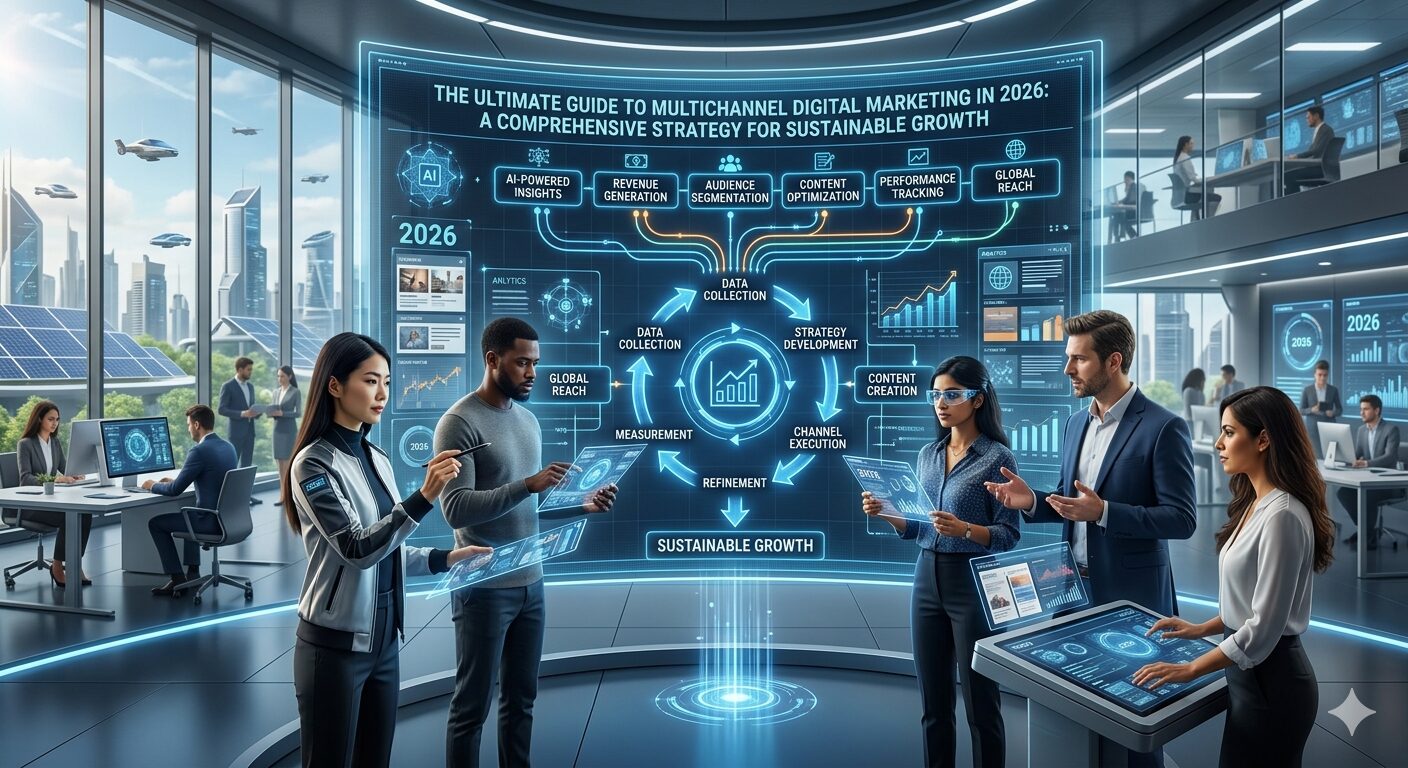
Introduction — Why Multichannel Marketing Matters in 2026
In 2026, digital marketing is more complex and more powerful than ever before. Gone are the days when posting on social media or running a couple of ads could deliver predictable results. Today’s landscape is defined by audience expectations — personalized, seamless, and value‑driven interactions across platforms.
Consumers no longer engage with brands on just one channel. They browse on search, interact on social, discover through email, and convert via your website or app. The brands that succeed do not treat these channels independently — they integrate them into a cohesive experience that drives discovery, engagement, conversion, and retention.
This complete guide explores how to build and optimize a true multichannel digital marketing strategy in 2026 — one that:
- Aligns with evolving audience behavior
- Balances paid, owned, and earned media
- Connects data across touchpoints
- Converts traffic into loyal customers
- Drives measurable business outcomes
Whether you’re a founder, marketer, or business owner looking to scale, this blueprint will help you design a modern, resilient marketing system that delivers in the long run.
1. What Is Multichannel Marketing — And Why It’s Essential
1.1 Defining Multichannel vs. Omnichannel
Multichannel marketing means engaging audiences through multiple channels — such as SEO, social media, email, content platforms, paid ads, and more.
Omnichannel marketing goes a step further — ensuring consistency and integration between those channels so that the customer experience feels seamless across touchpoints.
In 2026, marketers should aim for omnichannel experiences built on multichannel execution.
Why?
Consumers expect continuity:
- You advertise on LinkedIn → they search on Google
- They receive a retargeting ad → click through to your website
- They subscribe via email → and get personalized content
A disconnected presence feels disjointed and undermines trust.
2. Understanding Customer Behavior & Intent
Before choosing channels or creating content, you must understand your audience’s journey.
2.1 The Customer Journey Framework
The modern journey has three major stages:
- Discovery / Awareness
How do people first hear about your brand? (Search, social, referral, content) - Consideration / Evaluation
How do they learn about your value proposition? (Case studies, reviews, email) - Conversion / Retention
How do they purchase and stay engaged? (Offers, funnels, loyalty campaigns)
Each stage requires different tactics and messaging.
2.2 Mapping User Intent
User intent is the why behind every interaction:
- Informational: “What is social media marketing?”
- Navigational: “Mediashoes digital marketing services”
- Transactional: “Hire a marketing agency”
- Retention/Repeat: “Advanced campaign ideas for 2026”
Mapping content and ads to intent improves relevance and conversion.
3. Search Engine Optimization (SEO) — The Backbone of Discoverability
SEO remains the foundation of long‑term visibility.
3.1 Keyword Strategy That Aligns With Intent
Modern SEO focuses on topic clusters and semantic relevance:
- Identify core topic pillars (e.g., “digital marketing strategy”, “content funnel”, “SEO for small business”).
- Create supporting pages that link back to the pillar.
This improves authority and overall search presence.
3.2 Technical & On‑Page Optimization
High‑impact SEO factors in 2026 include:
- Page speed and Core Web Vitals
- Mobile friendliness
- Structured data/schema
- Clear content hierarchy (H1, H2 tags)
- Internal/external linking
Search engines reward pages that provide comprehensive and helpful answers to user queries.
3.3 Local & Voice Search Optimization
Local SEO and voice search continue to rise — especially for small and medium businesses. Optimize content for:
- Natural language queries (“digital marketing agency near me”)
- Featured snippets
- Google Business Profile and other directories
This expands visibility for relevant, high‑intent searchers.
4. Content Marketing — Educate, Engage & Convert
Content is much more than blog posts. It’s the center of your value exchange with audiences.
4.1 Long‑Form Content That Establishes Authority
Long‑form articles, guides, and pillar pages build trust and improve rankings. These should be:
- Well‑researched
- Actionable
- Optimized for readability (subheadings, visuals, CTAs)
Example Pillar Topics:
- “How to Build a Multichannel Marketing Strategy in 2026”
- “The Complete Guide to SEO Traffic for Small Businesses”
- “Social Media Content Ideas That Convert”
4.2 Diversified Content Formats
Different audiences prefer different formats:
| Format | Best Use Case |
|---|---|
| Blog Articles | SEO + educational content |
| eBooks/Whitepapers | Lead magnet and deep dive |
| Infographics | Visual summaries and shareable content |
| Videos | Explainers and social engagement |
| Webinars | Conversion‑focused education |
| Podcasts | Thought leadership and retention |
Content should align with where your audience spends time and how they prefer to consume information.
5. Social Media — Build Presence & Engagement
Social media is more than posting — it’s about community and relevance.
5.1 Choosing the Right Platforms
Focus where your audience is:
- LinkedIn: B2B, thought leadership, professional visibility
- Instagram: Visual storytelling and brand personality
- TikTok: Short, creative engagement
- Facebook: Broad reach and community groups
- YouTube: Long‑form educational and how‑to content
Not every platform is a priority — choose based on audience fit and business goals.
5.2 Content That Drives Engagement
People engage with content that:
- Educates
- Inspires
- Makes them think
- Entertains
Examples:
- Short how‑to videos
- Carousel posts summarizing key insights
- Behind‑the‑scenes content
- User‑generated content (UGC)
Tip: Always include a strong CTA — engage, save, click, share.
5.3 Social Listening & Community Interaction
Respond to comments, join conversations, ask questions, and use polls/stories to gather insights. Social listening tools help you:
- Monitor brand mentions
- Follow industry trends
- Identify customer sentiment
Interaction builds trust and increases reach.
6. Paid Advertising — Amplify Reach Efficiently
Organic alone rarely scales fast enough. Paid channels help you reach specific audiences quickly.
6.1 Paid Search Campaigns
Google Ads and search networks capture high‑intent audiences. Best practices:
- Target keywords with commercial intent
- Use ad extensions (site links, callouts, structured snippets)
- Test ad copy variations continuously
Measure cost per conversion — not just clicks.
6.2 Social Paid Campaigns
Use paid social to:
- Drive awareness
- Generate leads
- Retarget engaged audiences
Platforms like Meta, LinkedIn, and TikTok allow granular audience targeting — from demographics to interests to behaviour.
6.3 Retargeting Strategies
Retargeting brings back visitors who already showed interest:
- Website visitors who didn’t convert
- Landing page interactions
- Email click‑throughs
- Social engagers
Retargeting ads convert at higher rates because they are warm audiences.
7. Lead Generation & Conversion Optimization
Traffic alone doesn’t pay bills — qualified leads and conversions do.
7.1 High‑Impact Lead Magnets
Offer downloadable value in exchange for contact info — like:
- Checklists
- Templates
- eBooks
- Toolkits
- Case studies
Each magnet should tie into a clear next action — such as a consultation, trial, or purchase.
7.2 Landing Page Best Practices
Your landing pages must:
- Have a clear value proposition
- Include trust elements (testimonials, logos, numbers)
- Use a concise form
- Have a strong, action‑oriented CTA
Keep distractions minimal to improve conversion rates.
7.3 Conversion Funnels & Paths
A conversion funnel should guide prospects from:
- Awareness → lead magnet
- Lead magnet → nurture sequence
- Nurture → offer or consultation
- Offer → purchase or signup
Each stage has different messaging and expected outcomes.
8. Email Marketing — Nurture Leads and Customers
Email is one of the highest ROI channels in digital marketing.
8.1 Segmentation for Better Relevance
Segment your list by:
- Interest
- Behavior
- Stage in the funnel
- Past engagement
Personalized email flows outperform generic broadcasts.
8.2 Automated Campaigns
Set up:
- Welcome sequences
- Lead nurturing journeys
- Abandoned cart sequences
- Re‑engagement campaigns
Automation keeps your audience engaged even while you sleep.
9. Data & Analytics — Measure Performance, Inform Decisions
If you can’t measure it, you can’t improve it.
9.1 KPI Mapping by Channel
| Channel | Primary Metrics |
|---|---|
| SEO | Impressions, organic clicks, ranking positions |
| Social | Engagement, reach, follower growth |
| Paid | CPC, CPA, ROAS |
| Open rate, CTR, conversion | |
| Website | Bounce rate, session duration, goals |
Define what success looks like for each channel and report regularly.
9.2 Attribution and Unified Analytics
Understand the true value of each channel using:
- Multi‑touch attribution
- UTM tracking
- Conversion paths
This helps you invest where the real value is generated.
10. Aligning Teams & Workflow for 2026 Success
Modern marketing isn’t a solo effort — it involves collaboration across teams.
10.1 Break Down Siloes
Ensure:
- Content teams work with SEO
- Social teams share data with analytics
- Paid teams align with email and CRM
Shared KPIs promote alignment.
10.2 Use Agile Marketing Frameworks
Short sprints, regular stand‑ups, testing cycles, and iterative improvements keep marketing nimble and responsive to data.
11. Emerging Trends to Watch in 2026
11.1 AI‑Powered Personalization
AI tools allow:
- Dynamic content recommendations
- Automated personalization
- Smarter segmentation based on behavior
This improves relevance and boosts conversions.
11.2 Voice & Visual Search Optimization
With smart devices and voice assistants rising, optimize content for conversational queries and image‑based search.
11.3 Shoppable Content & Social Commerce
Integration of commerce features within social platforms makes instant purchases seamless.
12. Common Pitfalls and How to Avoid Them
12.1 Ignoring Audience Insights
Data ignores assumptions — not conclusions. Always validate strategies with data.
12.2 Not Testing Enough
A/B tests help refine headlines, CTAs, landing pages, and ad copy.
12.3 Overlooking Cross‑Channel Consistency
Your brand voice, offer, and messaging must feel unified across channels.
13. Final Blueprint Checklist for 2026
✔ Defined target audience
✔ SEO‑optimized content roadmap
✔ Paid advertising strategy with retargeting
✔ Lead magnets and conversion paths
✔ Email and automation architecture
✔ Analytics and performance dashboards
✔ Cross‑functional team workflows
✔ Trend monitoring and agile updates
Conclusion — Integrated Marketing for Sustainable Growth
The digital marketing ecosystem of 2026 rewards brands that plan strategically, execute consistently, and measure intelligently. Multichannel marketing is not a luxury — it’s a requirement for scale, resilience, and long‑term relevance.
By aligning your channels, optimizing every touchpoint, and continuously improving through data, you turn your marketing from a cost center into a growth engine that generates predictable results.
Start with a clear funnel, expand with tailored experiences, and refine through measurement — and your business won’t just compete — it will lead.