

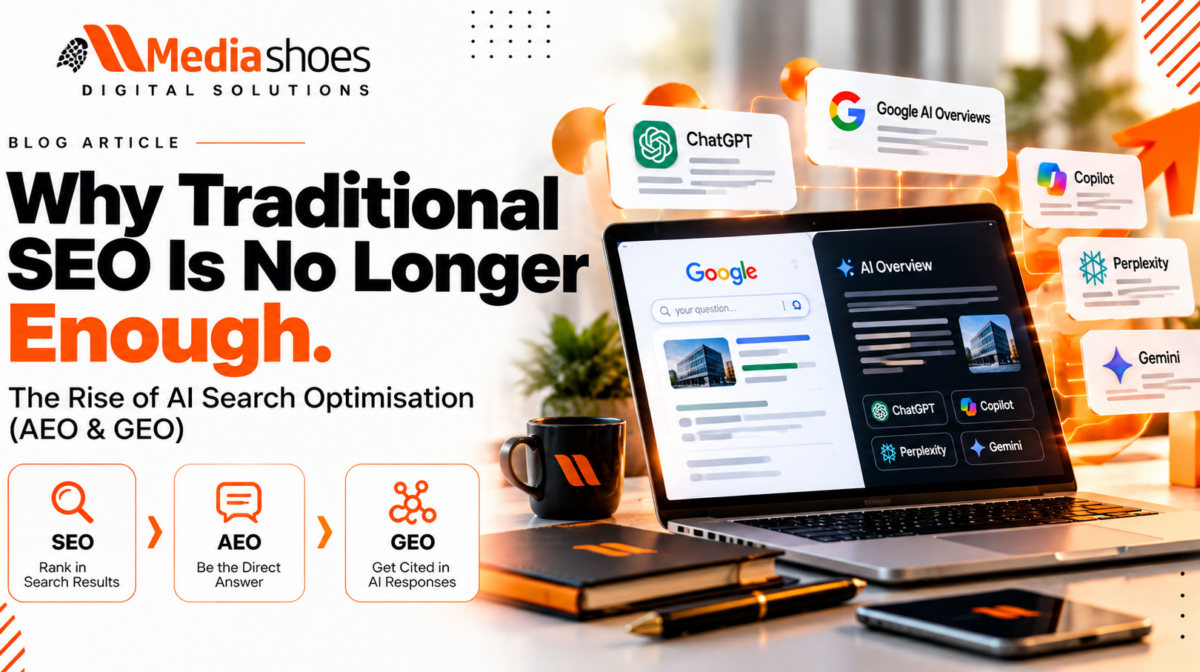
Search is changing rapidly.
For years, digital marketing strategies focused on a singular goal: ranking higher on traditional search engine results pages (SERPs). While foundational search engine optimisation (SEO) remains essential, today’s buyers and decisionmakers increasingly discover products, services, and industry insights through AI-powered answer engines and generative platforms such as ChatGPT, Microsoft Copilot, Google AI Overviews, and Perplexity.
Instead of browsing multiple websites, scanning competing landing pages, and piecing information together manually, users now prompt AI interfaces with complex, multi-layered questions and receive direct, synthesized answers.
The core challenge for modern businesses is no longer simply securing a spot on page one. It is becoming the primary source that AI models choose to reference, cite, and validate.
SEO vs. AEO vs. GEO: A Multi-Layered Visibility Strategy
The future of digital visibility requires expanding your strategy across three distinct yet interconnected pillars.
| Approach | Primary Purpose | How It Works |
|---|---|---|
| SEO (Search Engine Optimisation) | Improve rankings in traditional keyword-driven search results. | Optimises website architecture, technical performance, content relevance, and keyword targeting to improve crawler indexing and search visibility. |
| AEO (Answer Engine Optimisation) | Become the direct, authoritative answer to specific user queries. | Structures content into concise, question-focused formats with clear definitions, FAQs, and direct answers that answer engines can easily extract. |
| GEO (Generative Engine Optimisation) | Increase brand visibility, citation frequency, and trust within AI-generated responses. | Incorporates rich contextual information, verifiable entities, structured data, and E-E-A-T signals that generative AI systems use when synthesising responses. |
While traditional SEO helps users physically find your domain, Answer Engine Optimisation (AEO) and Generative Engine Optimisation (GEO) ensure that machine learning systems understand, trust, and explicitly cite your content when answering user prompts.
What AI Search Engines Look For: Mastering E-E-A-T
Modern AI systems evaluate digital content through a fundamentally different lens than legacy search crawlers. Rather than relying solely on keyword density and basic backlinks, generative models scan for clear, verifiable signals of credibility and expertise. These evaluation markers form Google’s E-E-A-T framework, which heavily dictates both traditional rankings and AI citation rates:
- Experience: Does the content demonstrate authentic, real-world operational knowledge and practical deployment history?
- Expertise: Does the author or brand genuinely master the technical nuances of the subject matter?
- Authoritativeness: Is the brand recognized by industry peers, external databases, and knowledge graphs as a trusted source?
- Trustworthiness: Can users and retrieval-augmented generation (RAG) pipelines safely rely on the accuracy and compliance of the information provided?
Why Entity-Based SEO Drives AI Retrieval
One of the most consequential shifts in modern search is the transition from keyword-based matching to entity-based understanding.
AI search models do not just read strings of words; they map relationships between real-world entities, which can include:
- Corporations and agencies
- Industry professionals and authors
- Specific software products, goods, and services
- Geographical locations and operational markets
Search engines and knowledge graphs evaluate the semantic associations surrounding your brand. For instance, if an AI retrieval system clearly associates Mediashoes with core capabilities like digital marketing, technical SEO, enterprise website development, strategic branding, and AI search optimisation, it is mathematically far more likely to surface and cite the business when enterprise buyers search for those exact services. This is why entity optimisation is rapidly becoming the backbone of modern digital visibility.
The E.A.G.L.E Framework™ for AI Search Visibility
At Mediashoes, we advise organizations to anchor their digital strategy in five core pillars designed to maximize retrieval probability across both legacy search engines and generative AI platforms:
E – Entity Optimisation
Forge robust, machine-readable connections that help search engines instantly understand who you are, what enterprise solutions you provide, and how your brand relates to your broader industry vertical.
A – Authority Content
Publish original, data-backed insights, technical whitepapers, and expert analysis that are inherently worthy of citation by both human researchers and generative models.
G – Graph Relationships
Build clear, data-driven connections between your brand, core services, contributing authors, target industries, and geographic locations to streamline machine mapping and knowledge graph integration.
L – Linked Validation
Earn stakeholder and algorithmic trust by securing high-authority backlinks, verified industry mentions, and external citations that meet rigorous industry compliance criteria.
E – Expert Demonstration
Showcase verifiable credentials, detailed enterprise case studies, and measurable performance metrics that provide indisputable proof of execution capabilities.
The Role of Structured Data and Schema Markup
Even the most comprehensive thought-leadership content can be misinterpreted by machine learning models if it lacks explicit context.
Schema markup and structured data act as a universal translation layer, helping search engines and AI crawlers unambiguously interpret:
- Corporate organizational structures
- Long-form articles and whitepapers
- Author credentials and credentials directories
- Service line specifications
- Frequently asked questions (FAQs)
- Verified client reviews and testimonials
When properly implemented, structured data eliminates ambiguity, improves semantic clarity, and directly strengthens machine comprehension of your brand assets. In the age of AI search, absolute clarity is a vital competitive advantage.
Frequently Asked Questions
What is AI Search Optimisation?
AI Search Optimisation is the strategic process of structuring, enriching, and formatting digital content so it can be seamlessly discovered, accurately understood, and frequently cited by generative AI platforms such as ChatGPT, Microsoft Copilot, Google AI Overviews, and Perplexity.
How is AEO different from traditional SEO?
Traditional SEO focuses primarily on improving visibility and rankings within traditional keyword-driven search engine results pages. Answer Engine Optimisation (AEO) focuses on structuring content into concise, authoritative answers designed to be directly extracted and surfaced by search engines and AI assistants.
What is Generative Engine Optimisation (GEO)?
Generative Engine Optimisation (GEO) is a specialized framework that helps businesses improve their visibility, citation frequency, and sentiment within AI-generated responses by strengthening content quality, brand authority, trust signals, and entity recognition.
Why is E-E-A-T critical for AI search visibility?
E-E-A-T (Experience, Expertise, Authoritativeness, and Trustworthiness) provides the foundational trust signals that search engines and AI models use to assess content credibility before choosing to display, reference, or cite a brand in an automated response.
Does schema markup improve AI visibility?
Yes. Schema markup provides machine-readable context that helps AI engines easily interpret relationships between organizations, service offerings, authors, and industry topics, significantly increasing the probability of correct retrieval and citation.