
What’s Your Biggest Marketing Challenge? How to Fix Visibility, Lead Generation and Conversion Problems
Low visibility, too few leads and disappointing conversion rates are three of the most common barriers to business growth. The good news is that each problem can be identified, measured and improved with the right digital marketing strategy.
Marketing can look busy without actually producing meaningful business growth. A company may be publishing social media content, updating its website, sending emails, investing in SEO and even running paid advertising — yet still struggle to generate enough enquiries or sales.
When this happens, the solution is rarely to simply “do more marketing.” The better approach is to identify exactly where the customer journey is breaking down.
For many businesses, the challenge can be traced back to one or more of three areas:
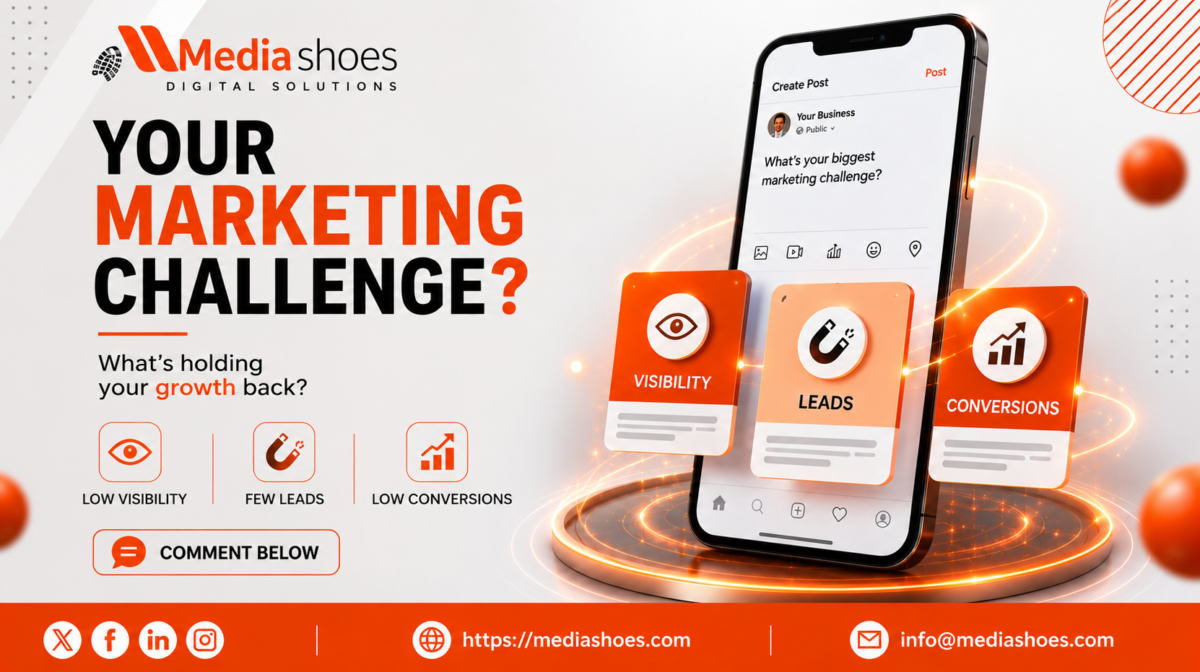
- Low visibility: the right people are not discovering your business.
- Too few leads: people are finding you, but not taking meaningful action.
- Low conversions: enquiries or visitors are not becoming customers.
Understanding which of these problems is affecting your business gives you a much stronger starting point for improving marketing performance.
Marketing works better when you fix the right problem.
More traffic will not solve a weak conversion process, and a better website will have limited impact if nobody can find it. Diagnose first, then invest.
In This Guide
- Understanding your real marketing challenge
- Challenge 1: Low online visibility
- Challenge 2: Not generating enough leads
- Challenge 3: Low conversion rates
- How SEO, content, social media and paid advertising work together
- Website and landing-page optimisation
- Marketing measurement and analytics
- A practical marketing improvement framework
- Common marketing mistakes
- Frequently asked questions
Start by Identifying the Real Marketing Problem
One of the most expensive marketing mistakes is investing in a solution before understanding the problem.
For example, a business might assume it needs more website traffic because sales are low. However, analytics could reveal that thousands of relevant visitors already reach the website every month. The real issue may be that the pages are confusing, the offer is unclear or the calls to action are weak.
In that situation, spending more money on traffic simply sends more people into an ineffective conversion journey.
Another company might redesign its website because enquiries are low, when its actual problem is poor search visibility. A beautiful website cannot generate many opportunities if potential customers never discover it.
| Marketing Problem | Typical Symptom | What to Investigate | Possible Focus |
|---|---|---|---|
| Low Visibility | Very little relevant traffic or brand discovery | Search rankings, impressions, reach and traffic sources | SEO, content, social media and paid reach |
| Few Leads | Traffic exists but enquiries remain low | Offers, CTAs, landing pages and audience quality | Lead generation and conversion paths |
| Low Conversions | Interest exists but few prospects become customers | Trust, UX, sales journey and follow-up | Conversion optimisation and nurturing |
Marketing Challenge #1: Low Visibility
Your business cannot convert people who never discover it.
Visibility is therefore the first stage of the digital marketing journey. Your brand needs to appear in the places where potential customers search, research, compare and spend their time.
Low visibility can affect established businesses as well as new companies. You may offer an excellent service, but competitors with stronger search rankings, better content or more consistent digital activity can capture attention first.
Signs That Visibility May Be Your Main Problem
- Low organic website traffic
- Very few impressions in search results
- Poor rankings for commercially relevant keywords
- Limited social media reach
- Competitors consistently appear before your brand
- Low branded search volume
- Customers rarely mention discovering you online
How to Improve Online Visibility
Visibility usually improves through a combination of channels rather than one isolated tactic.
1. Strengthen Search Engine Optimisation
SEO helps search engines understand what your website offers and connects your pages with relevant searches. Effective SEO goes beyond inserting keywords into pages.
It can involve:
- Keyword and search-intent research
- Technical website improvements
- Page-speed optimisation
- Title and meta-description optimisation
- Service-page development
- Internal linking
- Useful blog and informational content
- Local SEO where relevant
- Authority and reputation development
2. Publish Content People Actually Need
Content gives businesses additional opportunities to appear throughout the research process. Instead of creating content purely to remain active, focus on questions, problems and decisions that matter to your target audience.
Useful formats may include guides, industry insights, FAQs, case studies, comparisons, videos, social posts and educational articles.
3. Build Consistent Social Visibility
Social media can reinforce brand recognition and help businesses remain visible between buying decisions. The objective should not simply be posting frequently. Content needs a clear purpose and should support awareness, expertise, engagement or conversion.
4. Use Paid Advertising Strategically
Paid campaigns can create immediate visibility while organic channels develop. However, advertising performs best when targeting, messaging, landing pages and tracking are aligned.
Marketing Challenge #2: You Are Getting Traffic but Not Enough Leads
Traffic is useful only when it contributes to a business objective.
If people are reaching your website but rarely making contact, requesting information, booking consultations or completing other valuable actions, the issue may sit between attention and intent.
Visitors need a clear reason to move forward.
Why Websites Generate Traffic but Few Leads
- The value proposition is unclear
- The wrong audience is being attracted
- Calls to action are weak or difficult to find
- Landing pages contain too many distractions
- Forms are unnecessarily complicated
- The content does not answer buyer questions
- There is insufficient evidence or trust
- The offer does not match the visitor’s intent
- The next step feels like too much commitment
Build Clear Conversion Paths
Every important page should help visitors understand three things:
- What do you offer?
- Why should the visitor care?
- What should they do next?
Removing uncertainty makes it easier for users to continue through the journey.
A Simple Digital Marketing Journey
1. ATTRACT
Reach the right audience.
2. ENGAGE
Give them a reason to stay.
3. CAPTURE
Turn interest into a lead.
4. NURTURE
Build confidence and trust.
5. CONVERT
Create the customer action.
Marketing Challenge #3: Low Conversion Rates
Perhaps your business already has visibility and generates enquiries, but too few of those opportunities become customers.
This is where conversion optimisation becomes critical.
Conversion problems are not always caused by marketing alone. Pricing, positioning, customer experience, sales processes, response times and competitive factors can all influence the final decision.
What Can Reduce Conversions?
- Unclear messaging
- Poor mobile experience
- Slow website performance
- Weak calls to action
- Complicated forms
- Lack of testimonials or evidence
- Insufficient information
- Confusing pricing or service options
- Poor follow-up
- A mismatch between advertising and landing-page messaging
Your Website Should Support the Entire Marketing Strategy
A website should not simply act as an online brochure. For many businesses, it is the central point where search, social media, advertising, email and content campaigns ultimately send potential customers.
That means design and marketing cannot be treated as completely separate activities.
A strong marketing website should be:
- Fast enough to create a smooth experience
- Responsive across mobile, tablet and desktop
- Easy to navigate
- Clear about its value proposition
- Search-friendly
- Conversion-focused
- Trustworthy
- Measurable through appropriate analytics
How Different Marketing Channels Support Growth
Businesses often ask which digital marketing channel is best. There is no universal answer because each channel can serve a different stage of the customer journey.
| Channel | Primary Role | Can Support |
|---|---|---|
| SEO | Search discovery | Visibility, relevant traffic and long-term acquisition |
| Content Marketing | Education and authority | Awareness, trust and lead nurturing |
| Social Media | Reach and engagement | Brand visibility, community and traffic |
| Paid Advertising | Targeted reach | Traffic, leads and campaign-specific conversions |
| Email Marketing | Nurturing and retention | Repeat engagement, lead development and customer value |
| Website & CRO | Conversion | Enquiries, bookings, purchases and other actions |
Content Should Answer Real Customer Questions
Good content does more than fill a blog or social media calendar. It should help potential customers move from uncertainty towards a decision.
Before producing content, consider what your audience wants to understand at each stage.
Awareness Stage
Address the problems and challenges customers are beginning to recognise.
Consideration Stage
Explain potential solutions, approaches, advantages, disadvantages and important considerations.
Decision Stage
Provide the information and evidence customers need to feel confident choosing a provider.
This creates a connected content strategy rather than a collection of unrelated posts.
Measure What Actually Matters
Digital marketing creates large amounts of data, but not every metric is equally valuable.
A post receiving thousands of impressions may look successful, but those impressions have limited commercial significance if they reach the wrong audience and produce no meaningful action.
Measurement should connect marketing activity with business objectives.
| Objective | Useful Metrics |
|---|---|
| Increase Visibility | Impressions, reach, rankings, organic traffic and share of visibility |
| Improve Engagement | Engaged sessions, content interaction and relevant social engagement |
| Generate Leads | Enquiries, form submissions, calls and qualified leads |
| Improve Efficiency | Cost per lead, conversion rate and acquisition efficiency |
| Drive Revenue | Sales, qualified opportunities, customer acquisition and revenue contribution |
A Practical Framework for Improving Your Digital Marketing
Instead of making random changes, businesses can use a structured improvement process.
- Define the commercial objective.
Decide what marketing needs to achieve. More visibility? Qualified enquiries? Sales? Customer retention? - Understand the audience.
Identify who you want to reach, what they need and how they make decisions. - Audit current performance.
Review your website, SEO, content, social presence, campaigns, analytics and conversion journey. - Identify the biggest bottleneck.
Determine whether visibility, traffic quality, lead generation or conversion is limiting growth. - Prioritise high-impact improvements.
Focus resources on changes most likely to influence the desired business outcome. - Measure performance.
Track meaningful indicators rather than relying on assumptions. - Optimise continuously.
Use the resulting data to refine campaigns, content, pages and customer journeys.
Quick Marketing Audit Checklist
Ask your business these questions:
- ✓ Can customers easily find us through search?
- ✓ Are we attracting the audience we actually want?
- ✓ Does our website immediately explain what we offer?
- ✓ Is there a clear next step on important pages?
- ✓ Does our content answer genuine customer questions?
- ✓ Do we provide enough evidence to build trust?
- ✓ Is our mobile experience smooth?
- ✓ Are leads followed up effectively?
- ✓ Can we identify which marketing channels generate opportunities?
- ✓ Are marketing decisions based on data rather than assumptions?
Common Digital Marketing Mistakes to Avoid
Trying Every Channel at Once
Being everywhere is not automatically a strategy. It can spread budgets and resources too thinly. Prioritise channels according to your audience and objectives.
Focusing Only on Traffic
Traffic is an input, not necessarily an outcome. Relevant visitors and meaningful actions matter more than large numbers alone.
Creating Content Without a Purpose
Every piece of content should have a reason to exist. It might educate, improve search visibility, answer an objection, build authority or encourage action.
Ignoring the Website Experience
Marketing campaigns can successfully generate attention and still fail because of a poor website experience.
Treating Leads as the Finish Line
Generating an enquiry is only part of the process. Lead quality, response time, nurturing and sales follow-up can significantly influence final results.
Making Decisions Without Reliable Data
Without appropriate measurement, businesses may continue investing in activities that look impressive but contribute little to their objectives.
Why Integrated Digital Marketing Is More Powerful
SEO, content marketing, social media, email, advertising, website development and analytics should not operate as completely separate activities.
They become more effective when each channel supports the others.
For example, SEO can bring a potential customer to an educational article. The article can introduce the business’s expertise and direct the visitor towards a relevant service page. A strong service page can encourage an enquiry. Email or remarketing can then continue the relationship if the customer is not ready to make an immediate decision.
In this model, each channel has a specific role within one connected customer journey.
| Stage | Customer Question | Marketing Goal | Potential Channels |
|---|---|---|---|
| Awareness | What solutions exist? | Become discoverable | SEO, social, content, advertising |
| Consideration | Which approach is right for me? | Educate and build trust | Guides, email, case studies, service content |
| Decision | Why should I choose this business? | Reduce uncertainty and convert | Landing pages, testimonials, CTAs, remarketing |
| Retention | Why should I stay engaged? | Increase customer value | Email, content, social and customer communication |
Where Should You Invest First?
Your next marketing investment should depend on the bottleneck identified in your current customer journey.
If visibility is extremely low, improving conversion buttons alone is unlikely to transform growth because too few potential customers reach the website.
If traffic is already strong but enquiries are weak, increasing advertising expenditure may simply increase acquisition costs without fixing the underlying problem.
If leads are plentiful but sales remain disappointing, the priority may extend beyond marketing into qualification, nurturing, positioning or the sales process.
The Principle Is Simple
Find the bottleneck → understand why it exists → improve it → measure the result → repeat.
Frequently Asked Questions
What is the biggest digital marketing challenge for businesses?
There is no single challenge shared equally by every business. Common problems include poor visibility, attracting the wrong traffic, insufficient leads, low conversion rates and difficulty measuring which marketing activities contribute to commercial results.
How can I improve my online visibility?
Depending on your audience and market, visibility can be improved through SEO, useful content, social media activity, digital PR, local search optimisation and targeted advertising. The right combination depends on where potential customers look for information.
Why am I getting website traffic but no leads?
Possible causes include irrelevant traffic, unclear messaging, weak calls to action, poor landing pages, insufficient trust signals, difficult forms or an offer that does not match visitor intent.
How can a business generate better-quality leads?
Start by defining the ideal audience clearly. Align targeting, keywords, content and offers with that audience, then create conversion journeys that allow genuinely interested prospects to take an appropriate next step.
Does SEO help with lead generation?
SEO can contribute to lead generation by helping relevant potential customers discover useful content and commercial pages through search. However, the website must still provide strong messaging and an effective conversion path.
Should I focus on SEO or paid advertising?
The answer depends on objectives, competition, budget and timescale. Paid advertising can provide immediate targeted exposure, while SEO can build organic visibility over time. Many strategies use both for different purposes.
Why is conversion rate optimisation important?
Conversion optimisation focuses on generating more value from existing traffic. Improving messaging, usability, calls to action and trust can help more relevant visitors complete meaningful actions without relying entirely on additional traffic.
How often should a marketing strategy be reviewed?
Performance should be monitored regularly, while larger strategic reviews can be conducted periodically according to campaign cycles, business objectives and available data. Major changes should be based on meaningful evidence rather than daily fluctuations.
Stop Guessing. Start Solving the Right Marketing Challenge.
Low visibility, insufficient leads and poor conversion rates may appear to be separate problems, but they are often different stages of the same customer journey.
Successful digital marketing connects those stages.
First, the right audience needs to discover your business. Then your content and website need to create interest and demonstrate relevance. Finally, the customer journey needs to make the next step clear, credible and easy to complete.
The objective is not simply more posts, more clicks or more traffic.
It is to create a marketing system in which visibility generates relevant attention, attention creates qualified opportunities and opportunities have a clear path towards conversion.
MediaShoes Digital Solutions
What’s Holding Your Growth Back?
Whether the challenge is visibility, lead generation, conversion performance or the wider digital customer journey, the first step is understanding where improvement can create the greatest impact.
Analyse. Optimise. Grow.