
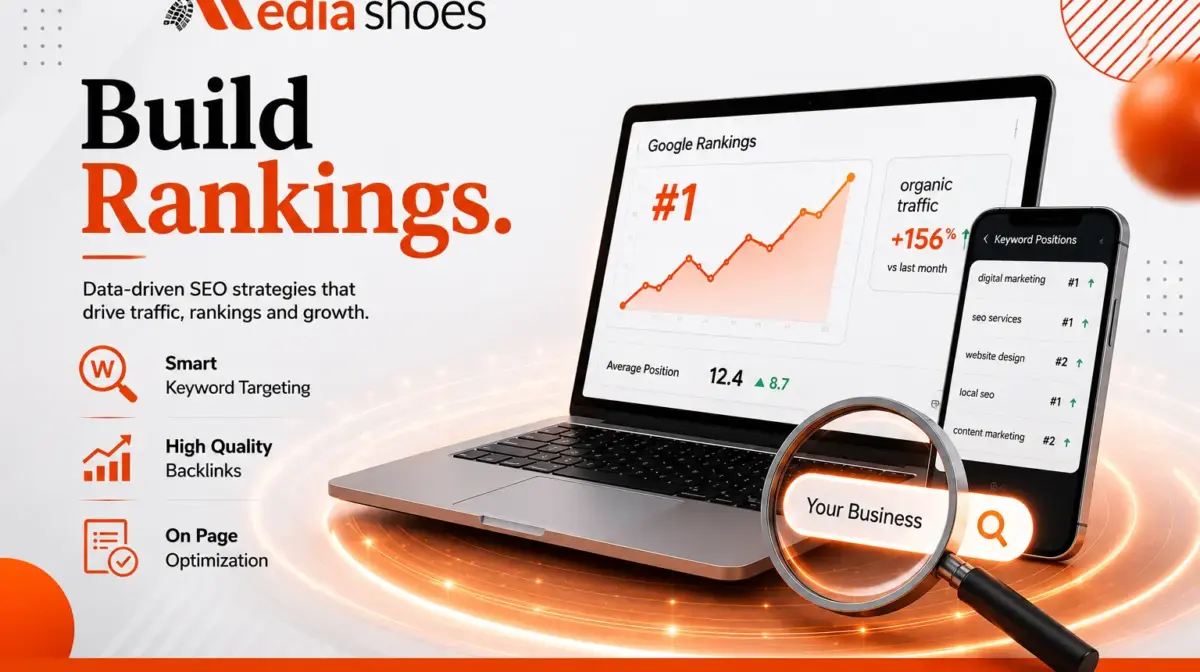
Search visibility is not built by chance. Smart keyword targeting, high-quality backlinks, strong on-page optimisation and a technically sound website work together to improve rankings, attract qualified traffic and turn search visibility into measurable business growth.
Every day, potential customers use search engines to find businesses, services and solutions. If your website does not appear when those searches happen, your competitors have an immediate advantage. This is why Search Engine Optimisation (SEO) is much more than trying to rank for a handful of keywords. It is about creating a strong digital presence that connects your business with people who are actively looking for what you offer.
At Media Shoes, effective SEO is approached as a long-term growth strategy. The objective is not simply to generate more clicks. The real goal is to improve visibility for commercially valuable searches, attract relevant visitors, create a better website experience and convert that visibility into enquiries, leads and customers.
Why Search Rankings Matter for Modern Businesses
A website can look impressive and offer excellent products or services, but its commercial potential is limited if the right audience cannot find it. Strong organic rankings position your business in front of users at the exact moment they are researching a problem, comparing providers or preparing to make a decision.
Unlike marketing channels that depend entirely on continuous advertising spend, SEO can create an increasingly valuable digital asset. Pages that establish relevance and authority can continue attracting organic visitors long after they are originally published or optimised.
- Greater search visibility for relevant products and services.
- More qualified organic traffic from people already searching for solutions.
- Improved credibility through stronger search presence.
- Better user experience through technical and content improvements.
- More opportunities for leads and conversions without relying solely on paid advertising.
- Long-term digital growth supported by content and authority that compound over time.
The Foundations of an Effective SEO Strategy
Successful SEO is rarely the result of one isolated improvement. Rankings are influenced by how well a website satisfies search intent, how clearly search engines can understand its pages, the quality of its content, its technical performance and the authority it builds across the web.
| SEO Area | Primary Purpose | Business Benefit |
|---|---|---|
| Keyword Strategy | Target relevant search demand | Attracts the right audience |
| On-Page SEO | Improve page relevance and structure | Helps pages compete for valuable searches |
| Technical SEO | Improve crawling, indexing and performance | Creates a stronger foundation for organic visibility |
| Content | Answer user questions and demonstrate expertise | Expands reach across the customer journey |
| Backlinks | Build authority and trust signals | Strengthens the site’s ability to compete |
| Analytics | Measure visibility, traffic and conversions | Supports smarter optimisation decisions |
1. Smart Keyword Targeting Starts With Search Intent
Keywords connect what your audience searches for with the pages your business provides. However, effective keyword research is not about choosing phrases simply because they have high search volume.
The more important question is: why is someone making that search?
A visitor searching for general information may be at the beginning of the buying journey, while someone searching for a specific service in a particular location may be much closer to contacting a provider. Understanding this difference allows businesses to build pages around genuine customer intent.
A stronger keyword strategy considers:
- Search volume and realistic ranking opportunity.
- Commercial relevance to the business.
- User intent behind each query.
- Location-specific searches where appropriate.
- Long-tail keywords with clear requirements.
- Questions prospects ask before purchasing.
- Competitor visibility and keyword gaps.
- The most appropriate page for each keyword group.
This creates a more focused SEO strategy. Instead of generating irrelevant traffic, the website attracts visitors whose searches closely match the products, expertise or services the business provides.
2. On-Page Optimisation Turns Good Pages Into Search Assets
Once the right search opportunities have been identified, individual pages need to communicate their purpose clearly to both users and search engines. This is where on-page SEO becomes essential.
A well-optimised page should not feel as though keywords have been forced into every paragraph. It should be clear, useful and naturally structured around the information a visitor expects to find.
Important on-page elements include:
- Clear and relevant page titles.
- Compelling meta descriptions.
- Logical H1, H2 and H3 heading structure.
- Helpful, original page copy.
- Natural keyword and topic coverage.
- Optimised image names and alt text.
- Descriptive URLs.
- Useful internal links.
- Strong calls to action.
These improvements make content easier to understand while creating clearer pathways between search visibility and business action.
3. High-Quality Content Builds More Than Traffic
Search engines aim to connect users with useful information. Businesses therefore need content that goes beyond filling pages with keywords. Strong SEO content should solve problems, answer questions, explain services and help potential customers make informed decisions.
A strategic content programme can target prospects throughout different stages of their journey.
| Customer Stage | Content Opportunity | Objective |
|---|---|---|
| Awareness | Guides, educational articles, FAQs | Build visibility and awareness |
| Consideration | Comparisons, detailed service guides, case studies | Build trust and demonstrate expertise |
| Decision | Service and landing pages | Generate enquiries and conversions |
When these pieces work together, a website can build topical depth instead of depending on a few isolated pages to generate all its organic traffic.
4. High-Quality Backlinks Strengthen Authority
Backlinks are links from other websites to your own. Relevant, trustworthy links can strengthen a site’s authority and help search engines understand that other sources consider its content valuable.
But backlink building should always prioritise quality over quantity. Hundreds of irrelevant links do not automatically create a strong SEO profile. A smaller number of credible, contextually relevant links can be far more valuable.
Sustainable link acquisition can come from:
- Creating genuinely useful resources.
- Digital PR and media coverage.
- Industry publications.
- Relevant partnerships.
- Original research and data.
- Expert commentary.
- Useful guides worth referencing.
- Legitimate business and industry citations.
The aim is not simply to collect links. It is to develop a credible online footprint that supports the reputation and authority of the business.
5. Technical SEO Creates the Foundation
Great content can struggle if the website underneath it has serious technical problems. Technical SEO ensures search engines can efficiently discover, understand and index important pages while users receive a fast and reliable experience.
A technical SEO review may examine:
- Website crawling and indexing.
- Page speed and performance.
- Mobile usability.
- Broken links and error pages.
- Redirect chains.
- Duplicate content.
- Canonicalisation.
- XML sitemaps.
- Site architecture.
- Structured data opportunities.
- HTTPS and security.
- Core user-experience issues.
Technical improvements may not always be immediately visible to website visitors, but they can have a significant effect on how efficiently the entire site performs in organic search.
6. Internal Linking Helps Build Search Authority
Internal links are one of the most practical SEO opportunities available to established websites. They connect related content, help visitors discover additional information and provide search engines with important context about the relationship between pages.
For example, an educational article about improving organic visibility could naturally link to a relevant SEO service page. Supporting articles can also link to each other when they address closely related topics.
A thoughtful internal linking structure helps prevent useful pages from becoming isolated and allows authority to flow more effectively throughout the website.
7. User Experience and SEO Work Together
Ranking a page is only valuable if visitors can use it effectively after they arrive. A slow, confusing or poorly structured website can lose potential customers even when it generates strong traffic.
This is why modern SEO should work closely with website design, development and conversion optimisation.
- Pages should load quickly.
- Navigation should be simple and predictable.
- Content should be easy to scan.
- Mobile visitors should receive an excellent experience.
- Calls to action should be clear.
- Contact and conversion processes should be straightforward.
The objective is not merely to bring someone to the website. It is to help that visitor successfully take the next step.
From Rankings to Revenue: Measure What Actually Matters
Rankings are useful indicators, but they should not be treated as the only measure of SEO success. Ranking number one for a phrase that produces no meaningful business activity may be far less valuable than ranking strongly for a smaller group of highly relevant commercial searches.
A better measurement framework connects SEO performance with business outcomes.
| Metric | What It Shows |
|---|---|
| Organic Visibility | How visible the brand is across relevant searches. |
| Keyword Positions | How important pages perform for target searches. |
| Organic Traffic | How many visitors search engines are generating. |
| Engagement | Whether visitors interact meaningfully with content. |
| Conversions | Whether organic visitors become leads or customers. |
| Revenue Contribution | How organic search contributes to commercial growth. |
Common SEO Mistakes That Hold Websites Back
SEO performance can stagnate when businesses focus on isolated tactics rather than the complete search experience. Some common problems include:
- Targeting keywords without understanding user intent.
- Creating multiple pages that compete for the same topic.
- Publishing thin or repetitive content.
- Ignoring technical website problems.
- Buying low-quality backlinks.
- Neglecting internal linking.
- Optimising only the homepage.
- Ignoring local search opportunities.
- Failing to update outdated content.
- Tracking rankings without tracking conversions.
Addressing these issues creates a stronger foundation for sustainable improvement rather than temporary ranking movements.
A Practical SEO Growth Framework
Businesses looking to improve organic performance can approach SEO as a continuous cycle rather than a one-time project.
- Audit: Understand current rankings, content, backlinks and technical issues.
- Research: Identify customers, competitors, keywords and search intent.
- Prioritise: Focus first on opportunities with meaningful business value.
- Optimise: Improve existing service, product and landing pages.
- Create: Develop useful content around relevant search opportunities.
- Strengthen: Improve technical performance and website architecture.
- Build Authority: Earn credible links and mentions.
- Measure: Track visibility, traffic, leads and conversions.
- Refine: Use performance data to continuously improve the strategy.
SEO Is a Long-Term Business Asset
One of SEO’s greatest advantages is its potential to compound. A well-optimised page can gain visibility. That visibility can generate engagement and links. Those signals can strengthen authority, which may help additional pages compete more effectively.
This is why sustainable SEO should not be viewed as a collection of quick tricks. It is an ongoing process of improving the website, strengthening content, understanding audiences and responding to changing search behaviour.
The key principle:
Do not chase rankings simply for the sake of ranking. Build search visibility around the topics, services and customer needs that can create genuine commercial value.
Frequently Asked Questions About SEO
What is SEO?
Search Engine Optimisation is the process of improving a website’s content, structure, technical performance and authority so it can achieve stronger visibility in relevant organic search results.
How long does SEO take?
SEO is generally a medium- to long-term strategy. The timeline varies according to competition, the current condition of the website, its authority, the quality of existing content and the scale of optimisation required.
Are keywords still important?
Yes, but modern keyword strategy should focus on topics and search intent rather than repeating exact phrases unnaturally. Keywords help identify what audiences want and how pages should be structured around that demand.
Do backlinks still matter?
Relevant and trustworthy backlinks can remain valuable signals of authority. The focus should be on earning credible links rather than accumulating large quantities of low-quality links.
Can SEO generate leads?
Yes. When SEO targets commercially relevant searches and directs visitors to strong landing pages with clear conversion paths, organic visibility can become an important source of enquiries and leads.
Is SEO only about Google rankings?
No. Rankings are only part of the picture. Effective SEO also considers organic traffic quality, user experience, engagement, conversions and the overall commercial contribution of search.
Should SEO and content marketing work together?
Absolutely. SEO identifies search opportunities while content provides the useful information required to address them. Combining the two creates a much stronger strategy than treating them as separate activities.
Build Rankings That Support Real Growth
Strong rankings are not created through a single keyword, backlink or technical adjustment. Sustainable organic growth comes from combining smart keyword targeting, useful content, high-quality backlinks, on-page optimisation, technical SEO and continuous performance analysis.
When these elements work together, SEO becomes more than a visibility channel. It becomes part of the wider growth strategy—helping businesses get discovered, build credibility, attract relevant prospects and create more opportunities online.
For businesses ready to strengthen their organic presence, Media Shoes Digital Solutions can help develop a strategic approach focused on visibility, performance and measurable growth.
Ready to Build Better Rankings?
Turn search visibility into a stronger digital growth channel with an SEO strategy built around your audience and business objectives.
Media Shoes Digital Solutions
Website: mediashoes.com
Email: info@mediashoes.com