
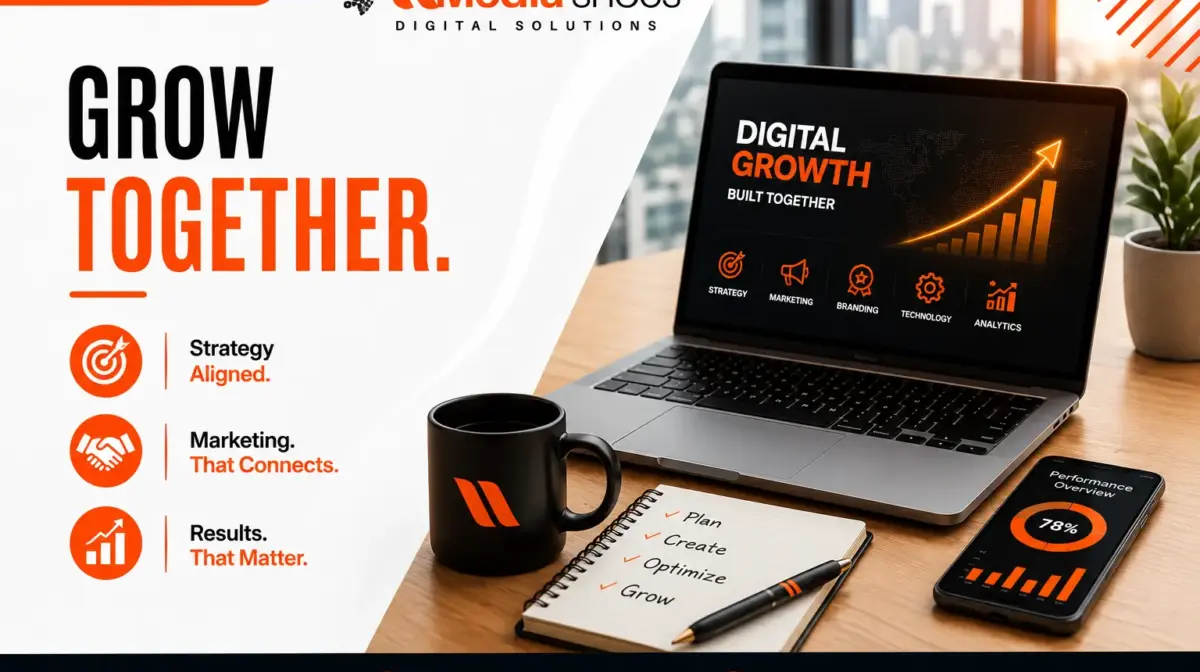
Sustainable digital growth rarely comes from one campaign, one channel or one clever idea. It comes from aligning strategy, marketing, branding, technology and analytics around the same commercial goals.
Businesses today have access to more marketing channels, platforms, tools and data than ever before. Search engines can generate high-intent traffic. Social media can build communities. Paid advertising can create immediate visibility. Email can nurture prospects. Content can establish authority. Automation can improve efficiency, while analytics can reveal what is actually driving results.
Yet having access to all these opportunities does not automatically create growth. In fact, the opposite can happen. When every activity operates independently, businesses can end up with fragmented messaging, inconsistent customer experiences, duplicated effort and marketing reports that look busy without clearly demonstrating commercial progress.
The stronger approach is to grow together. That means connecting strategy, marketing, branding, technology and analytics so that each part strengthens the others. Instead of treating digital marketing as a collection of separate tasks, it becomes an integrated growth system.
The central idea:
Strategy gives marketing direction. Marketing creates demand. Branding builds recognition and trust. Technology makes the customer journey work. Analytics shows what should be improved next. When these elements move together, growth becomes more focused, measurable and scalable.
Why Digital Growth Needs More Than Marketing Activity
One of the biggest mistakes organisations make is confusing activity with strategy. Publishing posts, running advertisements, sending emails and creating landing pages are all useful activities, but none of them automatically answer the most important questions.
- Who is the business trying to reach?
- What problem does that audience need solved?
- Why should they choose this business instead of a competitor?
- Which channels are most likely to influence the buying decision?
- What happens after somebody clicks, enquires or downloads something?
- How will leads be nurtured?
- What does a successful conversion actually look like?
- Which metrics connect marketing performance to commercial outcomes?
Without clear answers, businesses can generate plenty of activity while struggling to create predictable results. An integrated digital growth strategy starts with the commercial objective and works backwards to determine which marketing activities are actually required.
The Five Elements of an Integrated Digital Growth System
| Element | Primary Role | Key Question | Business Impact |
|---|---|---|---|
| Strategy | Creates direction | What are we trying to achieve? | Focused investment and priorities |
| Marketing | Creates visibility and demand | How do we reach the right audience? | Traffic, leads and opportunities |
| Branding | Builds recognition and trust | Why should people remember and trust us? | Differentiation and stronger perception |
| Technology | Connects and automates experiences | Can users move smoothly from interest to action? | Efficiency and better conversion journeys |
| Analytics | Measures and improves performance | What is working and what should change? | Smarter optimisation and decision-making |
1. Start With Strategy, Not Channels
A strong digital strategy should begin before deciding whether to invest more in SEO, social media, paid advertising or any other individual channel. Channel selection should be the result of strategy, not the strategy itself.
Start by defining the business objective. The organisation may want to generate qualified leads, enter a new market, increase ecommerce revenue, improve customer retention, strengthen brand awareness or support a longer B2B sales cycle. Each objective requires a different combination of audiences, messages, channels and measurements.
A practical strategy should define:
- Commercial objectives: the business outcomes marketing should support.
- Target audiences: the people, organisations or decision-makers most likely to buy.
- Value proposition: the reason those audiences should choose the business.
- Customer journey: how prospects move from awareness to consideration and conversion.
- Channel priorities: where resources should be concentrated.
- Content priorities: what information audiences need at different stages.
- Conversion goals: the actions that indicate commercial intent.
- Measurement: the KPIs used to judge progress.
This creates something every growing business needs: alignment. Teams understand what they are trying to achieve, why particular activities matter and how different parts of marketing support the same objective.
2. Build Marketing That Connects
Customers rarely experience a business through only one channel. Someone might discover a brand through Google, visit its website, read an article, see a social post, receive an email and then return through a branded search before finally making contact.
That means modern marketing should be designed around connected journeys rather than isolated channels.
Example of a connected journey
Search visibility → useful content → optimised service page → clear conversion → CRM capture → email nurture → retargeting → sales conversation → performance analysis.
Each stage has a specific job. SEO can attract demand. Content can answer questions. The website can build confidence. Conversion design can encourage action. CRM systems can capture information. Email can maintain engagement. Retargeting can bring prospects back. Analytics can identify where the journey performs well or breaks down.
The real advantage comes from the connections between those stages.
3. Make Your Brand Consistent Across Every Touchpoint
Branding is much more than a logo. It includes the visual identity, tone of voice, positioning, promises, messaging and overall experience people associate with an organisation.
Consistency matters because prospects often need multiple interactions before they are ready to act. If the website communicates one message, advertisements communicate another and social channels feel like a completely different company, trust can weaken.
A connected brand should maintain consistency across:
- Website design and messaging
- Search advertisements
- Organic search content
- Social media profiles and posts
- Email campaigns
- Landing pages
- Video and multimedia
- Sales presentations
- Lead-generation materials
- Customer communications
Consistency does not mean every piece of content must look identical. It means every interaction should feel as though it belongs to the same organisation and supports the same positioning.
4. Build a Website That Supports Growth
For many organisations, the website is where almost every digital marketing activity eventually converges. Search visitors arrive there. Paid advertising sends traffic there. Social campaigns link to it. Prospects use it to validate the business before making contact.
A growth-focused website therefore needs to do much more than look professional.
It should help users quickly understand:
- What the business does
- Who it serves
- What problems it solves
- Why it is different
- What services or solutions are available
- What evidence supports its claims
- What the visitor should do next
Navigation, page speed, mobile responsiveness, accessibility, technical SEO, content structure and calls to action all influence the effectiveness of the website as a marketing asset.
If marketing succeeds in generating attention but the website creates friction, part of that investment is wasted.
5. Connect SEO With the Wider Growth Strategy
Search engine optimisation is most powerful when it is connected to commercial intent. Ranking for a large number of keywords may look impressive, but visibility alone is not the objective. The aim is to attract relevant users who are genuinely interested in the products, services or expertise the organisation provides.
An integrated SEO programme typically combines:
- Technical SEO
- Keyword and search-intent research
- Site architecture
- Service-page optimisation
- On-page SEO
- Content strategy
- Internal linking
- Authority and backlink development
- Local SEO where appropriate
- Performance monitoring and continuous optimisation
SEO also creates valuable strategic intelligence. Search behaviour reveals the questions customers ask, terminology they use and problems they are actively trying to solve. These insights can improve paid campaigns, website messaging, content, social media and even product positioning.
6. Use Content to Connect Every Stage of the Customer Journey
Content is one of the strongest links between strategy, SEO, social media, email marketing, lead generation and sales.
Different prospects need different information depending on how close they are to making a decision.
| Journey Stage | Customer Need | Useful Content | Primary Goal |
|---|---|---|---|
| Awareness | Understand a problem | Guides, articles, social content, videos | Earn attention |
| Consideration | Compare possible solutions | Service pages, case studies, comparisons | Build trust |
| Decision | Reduce risk | Testimonials, FAQs, proof, consultations | Generate conversion |
| Retention | Continue receiving value | Email, resources, updates, support content | Strengthen relationships |
Rather than producing content simply to maintain a publishing schedule, businesses should create content that has a clear purpose within the customer journey.
7. Combine Organic and Paid Marketing
Organic and paid marketing are sometimes treated as competing strategies. In reality, they can be much more effective when used together.
Organic channels such as SEO and content marketing can build sustainable visibility and authority over time. Paid advertising can provide faster access to audiences, test messages and generate immediate traffic.
Combining the two creates several advantages:
- Paid campaigns can test keywords before larger SEO investment.
- High-performing organic content can inspire advertising creative.
- Retargeting can reconnect with visitors generated through organic channels.
- SEO can reduce long-term dependence on paid traffic.
- Paid campaigns can support new offers while organic visibility develops.
- Shared data can reveal which topics and messages create the strongest commercial response.
The question should not simply be “SEO or paid advertising?” It should be “What combination of channels creates the strongest customer journey and return?”
8. Turn Social Media Into Part of the Growth System
Social media can play several roles within an integrated strategy. It can introduce the brand to new audiences, demonstrate expertise, distribute content, strengthen relationships and keep the organisation visible between buying cycles.
Effective social media should therefore connect back to wider marketing objectives rather than existing as an isolated posting schedule.
Useful social content may include:
- Educational insights
- Industry commentary
- Customer success stories
- Behind-the-scenes content
- Service explanations
- Short-form video
- Research and statistics
- Thought leadership
- Frequently asked questions
- Links to deeper website resources
The strongest social strategy is not necessarily the one that posts most frequently. It is the one that consistently communicates relevant ideas to the right audience and supports the broader commercial journey.
9. Use Technology to Remove Friction
Technology should make marketing easier for both the organisation and the customer. Problems appear when businesses accumulate disconnected tools without considering how information flows between them.
A connected marketing technology ecosystem may include:
- Website and content management system
- Customer relationship management platform
- Email marketing system
- Marketing automation
- Analytics and reporting
- Advertising platforms
- Social media management tools
- Lead capture and forms
- Appointment or consultation booking systems
- Sales pipeline tools
The objective is not to use as much technology as possible. The objective is to create an efficient flow of information.
For example:
A prospect submits a website enquiry → information enters the CRM → the correct team is notified → the prospect receives an appropriate response → follow-up activity is tracked → the original marketing source remains visible → the eventual commercial outcome can be connected back to marketing.
That is significantly more valuable than simply recording another website form submission.
10. Use Automation Without Losing the Human Experience
Automation can improve efficiency, but it should support relationships rather than replace them. The strongest automation handles repetitive processes while allowing people to focus on strategy, creativity, communication and customer relationships.
Useful applications include:
- Lead acknowledgement
- Email nurturing
- Audience segmentation
- CRM workflows
- Internal lead notifications
- Campaign reporting
- Content distribution
- Remarketing audiences
- Customer follow-ups
Automation should always have a clear purpose. If it adds complexity without improving the customer experience or internal efficiency, it is not helping the growth system.
11. Measure Results That Actually Matter
Digital marketing produces an enormous amount of data. The challenge is deciding which data matters.
Impressions, clicks, followers and page views can provide useful context, but business leaders usually need to understand something deeper: whether marketing is generating meaningful commercial progress.
A stronger measurement framework may include:
- Qualified website traffic
- Search visibility for commercially relevant topics
- Engagement with important content
- Conversion rate
- Cost per lead
- Marketing-qualified leads
- Sales-qualified opportunities
- Customer acquisition cost
- Pipeline value
- Revenue influenced by marketing
- Customer lifetime value
- Return on marketing investment
Different organisations will require different metrics, but the principle remains the same: measurement should connect marketing activity to business outcomes wherever possible.
12. Create a Continuous Growth Cycle
Digital growth should not be treated as a project that is planned once and then left unchanged. Customer behaviour changes. Competitors adapt. Search demand evolves. Advertising costs fluctuate. Technology changes. New content opportunities appear.
High-performing strategies therefore operate as a continuous cycle:
1. Plan
2. Create
3. Launch
4. Measure
5. Optimise
6. Grow
The important step is optimisation. Data should feed back into strategy so that future campaigns become more informed than previous ones.
What Fragmented Marketing Looks Like vs Integrated Growth
| Fragmented Approach | Integrated Growth Approach |
|---|---|
| Channels operate separately | Channels support one customer journey |
| Content created without clear purpose | Content mapped to audience needs and journey stages |
| Different messages across platforms | Consistent positioning and brand experience |
| Reports focus mainly on activity | Reporting connects activity with outcomes |
| Marketing and sales data disconnected | Lead journey visible across systems |
| Campaigns repeatedly start from zero | Insights continuously improve future activity |
A Practical Digital Growth Framework
Businesses looking to create a more connected approach can use the following framework as a starting point.
- Audit the current position. Review the website, SEO, content, paid media, social presence, brand consistency, technology and analytics.
- Define commercial objectives. Establish what the business actually needs marketing to achieve.
- Understand the audience. Identify needs, motivations, objections, search behaviour and decision criteria.
- Map the customer journey. Understand the steps between discovery and conversion.
- Clarify positioning. Create consistent messages explaining value and differentiation.
- Prioritise channels. Invest where audience behaviour and commercial opportunity overlap.
- Build useful content. Create resources for different stages of the journey.
- Optimise conversion paths. Make important actions simple and obvious.
- Connect technology. Reduce gaps between marketing, lead management and sales.
- Establish meaningful measurement. Track performance beyond surface-level metrics.
- Optimise continuously. Use evidence to improve campaigns, pages and investment decisions.
Questions Businesses Should Ask Before Investing More in Digital Marketing
- Do we have clearly defined commercial objectives?
- Do we know which audiences create the most value?
- Is our positioning clear and consistent?
- Can prospects easily understand our services?
- Does our website provide obvious next steps?
- Are SEO and content aligned with genuine customer intent?
- Do paid and organic campaigns support each other?
- Does social media strengthen our broader brand strategy?
- Are leads being captured and followed up effectively?
- Can we identify which channels generate valuable enquiries?
- Are marketing and sales working from connected information?
- Are we measuring outcomes or simply reporting activity?
If several of these questions are difficult to answer, the immediate priority may not be spending more. It may be creating better alignment between the activities already taking place.
Frequently Asked Questions
What is an integrated digital marketing strategy?
It is an approach that coordinates multiple digital channels and capabilities around shared business objectives. Instead of SEO, content, paid media, social media, email and technology operating independently, they work together to create a connected customer journey.
Why is digital strategy important?
Strategy helps businesses determine what they are trying to achieve, who they need to reach, which channels deserve investment and how success should be measured. It reduces random activity and creates clearer priorities.
Should SEO and paid advertising be used together?
They can complement each other effectively. Paid advertising can provide immediate visibility and useful testing data, while SEO can build sustainable organic visibility over time. The right mix depends on the organisation’s objectives, market and available resources.
What role does branding play in digital growth?
Branding creates recognition, consistency and differentiation across marketing touchpoints. A strong brand can help prospects understand what a company represents and why it may be relevant to them.
How should digital marketing success be measured?
Measurement should reflect the business objective. Useful indicators may include qualified traffic, conversions, lead quality, acquisition cost, pipeline contribution, customer value and return on marketing investment rather than relying only on impressions or followers.
How often should a digital marketing strategy be reviewed?
Performance should be monitored continuously, while deeper strategic reviews should take place regularly enough to respond to changing customer behaviour, market conditions, campaign data and commercial priorities.
Final Thoughts: Sustainable Growth Happens When Everything Works Together
Digital marketing becomes more powerful when businesses stop thinking about individual channels as separate projects and start viewing them as parts of one connected growth system.
Strategy determines direction. Branding communicates value. SEO and content create discoverability. Social media builds visibility and relationships. Paid campaigns accelerate reach. Websites convert attention into action. Technology connects processes. Analytics provides evidence. Continuous optimisation improves what happens next.
None of these areas needs to operate alone.
The businesses that create stronger digital foundations are often those that understand how each element supports the others. Instead of simply doing more marketing, they create better alignment, clearer customer journeys and more meaningful measurement.
That is what growing together should mean: connecting strategy, marketing, branding, technology and performance around a shared objective — sustainable business growth.
Ready to Build a More Connected Digital Growth Strategy?
Media Shoes Digital Solutions brings strategy, marketing, creative thinking, technology and performance together to help businesses build stronger digital foundations and create measurable growth.
Media Shoes Digital Solutions
Website: www.mediashoes.com
Email: info@mediashoes.com