
Modern marketing moves quickly. Customers expect relevant communication, fast responses and consistent experiences across multiple digital channels. For growing businesses, managing every email, lead, campaign, follow-up and report manually can quickly become inefficient.
That is where marketing automation can make a significant difference. By connecting repetitive marketing activities with intelligent workflows, businesses can reduce manual work, improve consistency and give their teams more time to focus on strategy, creativity and growth.
At Media Shoes, we believe automation should not replace good marketing. It should make good marketing easier to execute, measure and scale. The goal is simple: automate, optimise and grow.
What Is Marketing Automation?
Marketing automation is the use of technology and structured workflows to automatically perform marketing activities that would otherwise require repeated manual effort.
Instead of a team manually sending every follow-up email, updating every lead record or preparing the same reports repeatedly, automation can trigger actions based on predefined rules, customer behaviour and campaign activity.
Common examples include:
- Automated email campaigns and follow-ups
- Lead capture and lead management
- Customer segmentation
- Lead nurturing workflows
- Campaign reminders and notifications
- Marketing and sales handovers
- Performance reporting
- Analytics and campaign tracking
- Customer journey communications
- Internal marketing processes
The objective is not simply to automate as many tasks as possible. Effective automation identifies the repetitive processes that consume valuable time and creates a more efficient system around them.
Why Marketing Automation Matters
As a business grows, its marketing operations naturally become more complicated. More website visitors create more enquiries. More campaigns generate more data. More customers require more communication. More channels create more tasks for the marketing team.
Without scalable systems, growth itself can create operational pressure.
Marketing automation helps businesses manage that complexity by creating repeatable processes. Instead of relying entirely on individual team members to remember every action, businesses can build workflows that support consistent execution.
The principle is simple:
Automate repetitive work so your people can spend more time on work that requires strategy, judgement, creativity and human relationships.
1. Work Smarter and Save Time
One of the clearest benefits of marketing automation is time efficiency.
Consider how many small marketing activities happen during a typical week: sending follow-up messages, moving leads between stages, distributing content, checking campaign performance, notifying sales teams and preparing reports.
Individually, these tasks may only require a few minutes. Collectively, they can consume hours of valuable team capacity.
Automation can handle many of these repetitive actions automatically. Once a reliable workflow has been created, the system can continue performing those actions consistently while the team concentrates on higher-value priorities.
2. Improve Lead Management
Generating leads is only the beginning. Businesses also need a reliable process for capturing, organising, nurturing and responding to those opportunities.
When lead management depends entirely on manual processes, enquiries can be overlooked, follow-ups can happen too late and valuable opportunities can become disconnected from marketing activity.
Automation can create a more structured journey.
For example, when someone completes a website enquiry, a workflow could automatically record the lead, send an acknowledgement, categorise the enquiry, notify the appropriate team member and schedule the next relevant communication.
This creates a smoother experience for the prospect while helping internal teams stay organised.
3. Create Better Email Marketing Workflows
Email remains an important digital marketing channel, but effective email marketing involves much more than sending the same message to an entire database.
Automation allows businesses to create communications around specific customer journeys and actions.
A prospect might receive different messages depending on whether they:
- Downloaded a resource
- Requested information
- Joined a mailing list
- Visited an important service page
- Started but did not complete an enquiry
- Became an existing customer
- Have not engaged for a period of time
This makes email marketing more relevant because communication can be aligned with the recipient’s stage, interests or behaviour rather than relying exclusively on broad mass campaigns.
4. Connect Marketing and Lead Management
A common challenge for growing organisations is the gap between generating interest and converting that interest into a genuine business opportunity.
Marketing may generate enquiries, but sales teams need useful context. Who is the prospect? What were they interested in? Which campaign generated the enquiry? What action did they take?
Integrated automation can help connect those stages.
Rather than marketing activity existing separately from lead management, information can flow between systems and teams. This gives decision-makers better visibility and helps create a more coordinated customer journey.
5. Improve Analytics and Reporting
Marketing becomes more valuable when businesses understand what is actually working.
Traffic alone does not tell the complete story. Neither do impressions, clicks or follower counts when viewed independently.
Businesses need to understand how different marketing activities contribute to meaningful outcomes such as enquiries, leads, conversions and revenue.
Automated reporting can bring important metrics together and reduce the amount of time spent manually collecting data.
Depending on the strategy, this might include:
- Website traffic
- Traffic sources
- Campaign engagement
- Lead generation
- Conversion rates
- Email performance
- Customer acquisition activity
- Paid advertising performance
- Revenue attribution
- Return on marketing investment
Better reporting creates better visibility, and better visibility helps businesses make more informed decisions.
6. Focus on Growth, Not Repetition
Marketing teams provide the greatest value when they are solving problems, developing ideas, understanding customers and improving strategy.
They provide less value when large portions of their time are spent repeatedly performing predictable administrative tasks.
Automation changes that balance.
A team that spends less time copying information between platforms, manually preparing routine reports and sending repetitive follow-ups has more capacity to improve campaigns, develop stronger content and explore new growth opportunities.
7. Build More Consistent Customer Experiences
Consistency matters throughout the customer journey.
If one prospect receives an immediate response while another waits several days, the experience becomes dependent on workload rather than process.
Automation can establish consistent baseline communications. Confirmation messages, onboarding information, reminders and follow-ups can be delivered at appropriate stages without requiring someone to initiate every interaction manually.
Human communication remains important, particularly for complex sales and valuable client relationships. Automation should support those interactions rather than eliminate them.
Automation Should Support Strategy
Installing an automation platform does not automatically create an effective marketing system.
Businesses first need to understand the journey they want customers to follow and the objectives they want marketing to achieve.
A strong automation strategy normally starts by answering questions such as:
- Where are leads coming from?
- What happens immediately after an enquiry?
- Which repetitive tasks consume the most time?
- Which communications should be automated?
- Where should human interaction remain essential?
- What information should marketing and sales share?
- Which metrics indicate genuine business performance?
Once these questions are clear, technology can be configured around the strategy rather than allowing technology to dictate the strategy.
A Practical Marketing Automation Journey
| Stage | Objective | Automation Opportunity |
|---|---|---|
| Attract | Generate interest | Campaign tracking and audience workflows |
| Capture | Convert visitors into leads | Forms, lead capture and automatic responses |
| Nurture | Develop interest | Email sequences and segmentation |
| Convert | Create opportunities | Lead routing and sales notifications |
| Retain | Strengthen relationships | Customer communication and re-engagement |
| Measure | Understand performance | Analytics dashboards and reporting |
What Should You Automate First?
Businesses do not need to automate everything at once. In many cases, starting with a few high-impact processes is more effective.
Look for activities that are repetitive, predictable and time-consuming. These are often strong candidates for automation.
Good starting points may include:
- Website enquiry confirmations
- Lead notifications
- Email welcome sequences
- Follow-up reminders
- Customer segmentation
- Routine marketing reports
- Internal campaign notifications
Once these workflows are operating effectively, businesses can gradually introduce more advanced automation.
Avoid Over-Automation
Automation is powerful, but not every interaction should be automated.
Customers still value genuine conversations, expert advice and personalised service. Businesses therefore need to identify where automation improves convenience and where human interaction creates greater value.
The strongest systems combine both.
Automate the process. Keep the relationship human.
Technology should remove unnecessary friction so your team has more time for meaningful customer interactions.
From Automation to Continuous Improvement
Marketing automation should never become a completely “set and forget” system.
Customer behaviour changes. Campaign performance changes. Business priorities change. Workflows therefore need to be monitored and improved over time.
A useful approach is:
AUTOMATE → MEASURE → ANALYSE → OPTIMISE → GROW
This creates a continuous improvement cycle. Automation produces consistent activity, measurement reveals performance, analysis identifies opportunities and optimisation improves future results.
Marketing Automation as Part of a Bigger Digital Strategy
Automation becomes considerably more powerful when it is connected with the wider digital marketing ecosystem.
Website development, SEO, content marketing, paid advertising, social media, email marketing, lead generation, analytics and automation should not operate as completely separate activities.
A prospect might discover a company through search, read content on its website, submit an enquiry, receive an automated email, speak with the sales team and eventually become a customer.
Every stage is connected.
That is why businesses should think beyond isolated campaigns and build integrated digital systems that support the complete customer journey.
How Media Shoes Can Help
At Media Shoes, our approach is centred on creating digital marketing systems that support measurable business growth.
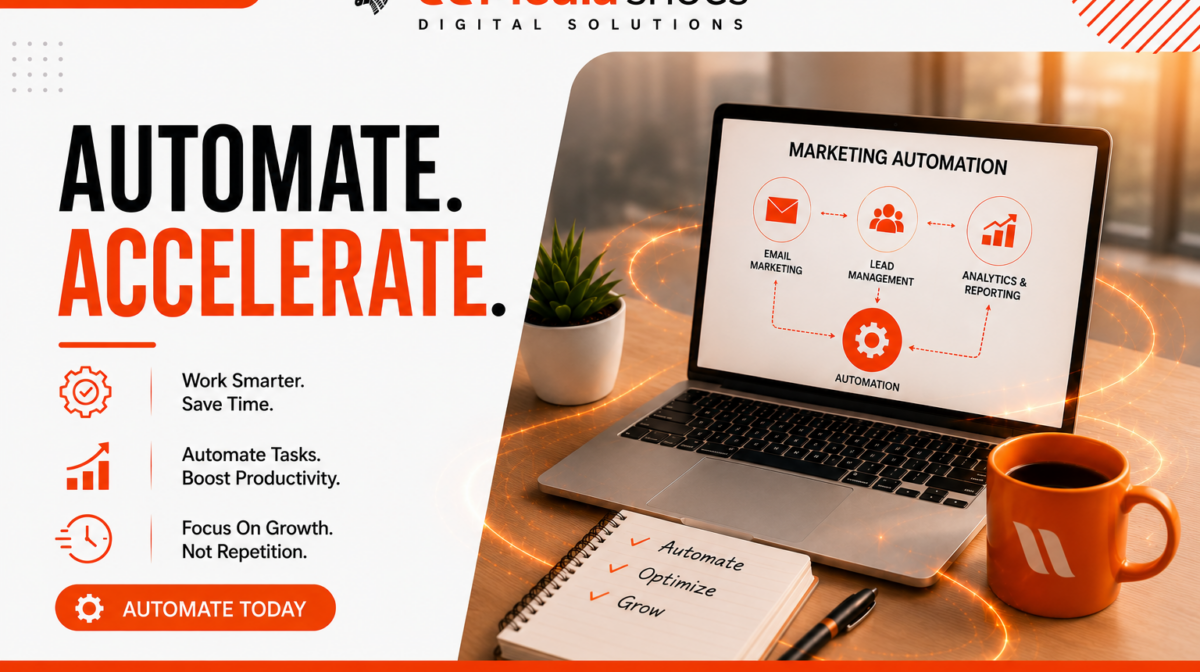
Marketing automation can connect email marketing, lead management, analytics and reporting while reducing unnecessary repetitive work. But successful implementation starts with understanding the business, its customers and its objectives.
The aim is not automation for the sake of automation. It is to create a smarter marketing operation where technology supports people, data supports decisions and marketing supports sustainable growth.
Frequently Asked Questions
What is marketing automation?
Marketing automation uses software and predefined workflows to perform repetitive marketing activities automatically, including email communication, lead management, segmentation, reporting and customer journey actions.
Can small businesses use marketing automation?
Yes. Small and growing businesses can benefit significantly because automation can help limited teams manage repetitive activities efficiently while maintaining consistent customer communication.
Does marketing automation replace employees?
Effective marketing automation is generally designed to support teams rather than replace them. It handles repetitive processes so people can spend more time on strategic, creative and relationship-focused activities.
What marketing tasks can be automated?
Email sequences, enquiry responses, lead routing, segmentation, reminders, campaign notifications, reporting and selected customer communications are common examples.
How does automation help business growth?
Automation can improve efficiency, response consistency, lead management and marketing visibility. These improvements give teams more capacity to focus on activities that directly contribute to business development.
Should every marketing activity be automated?
No. Human judgement and personal communication remain essential. Businesses should automate repetitive processes while preserving human interaction where expertise, trust and relationships matter.
Final Thoughts: Automate. Accelerate. Grow.
Business growth does not necessarily require teams to work longer or manually manage an ever-increasing number of marketing tasks.
It requires better systems.
By automating repetitive processes, connecting marketing activities and improving access to performance data, organisations can build a more efficient foundation for growth.
The opportunity is to work smarter, save time, automate repetitive tasks and focus your people on growth rather than repetition.
Ready to Automate Your Marketing?
Build smarter marketing processes that connect strategy, automation, analytics and growth.
Media Shoes — Digital Solutions Built for Growth.